

Hello Interactors,
I recently attended the annual American Association of Geographers (AAG) in San Francisco. It’s primarily an academic conference, but there are practitioners here and there. I gave a version of the talk I did at the Digital Geography conference in Lisbon in a session on political geography.
AAG started in 1904 as the Association of American Geographers, and as a former AAG treasurer commented in one session, it was mostly attended by white males up and through to the 1990s. In 2016 the name changed to American Association of Geographers “in an effort to re-think our systems of representation to acknowledge our growing internationalism.” I can report that every session I attended was diversely represented.
Attending a geography conference amidst geopolitical upheaval was enlightening. Global disruptions stem from various geographical disciplines, such as fossil fuel physical geography, state power political geography, shifting economic geographies, and GIScience quantifying, measuring, and predicting events, especially with an insurgent AI.
I thought I’d offer my takeaways from the many papers session I attended over the course of six days!
THE STRUCTURE OF CONJUNCTURE
The first adjustment required at an academic conference is to the language. Territoriality is a term I heard a lot down there but doesn’t exactly pop up in conversation back home. There’s a kind of in-group signaling that comes with the use of these terms. It’s almost as aesthetic as it is useful. I don’t think it’s pure posturing because specialized vocabulary can indeed improve precision, reduce ambiguity, and allow efficient communication among experts. Sometimes these words do seep into everyday use. I used to think the word discourse sounded kind of academic but then I heard Alyssa Liu use it in multiple interviews!
Conjuncture is another word I heard a lot. It’s not a word yet used in everyday language but was widely used there…and for good reason. It means a critical combination of events or circumstances. This term represented what I sensed was an overall impatience with describing something that never quite reaches explanation.
But these are some that tried tried to reach like disorder, fragmentation, transition, platformization, crisis, and uneven development. But across several sessions I attended, the pressing question was what, exactly, is driving these changes, through what mechanisms, and at what scales?
That mood could be found in a session called “Explaining Capitalism in Motion.” The organizers pushed back against a habit that has become familiar across the humanities and social sciences of multiplying terms, like perhaps conjuncture, without always clarifying the material dynamics beneath them.
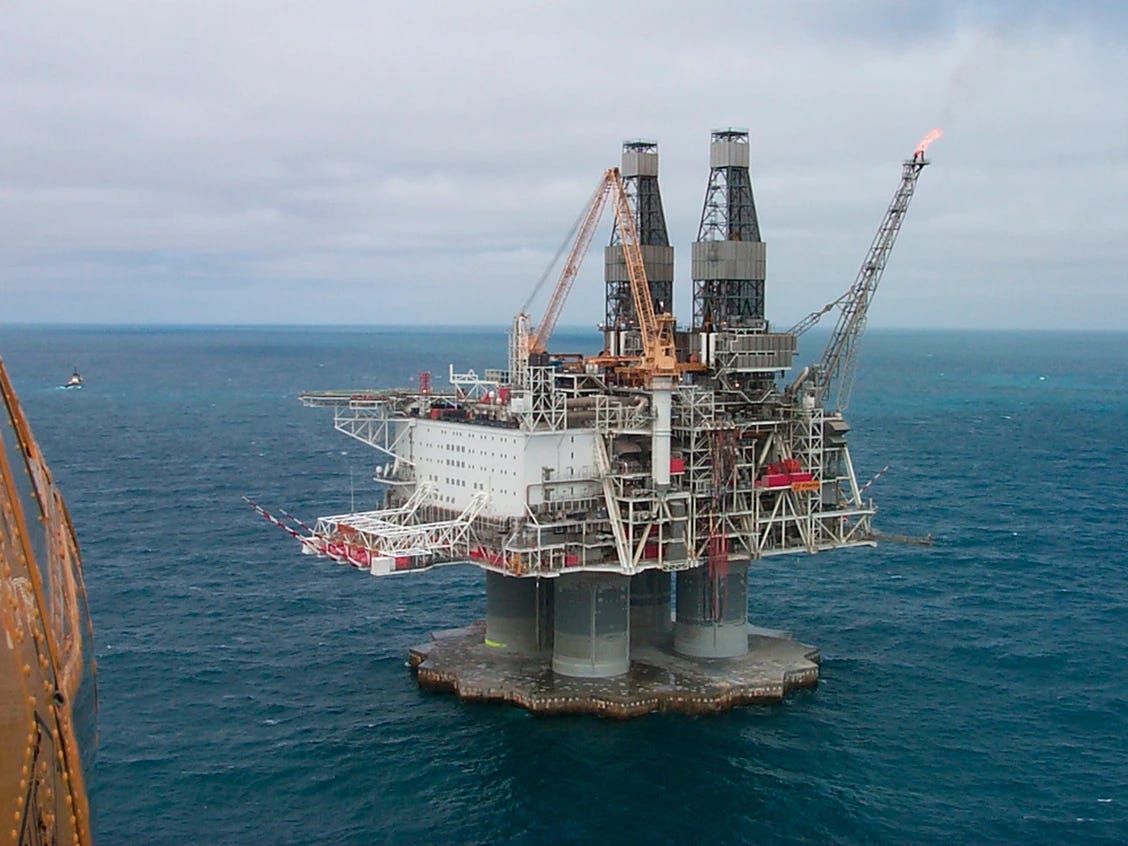
Their counterproposal was to start with capitalism’s internal drivers like competition, profitability, crisis management, state intervention, labor reorganization, and the fight over ownership and control amidst global green energy transitions. In their framing, the task is not to name ever more varieties of capitalism, but to clarify the one we actually inhabit. That struck me as a useful correction. Rhetoric may scratch an intellectual itch, but attempts at explanation tells us where power sits and how it moves.
I found a similar thread organized by Pete Kedron at UCSB’s Center for Spatial Science. His session, “Causal Analysis in Geography,” aimed to make a case for causal description and explanation as foundational to geography inquiry. Geographers must understand underlying mechanisms to explain spatial patterns and persist. These mechanisms should support intervention, not just interpretation. The goal should be better explanations that produce actionable knowledge and outcomes to spatial problems, not methodological purism.
That concern expanded to globalization and geopolitics in a session titled “Shifting Globalization?” This examined today’s world economy as a messy condition of disrupted connectivity, not as a neatly integrated whole or a clean story of “deglobalization.” Global networks of trade, investment, talent, and knowledge are strained by inequality, tariffs, geopolitical tension, climate pressures, and pandemic aftershocks. The session emphasized the need for both large datasets to identify broad shifts in flows and networks, and detailed local narratives to understand how firms, communities, and regions experience disruptions.
This theme also emerged in a session titled “Hegemony and War.” Instead of envisioning a seamless transition from US dominance to Chinese dominance, as we imagine the transition from Great Britain’s dominance to US dominance, the session highlighted instability and shallow regional and corporate alignments. One paper used another popular academic term these days, interregnum, to describe our current situation — a period in between. I imagine it as a slack-tide.
Another paper described the erosion of long-standing US-centered trade relations without a corresponding consolidation around China. Instead, many states practice polyalignment, maintaining ties with both China and others. This image is useful for the present. We’re accustomed to orderly succession, but we’re now in the midst of overlapping dependencies in a globally fragmented system.
It was Adam Tooze who introduced polycrisis. But he also recently highlighted an example of polyalignment in the Cambodian economy. In Cambodia consumer goods are priced in US dollar, but the payment infrastructure is Bakong, a blockchain run by the National Bank of Cambodia and co‑developed with Soramitsu, a Japanese/Swiss fintech firm. To pay, you pull out your phone and use the Chinese Alipay+ app that utilizes and optimizes cross-border QR links. The relationship on the merchant side is handled through ABA Bank which is a Cambodian company owned by a Canadian parent company. Take the US dollar out of this scenario and the US is absent.
Together, these sessions seemed to be looking at not just what is changing, but why this way. They called for deeper scrutiny of which infrastructures, institutions, and incentives, and with what uneven spatial effects. My admittedly biased sampling suggested that the strongest work was not shrinking from complexity but striving to specify it.
SHAPES OF SUBJUGATION
Many of the most interesting sessions I attended didn’t just focus on how things get accumulated, who’s in charge, or how things are built. They wanted to show how those things are actually lived, why people believe in them, how they become normal, and how people resist them. In the end, they gave us a better understanding of power as something that’s built into places, property rights, infrastructure, emergency talk, and the ways in which whole groups of people are made to follow certain rules.
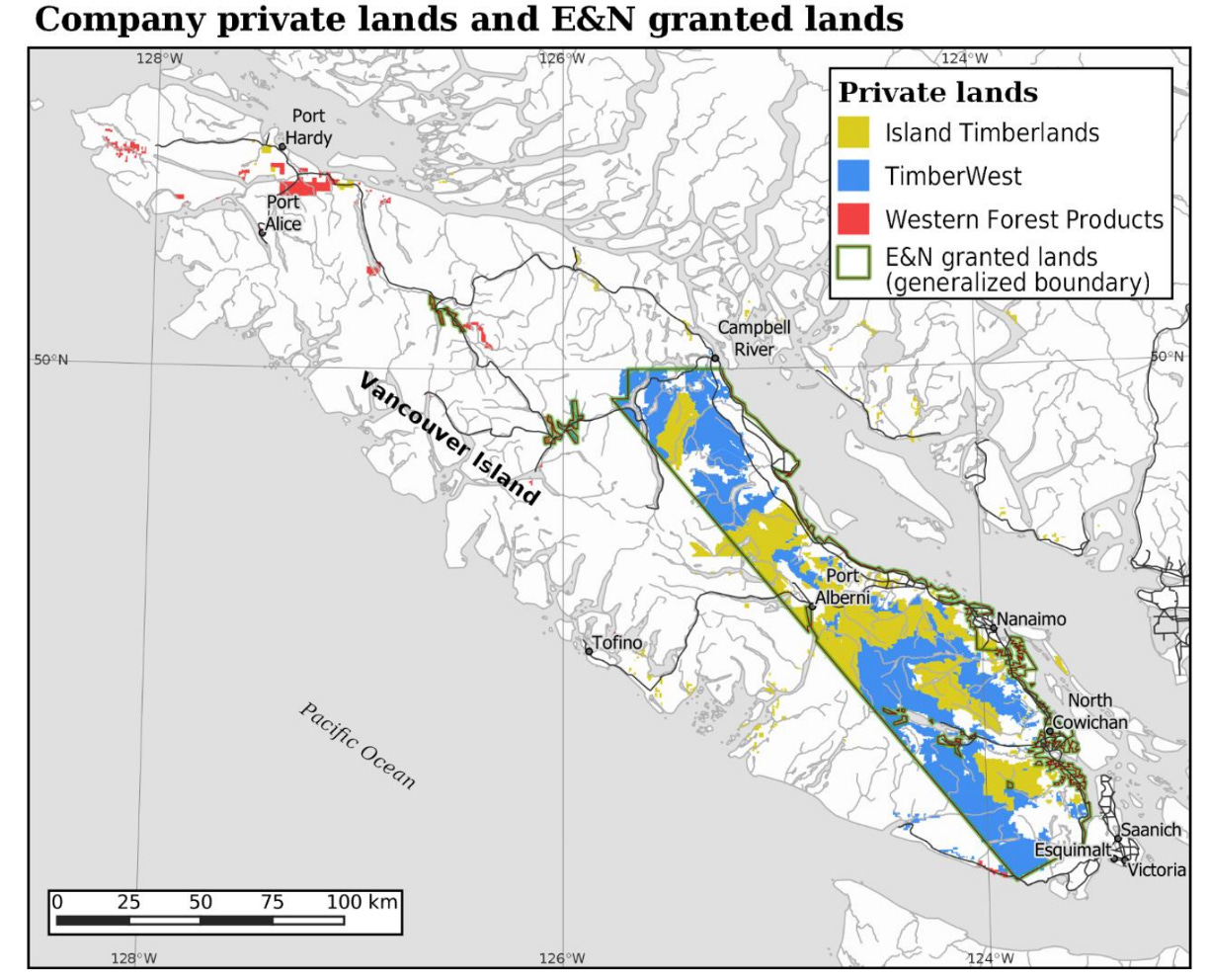
That was especially clear in “Spaces, patterns, and path dependencies of colonial capitalist development.” It insisted that capitalist landscapes are layered spatial records of racialization, territorial dislocation, and domination, not just economic outcomes. The built environment is one of the means through which capital accumulation has been organized and reproduced, through plantations, ports, rail, pipelines, grids, jurisdiction, and property. Colonial and racial orders persist in the infrastructural and legal imprints that shape who benefits, who is exposed, and whose claims count, even when new development models arrive.
“Beyond the State: Property, Territory, and Relational Geographies” pushed that critique further by questioning some of geography’s own inherited vocabulary. Territory is often assumed to belong to the language of sovereignty, bounded control, and state space. But this session opened territory back up by asking what it looks like when understood through Indigenous, Afro-diasporic, and other relational geographies that exceed liberal property regimes and state recognition. That is a meaningful shift. It moves critique beyond saying existing arrangements are unjust and toward asking whether some of the conceptual tools used to describe land, governance, and belonging are themselves part of the problem.
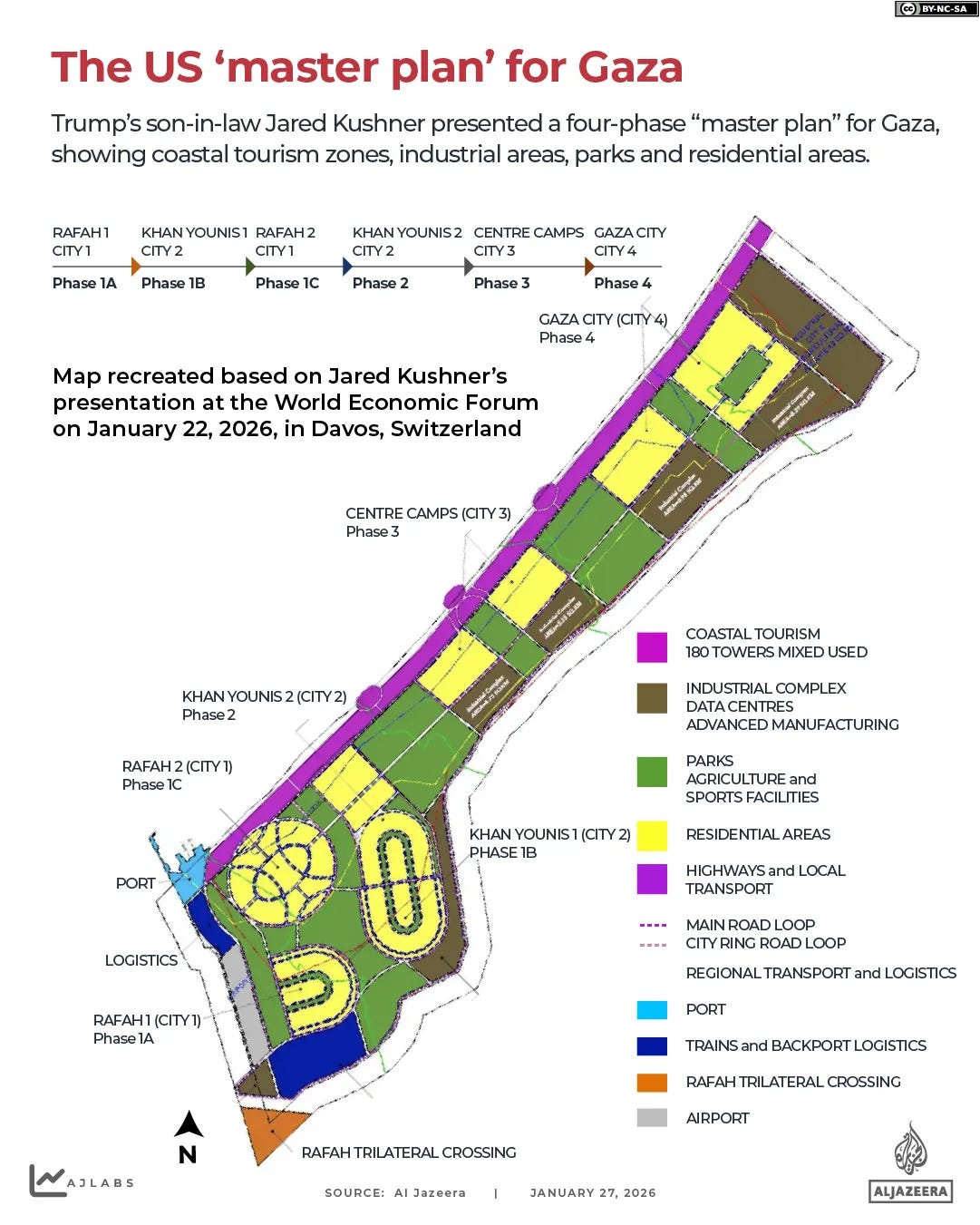
The Geographers for Justice in Palestine session shifted the discussion from abstract institutional complicity to the destruction of knowledge production conditions. The panel’s force came from its call for boycott and divestment within the AAG, emphasizing the demand against the systematic dismantling of Palestinian academic life. Organizers described the destruction of Gaza’s universities, the killing and displacement of teachers and students, and the obliteration of educational infrastructure, including whole geography departments, as what the UN has termed “scholasticide.”
This is not confined to Gaza; in the West Bank, military infrastructures, arrests, and interruptions make attending classes difficult, yet universities remain spaces of hope and persistence. The session linked these conditions to retribution faced by scholars abroad, reminding attendees that academic freedom is not protected by relocation to North American institutions. The panel widened the critique beyond unjust land arrangements to include attacks on institutions, movements, and intellectual practices that enable people to know and contest those arrangements.
Palestinian-American UC Berkeley scholar Hatem Bazian, a longtime analyst of Islamophobia, settler colonialism, and U.S.–Middle East politics, provided a broader historical and conceptual framework for discussions of colonialism, territory, and power in his plenary talk. He rejected the tragic “conflict” framing. He views Palestine as an ongoing settler-colonial project shaped by British imperialism, territorial transformations, and a political vocabulary that treats the colonized as the problem while preserving colonial structure.
Bazian emphasized that even the familiar “peace process” frame obscures reality by normalizing settler claims and depoliticizing indigenous dispossession. His framing pushed critique beyond moral outrage, asking what becomes visible when Palestine is named as a colonial formation that the geography discipline must describe honestly.
A complementary provocation from “Beyond Liberal Emergencies” explained how colonial violence is often managed politically and rhetorically. The session argued that “emergency” is a governing frame that authorizes exceptional measures, narrows political imagination, and sorts whose suffering counts as urgent. Liberal governance relies on legal, technical, and administrative means to identify and contain crisis, but current events reflect this mutation. In a more authoritarian-leaning environment, emergency language is used by competing projects to generate fear and justify intervention in hopes of securing legitimacy.
These sessions suggested that geography’s critique is strongest when it does two things at once: it shows how domination is sedimented in space, and it spots the seeds of different spatial futures already being sown.
PATHS TO POSSIBILITY
If geography is good at explaining structural problems and critiquing the power behind them, where, exactly, are the openings for intervention? There were definitely a lot of papers calling for new ways to imagine future possibilities — a term commonly used is imaginaries. These kinds of sessions and papers help summon a kind of optimism in these bewildering times. After all, while utopias may not be attainable, steps toward them are. But if there’s one thing we’re learning, faith in more and better data, or even policy, won’t save us. We need to find actual openings for positive change.
One session on anticipatory AI governance in public administrations focused on making public institutions more capable rather than just efficient. It aimed for foresight, digital inclusion, territorial innovation, public value, and data sovereignty, rather than automation for automation’s sake. This contrasts with the usual story of governments lagging behind technology and reacting to damage. Public institutions, especially regional and local ones, might build capacity to govern AI before platform logics become entrenched. These efforts may not address power asymmetries, but suggest that administration can still be a site of democratic invention.
One such opening came from the Australian geographer Sarah Barns and her work at Civic Interplay. She frames a shift from platform urbanism to civic AI capabilities. National or regional AI sovereignty can become an elite project, measured by compute, data centers, and industrial policy. Civic AI asks what digital citizenship, public infrastructure, and collective accountability are built into these systems and for whom. In Barns’s version, that question includes Indigenous sovereignty, planetary limits, and digital system materialities. It repositions the public as not just a user base and citizenship as not just access.
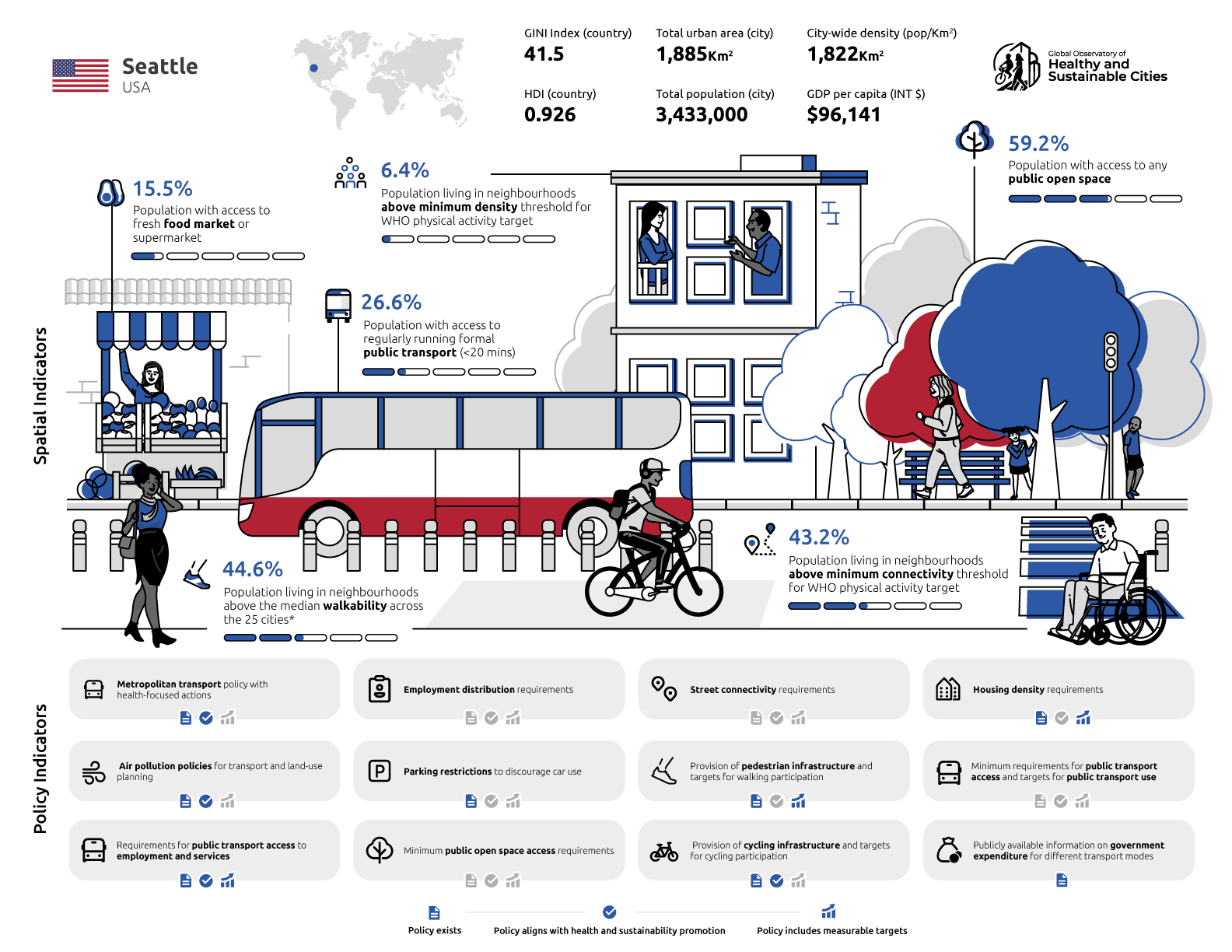
Another opening came from less overtly political but consequential sessions. I attended one session organized by Geoff Boeing at USC. Geoff built and maintains a street science Python package leveraging OpenStreetMap I used for my capstone: OSMnx. His work focuses on urban spatial analytics for benchmarking health and sustainability goals using open, comparable neighborhood-scale indicators. Metrics are never neutral, but many cities lack the capacity to measure if their built environments align with their stated goals.
Geoff’s session paired measurement with policy analysis, emphasizing how making frameworks open for under-resourced places can offer hope. Better tools tied to public goals can widen participation rather than concentrating expertise to planners, who are often guided by leaders easily swayed by powerful actors, especially in resource-strapped communities.
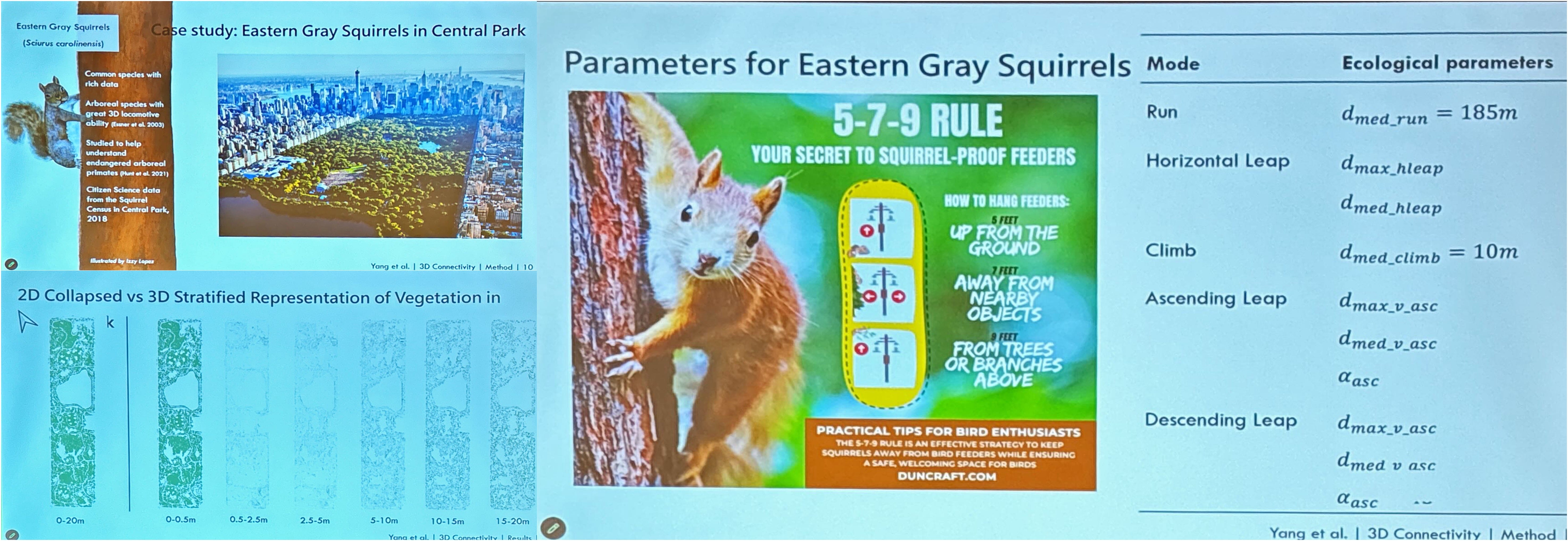
Yet another opening came from an unexpected inquiry organized by the Director of the Spatial Conservation and Landscape Ecology (SCALE) Lab at UCSB, Amy Frazier — also part of the Center for Spatial Science. She organized a conservation session featuring a paper she co-authored with a student on 3D landscape connectivity. Despite abundant citizen data scientists documenting squirrel behavior in Central Park, analysis has only considered 2D spatial behavior. This paper highlighted geography’s role in refining our perception of complex environments, making interventions more ecologically appropriate. Since species move in three dimensions, our models should too. This seemingly obvious yet challenging concept is exemplified by the few examples that incorporate 3D spatial data. Amy’s destined to change that.
Given that so many of us gathered under the shadow of war, dispossession, and attempted genocide, I left with a more grounded sense of possibility than I expected. Not optimism in any easy sense, and certainly not comfort. The most meaningful work I encountered did not retreat into techno-solutionism, nor did it stop at critique, however necessary critique remains. It asked harder things of geography and of geographers. It tried to build concepts, institutions, and methods sturdy enough to act in a damaged world without mistaking that world for all that is possible.
In that setting, even modest openings felt consequential. They suggested that scholarship can still help protect what is being destroyed, clarify what power works to conceal, and keep alive forms of public reasoning and collective action that refuse to accept the present order as inevitable. That, to me, was the conference’s most poignant lesson. It’s not that a better world is close at hand, but that amid inequities, injustices, ruin, repression, and organized forgetting, there are still people doing the patient work of making new possibilities thinkable.