


Hello Interactors,
As Canadian and Alaskan wildfire smoke drifts across North American borders, it’s easy to resort to feelings and language of crisis in the demand for urgent, immediate control. But fires are not new to these landscapes, and this “crisis” sits alongside others that are also on fire. Climate crises events bring into focus which histories we forget, whose knowledge we ignore, and which relationships we disrupt. Turns out it’s happening at a cellular level too. The real danger is a world and ecology changing so quickly, and understood so narrowly, that it erases the very temporal patterns, memories, and ecological relationships that make adaptation possible.
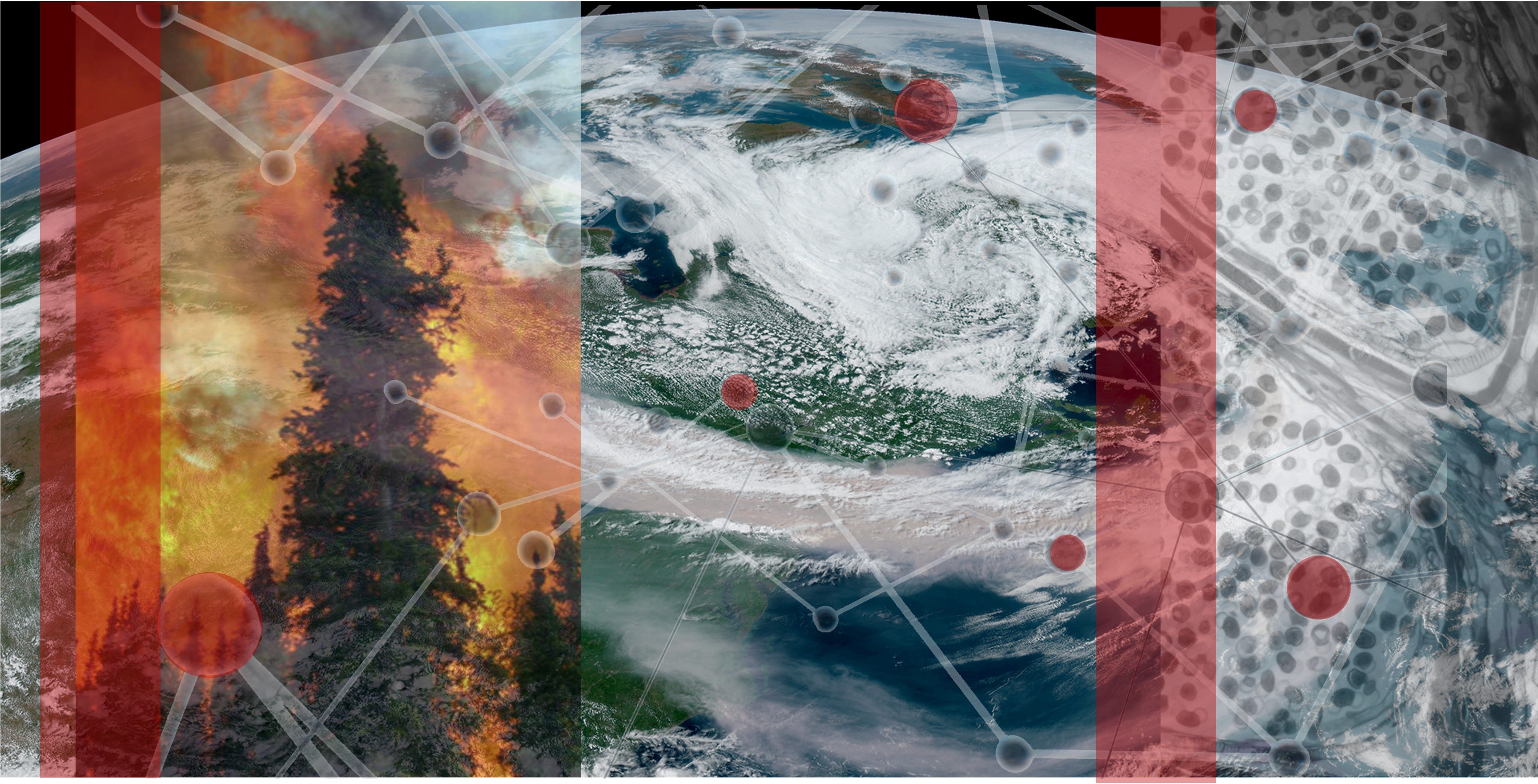
FIRE’S FRACTURED FREQUENCY
The climate crisis is often communicated through rising averages. We read of climbing global temperatures, sea levels, atmospheric carbon dioxide concentrations, and acres burned. These measurements are indispensable, but averages can make crisis feel distant and abstract. In a forest, climate change is also experienced as an altered interval — as too little time between one disturbance and the next.
A forest is not a passive surface. It actively shapes its own microclimate, stores carbon, and retains moisture until fire temporarily disrupts these relationships…and in doing so creates new ones.
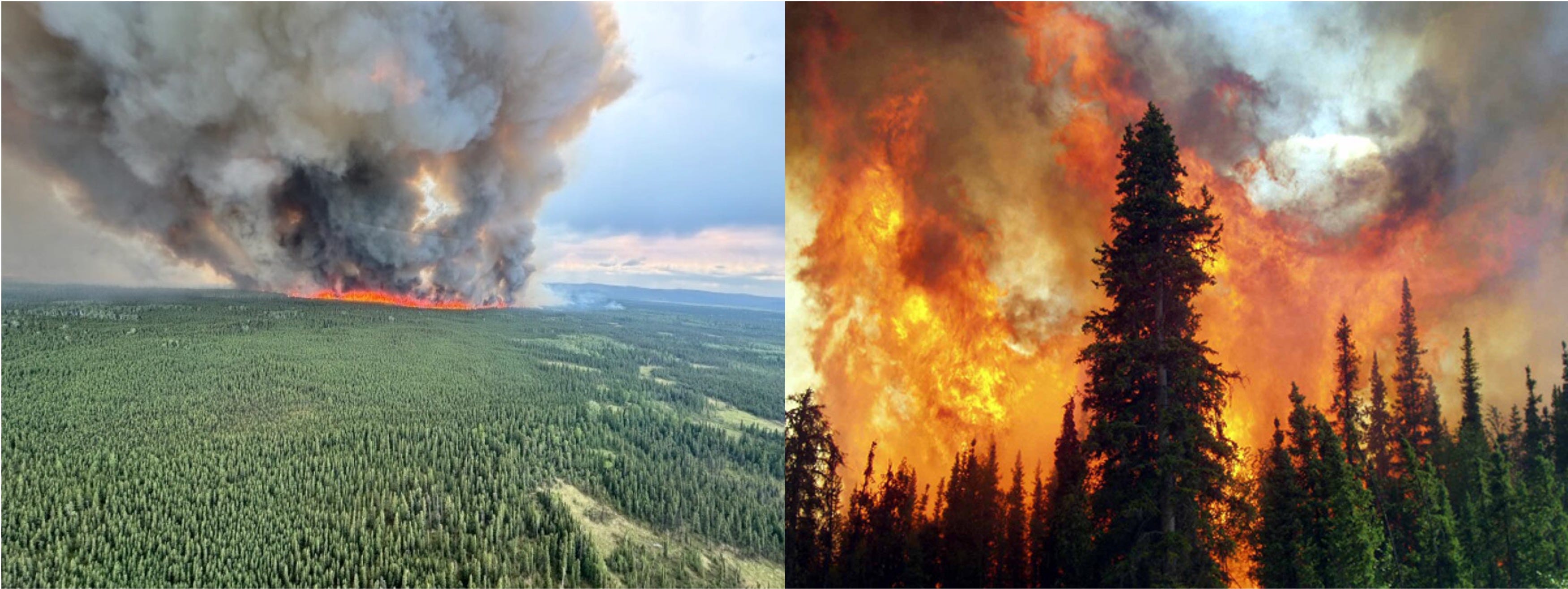
To understand what shorter fire intervals are doing to Alaska’s boreal forests, ecologist Xanthe Walker and an interdisciplinary team of researchers examined carbon storage and forest recovery across 555 plots associated with thirty-one fires. They compared stands with different fire histories, including sites that had burned repeatedly before black spruce forests could fully recover. The absolute amount of carbon released by individual fires was broadly similar across fire-return intervals, but recently burned landscapes began with smaller remaining carbon pools and therefore lost a greater proportion of what remained. Repeated burning also consumed more legacy carbon — the carbon inherited from earlier vegetation and accumulated soils — and reduced the likelihood that some sites would regenerate as black spruce forest. Fire was doing more than releasing carbon in the present. By interrupting regeneration, it was weakening the landscape’s capacity to store carbon in the future (Walker et al., 2025).
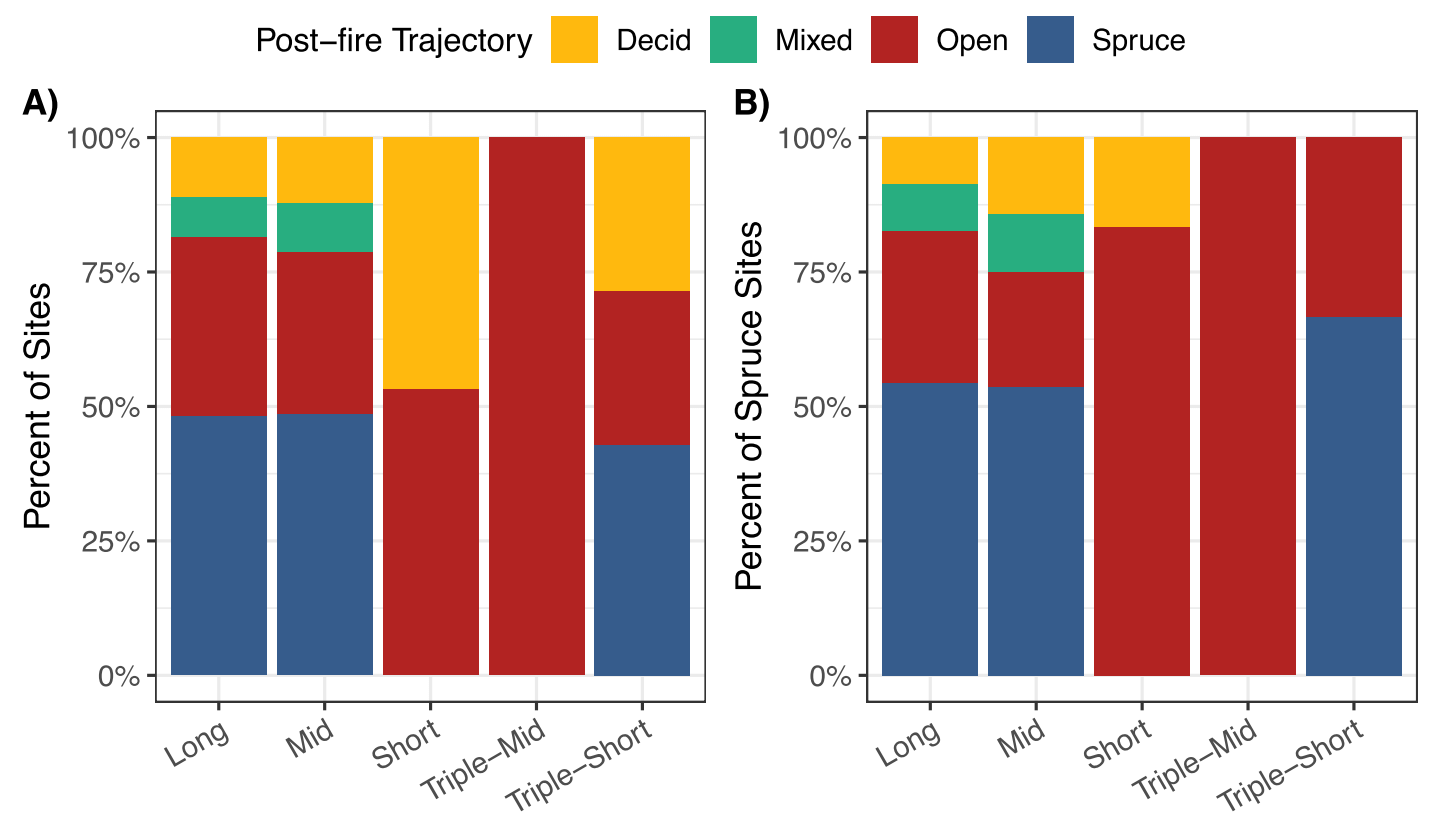
Black spruce forests are not merely tolerant of fire but have evolved with stand-replacing fire as a recurring part of their life cycle. Their cones evolved to be little seed bombs that stay in the trees and release their seeds when they burn. This helps new trees grow on the ground where they’re not protected by the canopy. That strategy works when fires recur at intervals long enough for stands to mature, rebuild their seed stocks, and accumulate biomass. Historically, boreal fire-return intervals commonly ranged from about seventy to 130 years. Black spruce may require roughly fifty years to produce enough seed for self-replacement. Yet intervals of less than thirty years are becoming more common in some areas, allowing another fire to arrive before recovery is complete (Walker et al., 2025).
Under those conditions, fire can push regeneration away from black spruce toward deciduous vegetation or more open landscapes. Such places may remain biologically productive, but they are no longer the same forests. They store carbon, retain moisture, shelter organisms, but also carry subsequent fires differently. The landscape may not simply return to its former state after disturbance; it may cross into another ecological regime, organized by different species, intervals, and feedback loops.
MEMORY, MEANING, AND MALLEABILITY
It is tempting to call such transformations unprecedented. In some measurable respects, they are. We know Industrial greenhouse-gas emissions are rapidly altering atmospheric and ecological systems on a planetary scale, and the effects are not confined to normal oscillations around once-familiar conditions. The rate, direction, and geographic concentration of change effects forests adapted to fire and may be unable to adjust when fire’s frequency exceeds the time needed for reproduction and recovery.
The fact that Earth has always changed does not make the present disruption ordinary. But neither does the climate crisis mark the first time people have faced the collapse of an expected environmental order. Many humans didn’t survive the Little Ice Age, but many did.
For many Indigenous peoples, colonization produced generations of forced displacement, altered fire and water regimes, destroyed food systems, suppressed governance, and separated communities from ancestral lands. What dominant institutions now describe as an unprecedented disruption may appear within Indigenous histories as another transformation imposed by powers that have long treated land, water, plants, animals, and people as resources to be reorganized.
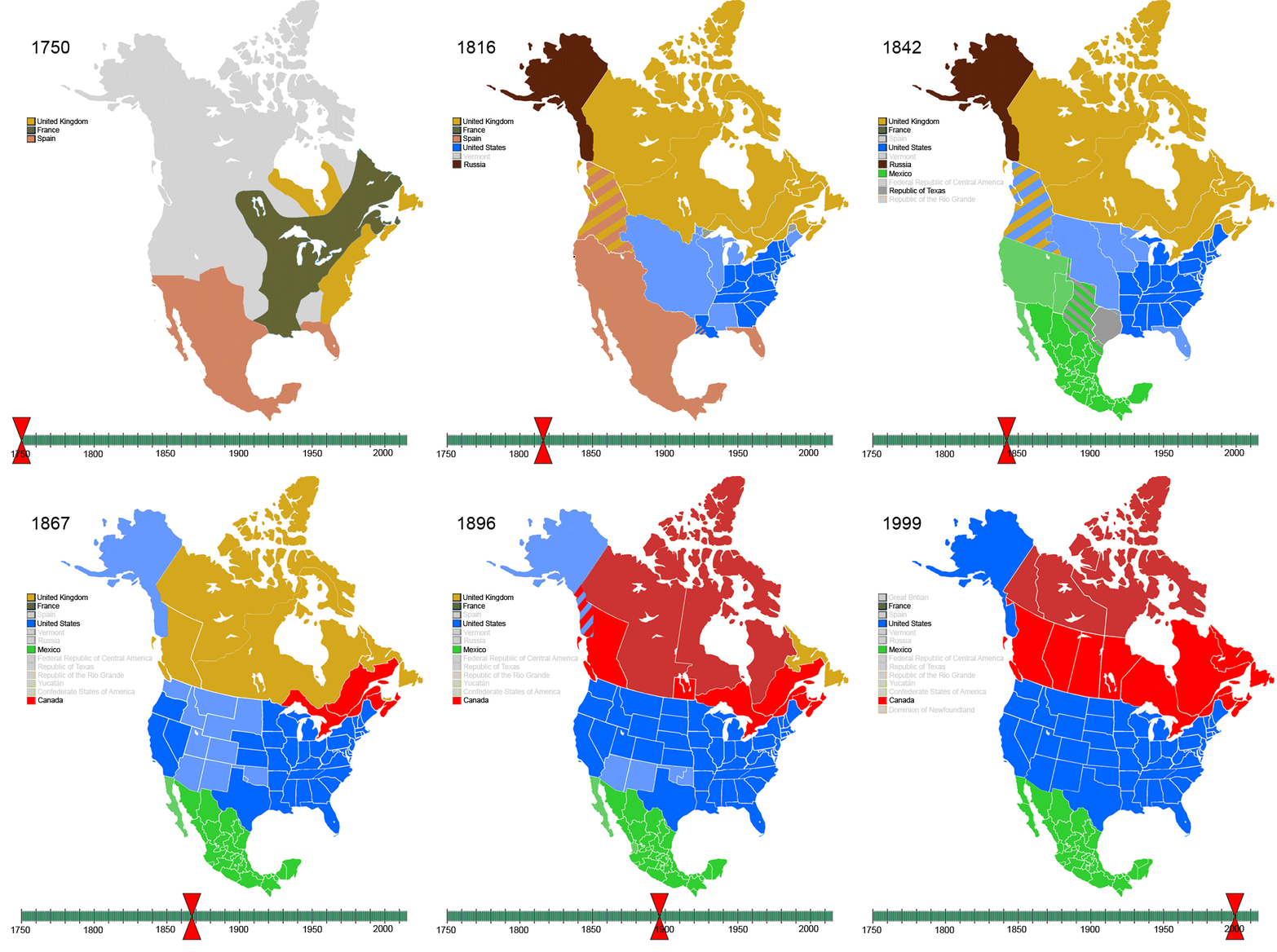
The word crisis can therefore describe an observable material condition while concealing a historical one. The flames are real, but so are the questions of who altered the landscape, whose losses are treated as new, who is expected to adapt, and who gets to define recovery. Potawatomi scholar Kyle Whyte challenges this framing, arguing that a dominant “epistemology of crisis” treats environmental disruptions as radically new, imminent threats (Whyte, 2021). This framing isolates the crisis from historical contexts of colonialism, allowing institutions to justify urgent, top-down actions that bypass local consent and justice under the guise of emergency.
That framing carries two recurring assumptions. The first is unprecedentedness — the belief that the past contains few usable precedents or lessons for present conditions. The second is urgency — the belief that immediate action may justify setting aside ordinary concerns about consent, justice, and responsibility. Whyte’s intervention exposes how crisis language can obscure Indigenous histories of displacement and adaptation while allowing new forms of dispossession to proceed in the name of emergency responses (Whyte, 2021).
Whyte is not arguing that climate change is unreal or that rapid action is unnecessary. He is asking what calls for urgency and emergency action leads people to overlook or forget.
When the present is imagined as unprecedented, earlier crises become difficult to see. Climate-related relocation may be narrated as a novel problem even though Indigenous nations have extensive experience with forced removal, shrinking territories, flooding, and government-directed resettlement. Declaring the current moment historically unique can erase not only previous violence but also knowledge formed through surviving it.
Whyte contrasts crisis epistemology with an “epistemology of coordination.” Coordination begins not with novelty but with constant change. It asks whether the relationships needed to respond remain intact. Those relationships take the form of kinship and mutual responsibilities, including care, consent, and reciprocity. They generate what Whyte calls the “responsible capacity to respond to constant change” (2021, p. 52).
This is a big geophilosophical change in how we think about the world. Adaptation isn’t just about an organism or group of organisms changing to fit their environment, it’s also about how things are connected, like people, places, history, and processes (the primary focus of Interplace). Fire isn’t just about heat progressively burning through plants. It depends on things like how old the trees are, how much moisture there is in the soil, how many seeds are available, if there have been any fires before, what the weather is like, and the rules and laws that people have made about how to handle fire. What the forest looks like after a fire depends on which relationships are still around.
The same is true of human communities. Memory is not merely a record of what happened. It is part of the infrastructure of adaptation. It carries knowledge of earlier disturbances, durable practices, failed interventions, and obligations extending beyond the present generation. A society that repeatedly labels each disruption unprecedented may collect and reason over immense quantities of data while remaining unable — or unwilling — to learn from other histories.
CELLS, CUES, AND CONTINGENCY
The adaptive value of memory may reach far deeper into life than culture or nervous systems. Evolutionary biologists Maor Knafo, Elena Casacuberta, and Iñaki Ruiz-Trillo begin a recent study with the observation that “one of life’s most remarkable features is its persistent and adaptive resilience in the face of constant environmental fluctuations” (2026, p. 1). They investigated whether a single-celled organism could use an environmental cue to anticipate future stress rather than responding only after that stress arrived.
Cells exposed to a predictable light and vibration cue before heat stress experienced a 12 percent mortality rate, compared to a 27 percent mortality rate for cells subjected to unpredictable, random cues. The cells didn’t just adapt to the heat; they learned to anticipate it, demonstrating that even single-celled life relies on temporal regularities to survive.
The authors paired this experiment with a computational model. A nonlearning “blind” agent could adapt only through genetic mutation and selection across generations. A learning agent could also revise its phenotypic strategy within its lifetime, exploring alternatives when earlier responses performed poorly. In predictable environments, learning agents achieved higher fitness because they could use environmental cues to prepare for approaching conditions.
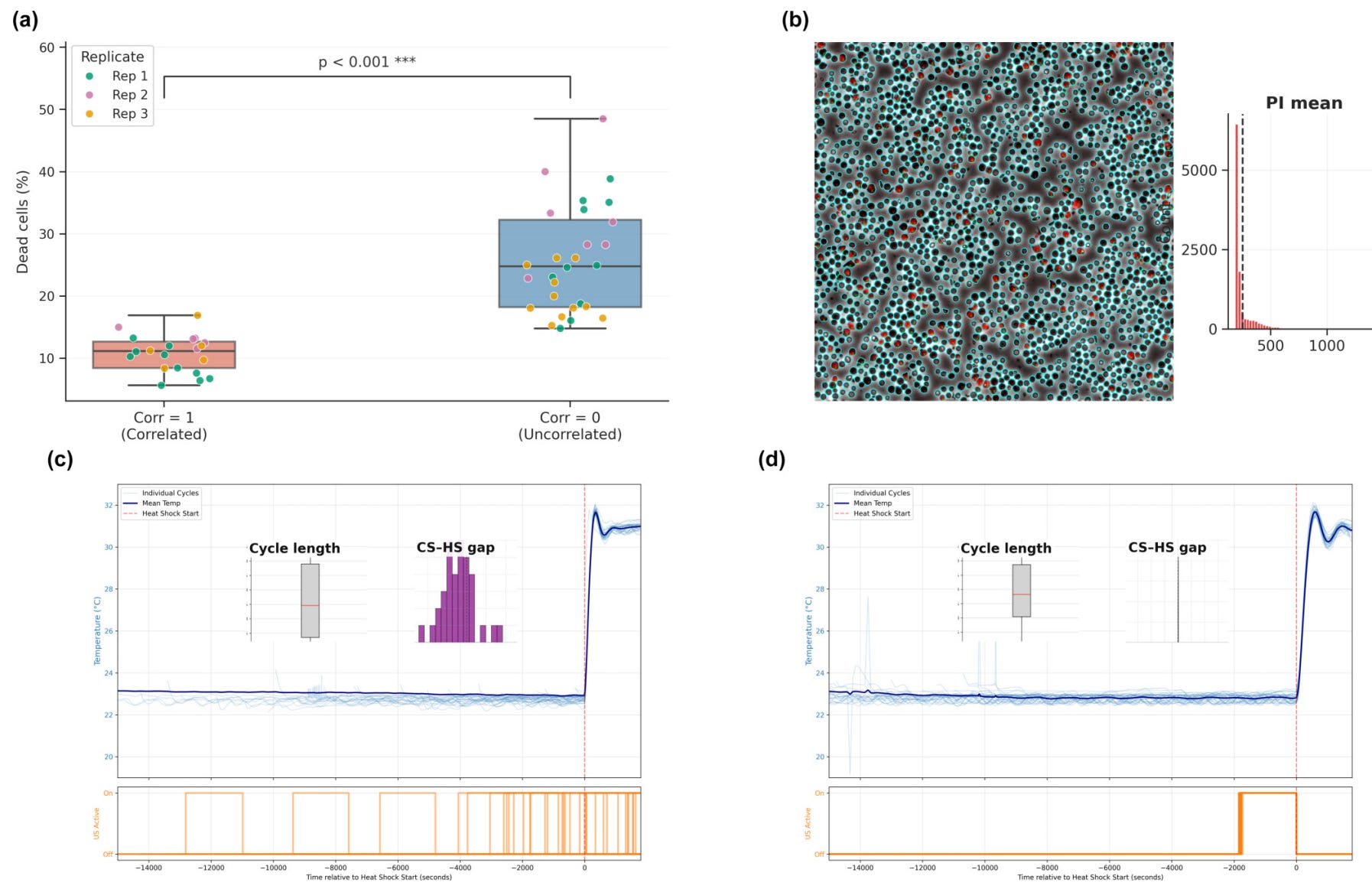
The study does not demonstrate that cells reason as humans do. Nor does a cellular experiment prove a general philosophy of life. It does, however, offer evidence that even single cells can exploit temporal regularities in their surroundings. Adaptation is not always a passive process through which an external environment selects among fixed organisms. Organisms detect, respond to, and sometimes anticipate the worlds they inhabit.
The model also showed that flexibility has its limits. As the simulated environment became more unpredictable, the benefits of learning started to fade. After a certain point, the cues that used to predict what would happen next didn’t work as well. Keeping things flexible came with a cost, because it didn’t give them any clear guidance. In the end, simpler, fixed strategies performed better. When the environment suddenly changed, the learning agents first took a big hit because their expectations had become useless. But their flexibility eventually helped them bounce back, but it also meant they made mistakes, got confused, and took time to adjust. (Knafo et al., 2026).
Let’s not get carried away with the comparisons. A forest isn’t a Bayesian agent, and Indigenous knowledge can’t be boiled down to simple conditioning. They’re different forms of life, knowledge, and organization. What they do have in common is this shared principle: adaptation relies on meaningful patterns connecting past experiences to future situations.
A black spruce forest can recover from a fire when trees have time to grow and produce seeds. A cell can prepare for heat when it anticipates it. A community can adapt when things change, remembering past actions, taking responsibility, and maintaining relationships. Resilience arises from a symbiotic relationship between living things and their environment. Life’s resilience isn’t innate. It’s more that it stems from memory, prediction, adaptation, and readiness…until the world’s race surpasses its ability to keep pace.
RELATIONSHIPS, RECOVERY, AND RESPONSIBILITY
Geographer Karen Bickerstaff warns against the dominance of a “catastrophic gaze” that portrays climate change as an imminent, universal threat (Bickerstaff, 2026). While planetary measurements are indispensable, this abstract framing can paralyze political agency, reducing people to passive spectators awaiting either inevitable collapse or a far-off technological rescue (Bickerstaff, 2026). Although our atmosphere is shared, climate exposure, responsibility, and adaptive capacity remain radically uneven. The crisis is planetary in cause, but it is lived and experienced through particular bodies, infrastructures, and local ecosystems.
This planetary abstraction often fosters a form of “cruel optimism” — a reliance on grand technological promises like geoengineering or carbon-removal systems that allow us to avoid changing our politics or holding powerful actors accountable (Bickerstaff, 2026). The dangers of these universal, top-down approaches are highly visible in fire governance. Simple, blanket policies — such as total fire suppression or restrictive carbon-offset projects — frequently ignore the diverse ecological histories of fire and displace Indigenous burning practices, which ultimately increases the flammability of the landscape.
In contrast to these universalizing fixes, true responsibility must preserve and restore the unique capacities of particular systems to respond to change. This is where Kyle Whyte’s epistemology of coordination can turn to practice. His push is for climate action to strengthen the relationships — such as consent, reciprocity, and intergenerational obligations. This is what is his ancestors practiced surviving constant change (Whyte, 2021).
Instead of top-down emergency responses that make justice disposable in the name of speed, we need “situated action” (Bickerstaff, 2026). While individuals cannot act on a planetary scale, they can act meaningfully within their own watersheds, neighborhoods, and local political coalitions. Climate action becomes durable not when it chases abstract global targets, but when it visibly improves local health, restores specific ecosystems, and corrects immediate injustices (Bickerstaff, 2026).
This is not an argument for delay. Emissions do need to fall (leading to innumerable benefits), but urgency cannot excuse us from asking what kind of world our interventions produce. The task is to connect scales without allowing the global to erase the particular. A mature black spruce indeed stores carbon, but it also stores decades of growth, fungal relationships, and a history of fire and recovery. When fire returns too soon, the forest loses not just biomass, but time. Climate responsibility begins here. Not in the fantasy of holding a restless Earth still, but in preserving the intervals, relationships, and possibilities through which living systems can continue to adapt.
REFERENCES
Bickerstaff, K. (2026). The perils of climate catastrophism: A call to situate crisis and change. WIREs Climate Change.
Knafo, M., Casacuberta, E., & Ruiz-Trillo, I. (2026). Beyond diffusion: Bayesian learning strategies in single-cell life.
Walker, X. J., Mack, M. C., Black, B., Dean, J., Kemper, L. F., Potter, S., Rogers, B. M., & Truettner, C. M. (2025). Increasing wildfire frequency decreases carbon storage and leads to regeneration failure in Alaskan boreal forests. Fire Ecology.
Whyte, K. (2021). Against crisis epistemology. In B. Hokowhitu, A. Moreton-Robinson, L. Tuhiwai-Smith, C. Andersen, & S. Larkin (Eds.), Routledge handbook of critical Indigenous studies (pp. 52–64). Routledge.


