


Hello Interactors,
I’ve long been a fan of “regreening” cities, imagining replacing bits of asphalt and concrete with trees, plants, mini-parks, and green roofs to cool them down. In many cases these are indeed good interventions. But even these celebrated nature-based solutions to the “urban heat island” effect require closer inspection. It turns out any land cover change alters energy, water, and momentum exchanges between the Earth’s surface and the atmosphere. Which are the right ones and where?
To understand why cookie cutter greening plans can fail and how planners and policy makers can build cities that can handle climate change, we need to understand how land and the air interact. Environments vary from place to place, and this puts limits on what we can do to land to create urban climates that are both beautiful and healthy.
To get a handle on what the research says, I found a literature review from 2025 that synthesized findings from 84 peer-reviewed studies. In was published in the journal Climate Risk Management.
Let’s see what they, and others, found.
BEATING HEAT WITH BIOPHYSICAL FEATS
What better place to start than science. Let’s just delve right into how urban green spaces affect temperature. It starts with determining the energy balance at the surface of the earth. This comes from a budget equation found in physical geography. When sunlight hits the Earth’s surface, it breaks down into three main fluxes, or ways heat moves around
Sensible heat flux: the heat that directly warms the surrounding air, which we measure as temperature.
Latent heat flux: the heat that’s used to turn water from a liquid to a gas, like when we sweat or plants release water vapor (transpiration).
Ground heat flux: the heat stored in building materials, asphalt, and soil.

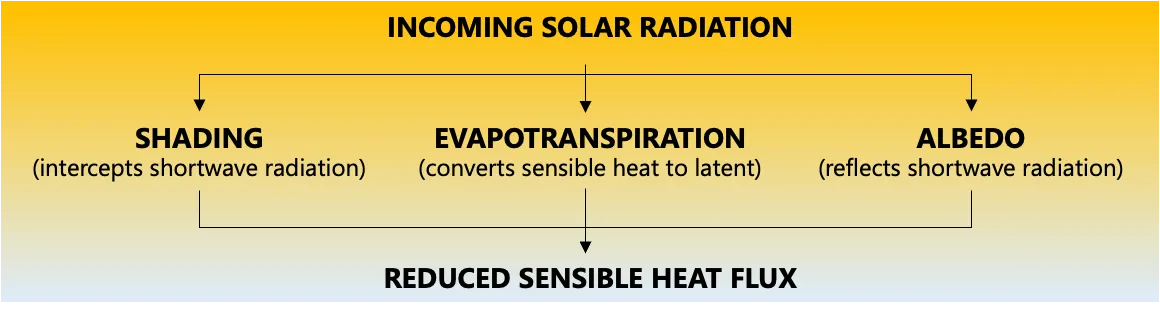
In conventional urban environments dominated by concrete and asphalt, latent heat flux is minimal because we’ve built cities in ways that rapidly drain water away as ‘waste’. As a result, incoming solar energy is funneled into sensible heat. This raises daytime air temperatures that gets stored as ground heat, which is slowly radiated back into the city at night. Urban greening can reshuffle this thermodynamic budget through three interconnected physical mechanisms: shading, evapotranspiration, and albedo modification.
Mechanism 1. Shading: Intercepting Solar Radiation
Shading — the most immediate and reliable cooling mechanism provided by vegetation — requires precise microclimatic quantification. Vegetative canopies act as physical shields, intercepting incoming shortwave solar radiation before it strikes impervious surfaces like concrete or asphalt. By preventing these dense materials from absorbing heat and emitting sensible heat flux back into the boundary layer, shading dramatically lowers surface temperatures and reduces the baseline thermal energy transferred to the surrounding air. (Bowler, D. E., et al. 2010)
The cooling benefit of urban trees is non-linear, accelerating significantly once neighborhood canopy cover crosses a critical threshold of around 40%. Measuring daytime air temperatures across urban gradients, they found that canopy cover above this 40% mark can lower local air temperatures by up to 1.5 to 2.0 degrees Celsius, effectively offsetting the thermal burden created by surrounding roads and impervious surfaces. (Ziter, C. D., et al. 2019)
Mechanism 2. Evapotranspiration: Trading Sensible Heat for Latent Heat
While shading blocks heat absorption, evapotranspiration actively removes heat from the air. Plants absorb soil moisture through their root systems and release it as water vapor through tiny microscopic pores in their leaves called stomata. This process requires thermal energy that turns phase-changing liquid water into gas. This energy transfer absorbs sensible heat and converts it into latent heat.
Evapotranspiration from well-watered urban green spaces can lower local air temperatures by 2-4 degrees celsius. (Coutts, et al., 2013) However, physical geographers emphasize a crucial physical prerequisite that is easy to overlook: evapotranspiration is entirely dependent on available water. When the soil is dry or the air is super dry, plants close their stomata to save water. When stomata close, evapotranspiration shuts down. This leaves shading as the sole remaining cooling mechanism.
Mechanism 3. Albedo Dynamics: The Surface Reflectivity Paradox
Albedo measures the reflectivity of a surface on a scale from 0.0 (total absorption) to 1.0 (total reflection). Urban asphalt has a low albedo (0.05 to 0.10), absorbing up to 95% of incoming solar energy. Vegetation’s albedo can range from 0.11 to 0.25.
In temperate climates, replacing low-albedo asphalt with greenery or reflective surfaces increases surface reflectivity, sending more solar radiation back into space before it can be absorbed as sensible heat. One study documented that increasing urban surface albedo typically lowers peak ambient air temperatures by 0.3 degres Celsius to 1.0 degree Celsius — alongside much larger drops in surface pavement temperatures. While a temperature change under one degree Celsius may sound modest at first glance, a baseline shift of this magnitude across a neighborhood is enough to redefine a local microclimate. (Santamouris, 2014)
But swapping out light urban surfaces for dark vegetation can also have a negative effect. Paradoxically, when researchers in 2023 replaced dry, light-colored desert soil with darker vegetation in hot, arid regions it reduced overall surface reflectivity. The drop in albedo caused an increase in daytime surface warming. (Schlaerth, et al., 2023)
Furthermore, dense tree canopies inside narrow urban street canyons can act as thermal blankets at night. While trees provide valuable shade during the day, their foliage reduces the sky view factor at street level, trapping outgoing longwave thermal radiation emitted by surrounding building facades and asphalt. When combined with reduced wind permeability, this canopy barrier restricts nocturnal radiative cooling and holds warm air near ground level (Lee et al., 2016).
These are the physical realities that can demonstrate how urban greening is not a consistently inherent cooling practice. It is a complex thermodynamic intervention whose success relies entirely on local environmental conditions.
PLACEMENT, PATCHES, AND PARK PATTERNS
Because thermodynamic processes happen across physical spaces, cooling urban green space can be uneven. The literature review reveals that a green space’s cooling capacity depends on four spatial and biological variables: vegetation density, species selection, spatial configuration, and urban morphology. Let’s break them down individually.
Cooling Factor 1. Vegetation Density and Species Traits
Not all greenery cools equally. One way to measure this is through a Leaf Area Index (LAI). This is the total leaf area per unit of ground area and is a primary predictor of thermal performance. As you might imagine, dense foliage absorbs more from the sun and then produces higher cumulative transpiration (so long as there’s adequate water).
Botanical traits also play a big role. Broadleaf deciduous species (like oaks or maples) feature large surface areas that maximize summer transpiration, but that goes away when they drop their leaves in winter. Evergreen coniferous trees, however, maintain continuous canopy coverage through every season.
In temperate rainforest environments like Seattle or Vancouver, researchers found that conifers cooled urban surroundings up to 1.7 degrees celsius more effectively than broadleaf trees. Dense needle canopies continuously block incoming solar radiation due to higher LAI and the fact that clusters of spiny needles better trap a stable buffer of calm air which moderates heat exchange with the surrounding urban environment. (Eyster & Beckage, 2022, 2023)
Cooling factor 2. Spatial Configuration: Landscape Ecology Principles
Ecologists and geographers commonly evaluate green spaces through two main attributes: composition (how much green space exists) and configuration (how those green patches are arranged across the landscape). Over 58% of the mechanism-focused studies in the literature review analyzed spatial pattern metrics. The consensus is the spatial layout of green space is just as important as its total area!
Other empirical studies consistently demonstrate that cooling effects decay the further you get from green spaces. Research done in 2016 and 2023 shows how urban parks can produce a primary “cooling footprint” that extends typically 100 to 300 meters from the park boundaries. If you’re lucky enough to live within this buffer, temperatures drop between 1.9 and 3.1 degrees celsius, but beyond 300 meters, the cooling influence quickly falls off. (Bao, et al. 2016, Shi et al. 2023)
This spatial limit leads to a couple spatial layout choices. A few big parks or connected networks of smaller green spaces. Large, consolidated parks (>2 hectares) generate intense, stable “cool islands” at their core, but their benefits remain localized. For example, a study in Xalapa, Mexico, revealed that parks larger than 2.8 hectares with over 21% tree cover provided reliable local cooling of around 2 degrees celsius . (Lemoine-Rodriguez et al., 2022)
Connected networks of smaller green spaces distributed across a city create a more equitable cooling effect. Three studies in 2019 and 2021 show that fragmented, isolated green patches — like big parks — perform poorly compared to continuous, linear green corridors. Linear “green belts” or street-tree networks (in the right environment) can act as ventilation channels, allowing cool air generated by vegetation to flow into adjacent built-up neighborhoods. (Masoudi et al., 2019, 2021; Pramanik, 2019)
Cooling factor 3. Urban Morphology: The Built Environment Matrix
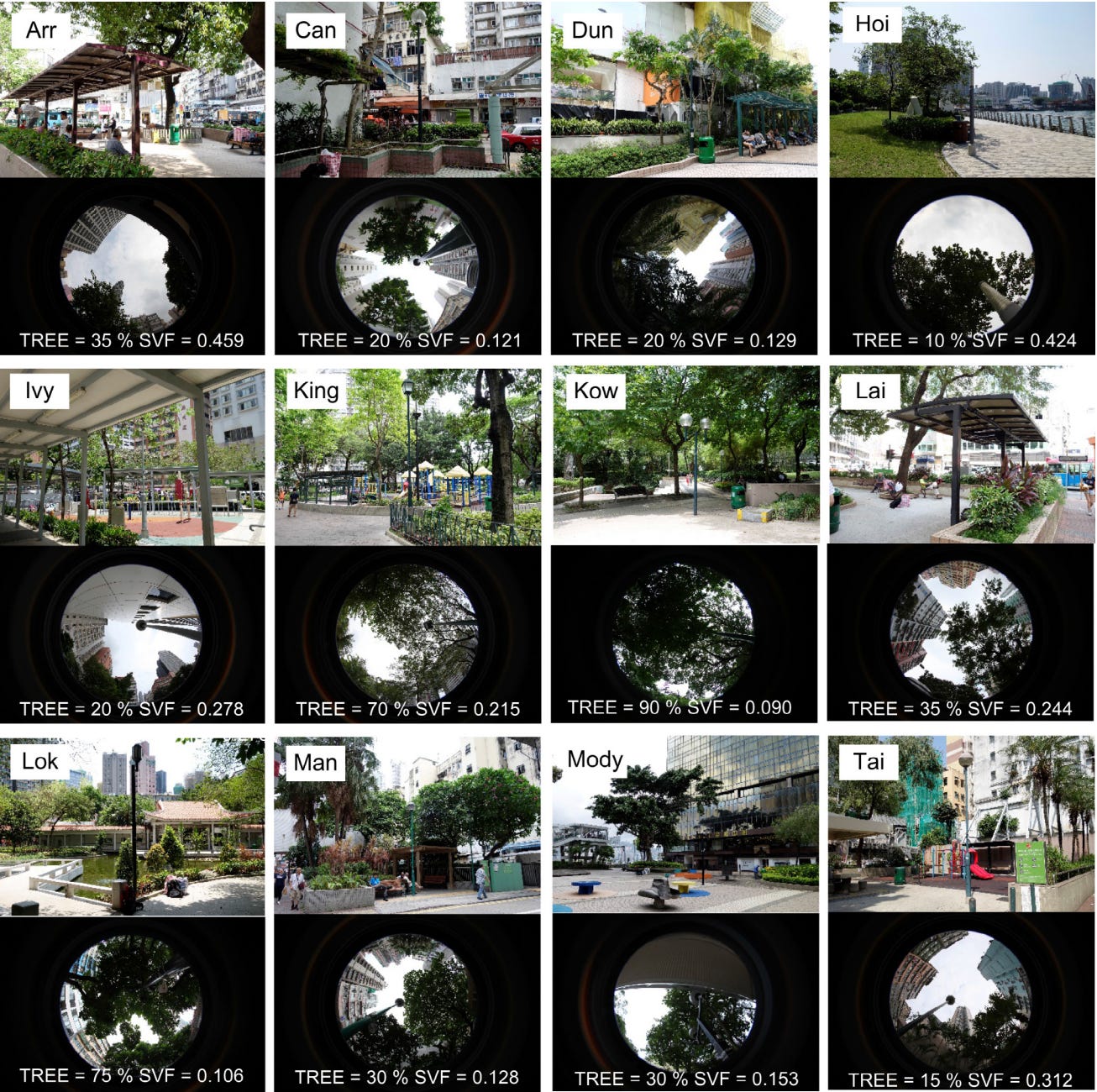
Obviously, green spaces don’t exist in isolation. They’re embedded within a three-dimensional hodge podge of buildings, streets, and other bits of infrastructure. Urban morphologists can quantify this urban morphological cacophony using building height-to-street-width ratio and sky view factor - the extent to which surrounding structures and canopies obstruct a location's view of the open sky.
High-density urban cores with tall buildings create deep “urban canyons” that generate their own shade. In these settings, building shade can combine with tree shade during peak daylight hours to significantly lower temperatures.
However, studies show that if tree canopies in narrow street canyons are too dense — particularly in humid environments — they can trap anthropogenic heat emitted by vehicle exhaust and air conditioning condenser units. They can also significantly reduce localized wind speeds. As a result, maximizing green space cooling efficiency requires aligning vegetation density and canopy architecture with prevailing wind corridors to preserve urban ventilation channels (Cheung & Jim, 2019; Morakinyo et al., 2019).
Nothing is every as easy as it seems.
BRIDGING GAPS WITH BETTER MAPS
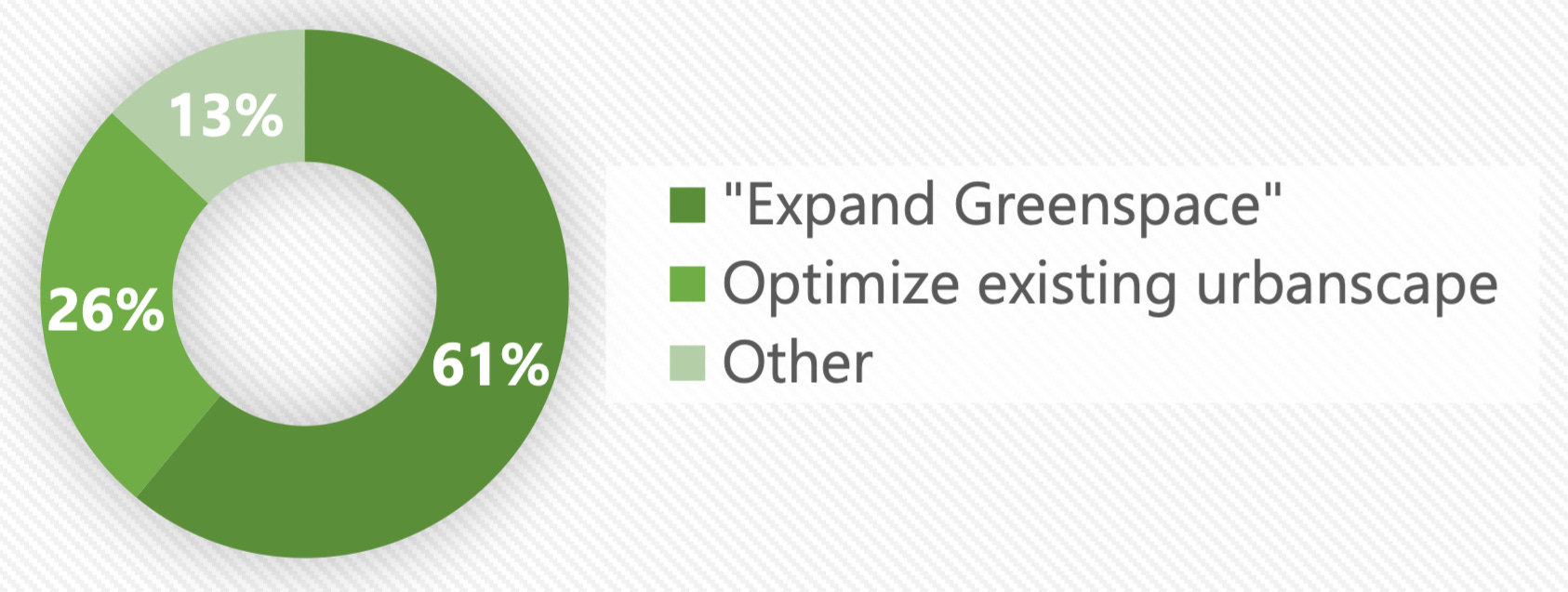
While academic literature can offer detailed insights into microclimatic processes, there remains a big gap between academia and urban planning and governmental policy. That gap may be self-fulfilling. The literature review of 84 papers revealed 61% of the papers simply advocate for expanding green space area, whereas only 26% focus on optimizing existing green infrastructure.
Recommending that dense, historical cities “add more large parks” ignores real-world urban constraints. In modern, rapidly expanding cities, urban land is expensive, highly contested, and structurally constrained. Space dedicated to a new park often competes directly with housing, transit infrastructure, or commercial development. To move beyond idealistic slogans, urban planning will have to recon with three major implementation challenges.
Challenge 1. The Water-Energy-Heat Nexus in Arid Cities
The most significant implementation challenge facing nature-based solutions occurs precisely where urban heat stress is most severe — in hot, arid regions. Cities like Phoenix, Cairo, Tehran, or Riyadh already suffer from intense summer heatwaves. You don’t have to live in or visit these places to know water there is extremely scarce.
Maintaining green spaces in places like this requires pumping groundwater or desalinating seawater. Pumping and desalinating water requires massive amounts of electricity, which only increases greenhouse gas emissions if that power is coming from fossil fuels. Furthermore, if irrigation water runs out during a heatwave, non-adapted vegetation dries out, loses its cooling capacity, and can even become a wildfire risk.
To solve this dilemma, physical geographers advocate evaluating urban greening through a standardized resource efficiency metric: evapotranspirative cooling per unit of water applied. In plain language, this ratio measures how many degrees of cooling you get for each liter (or gallon) of water that plants and soil release into the air through evaporation and transpiration.
In dry climates — where municipal water is already tightly rationed and turfgrass is increasingly discouraged but rarely banned (I’m looking at you Arizona) — urban greening strategies are going to have pivot away from high-water lawns and non-native foliage. These cities have to move from simply prioritizing or incentivizing drought-tolerant species to requiring them. While drought-tolerant plants transpire less water than many other plants and trees — and still require water — when combined with drip-irrigation using treated municipal wastewater (greywater), they can provide a pretty reliable canopy shade and even modest evaporative cooling without draining water reserves.
Challenge 2. Environmental Justice and Thermal Equity
Urban heat exposure is rarely, if ever, distributed evenly across socio-economic groups. In many cities worldwide, low-income neighborhoods exhibit significantly lower tree canopy cover, higher proportions of impervious asphalt, and higher building densities than the more affluent suburbs and ex-urbs. This imbalance leaves more vulnerable populations exposed to extreme heat hazards.
When municipalities undertake uncoordinated “regreening” projects, they risk triggering green gentrification. Installing fancy attractive parks can then inflate surrounding property values, displacing residents while still not reducing their heat related vulnerability.
To address this, requires targeted interventions like deploying small-scale, distributed interventions (think pocket parks, vegetated bus stops, and road corridors) directly in high-vulnerability, low-canopy/vegetation neighborhoods. You could focus on functional shading over high-maintenance aesthetics. This could better ensure that at least transit stops, pedestrian walkways, and playgrounds are prioritized for canopy cover. Lastly, combining situated green infrastructure with social policy could create and/or protect more affordable housing around old and new greened public corridors and spaces.
Challenge 3. A Multi-Benefit, Context-Specific Design Framework
No single cooling intervention works everywhere. Planners and policy makers need to adopt an integrated, multi-tiered approach that combines nature-based solutions with material interventions.
In arid and semi-arid environments, planners should prioritize structural canopy shading and end an over-reliance on water-intensive lawn evapotranspiration. It’s time to demand drought-tolerant trees with greywater irrigation networks, shade sails, and high-albedo “cool pavements” that can better reflect solar radiation without draining water resources.
In contrast, humid and more temperate climates would likely benefit most from maximizing green spatial connectivity. By linking existing parks through linear street-tree corridors — with select broadleaf and/or coniferous species — summer evapotranspiration can be enhanced while maintaining year-round microclimate regulation.
Finally, within high-density, built-up cores where ground space for new parks is limited, cities should leverage vertical green walls and green roofs paired with reflective building materials. But they best also preserve prevailing wind corridors while preventing nighttime heat traps through street canyons.
“Regreening” is a compelling slogan, but as physical geography demonstrates, simplistic blanket policies can yield unpredictable thermodynamic results. Simply planting trees without considering local climate, available water, species traits, spatial configuration, and urban geometry can lead to unintended consequences.
The exhaustive synthesis of decade-long research provided by Hadi Soltanifard and Majid Amani-Beni (2025) offers a clear path forward. Nature-based solutions are not off-the-shelf products that can be copy-pasted across different global cities. They are dynamic, living interventions that alter energy fluxes across urban surfaces.
By moving beyond blanket acreage targets and framing urban greening as the strategic reorganization of surface-energy relations, geographers, urban planners, and policymakers will need to work together. When we design green infrastructure that respects local environmental constraints, honors spatial equity, and optimizes microclimatic processes, urban greening moves from a vague policy promise toward tools of experimentation that can pragmatically evolve our cities and megaregions into truly climate-resilient urbanscapes.
References
Bowler, D. E., Buyung-Ali, L., Knight, T. M., & Pullin, A. S. (2010). Urban greening to cool towns and cities: A systematic review of the empirical evidence. Landscape and Urban Planning, 97(3), 147-155.
Cheung, P.K., Jim, C.Y., 2019. Differential cooling effects of landscape parameters in humid-subtropical urban parks. Landscape and Urban Planning 192, 103651.
Coutts, A.M., Tapper, N.J., Beringer, J., et al., 2013. Watering our cities: the capacity for Water Sensitive Urban Design to support urban cooling and improve human thermal comfort in the Australian context. Progress in Physical Geography 37(1), 2–28.
Eyster, H. N., & Beckage, B. (2022). Conifers may ameliorate urban heat waves better than broadleaf trees: Evidence from Vancouver, Canada. Atmosphere, 13(5), 830.
Eyster, H. N., & Beckage, B. (2023). Arboreal urban cooling is driven by leaf area index, leaf boundary layer resistance, and dry leaf mass per leaf area: Evidence from a system dynamics model. Atmosphere, 14(3), 552.
Lee, H., Mayer, H., & Chen, L. (2016). Contribution of trees and grasslands to the mitigation of human heat stress in a residential district of Freiburg, Southwest Germany. Landscape and Urban Planning 148:37–50.
Lemoine-Rodríguez, R., Inostroza, L., Falfán, I., & MacGregor-Fors, I. (2022). Too hot to handle? On the cooling capacity of urban green spaces in a Neotropical Mexican city. Urban Forestry & Urban Greening, 74, 127633.
Masoudi, M., Tan, P.Y., 2019. Multi-year comparison of the effects of spatial pattern of urban green spaces on urban land surface temperature. Landscape and Urban Planning. 184, 44–58.
Masoudi, M., Tan, P.Y., Fadaei, M., 2021. The effects of land use on spatial pattern of urban green spaces and their cooling ability. Urban. Clim 35, 100743.
Masoudi, M., Tan, P.Y., Liew, S.C., 2019. Multi-city comparison of the relationships between spatial pattern and cooling effect of urban green spaces in four major Asian cities. Ecol. Indic 98, 200–213.
Morakinyo, T.E., Ouyang, W., Lau, K.-K.-L., et al., 2020. Right tree, right place (urban canyon): Tree species selection approach for optimum urban heat mitigation-development and evaluation. Sci. Total. Environ 719, 137461.
Pramanik, M. (2019). Impacts of urban expansion on land surface temperature and urban heat island in Kolkata Municipal Corporation, India. Environmental Monitoring and Assessment, 191(12), 738.
Santamouris, M. (2014). Cooling the cities—a review of reflective and green roof mitigation technologies to fight heat island and improve comfort in urban environments. Solar Energy, 103, 682-703.
Schlaerth, Hannah L., et al. "Albedo as a competing warming effect of urban greening." Journal of Geophysical Research: Atmospheres 128.24 (2023): e2023JD038764.
Soltanifard, H., & Amani-Beni, M. (2025). The cooling effect of urban green spaces as nature-based solutions for mitigating urban heat: Insights from a decade-long systematic review. Climate Risk Management, 49, 100731.
Ziter, C. D., Pedersen, E. J., Kucharik, C. J., & Turner, M. G. (2019). Scale-dependent interactions between tree canopy cover and impervious surfaces reduce daytime urban heat. Proceedings of the National Academy of Sciences (PNAS), 116(15), 7575-7580.


