

Hello Interactors,
It’s been a while. Traveling for family, and a bit flooded by the relentless sneaker waves of unsavory world events — the kind that usually inspire me to write but lately threaten to pull me under.
Spring in the northern hemisphere means Interplace turns to geographic information science and spatial analysis. How might we look at the complex unfolding of world events through this lens — and what happens when we push it further than emergence alone can carry it? That’s what I attempt to explore here.
PATTERNS PRECEDING PHYSICAL PLACES
Geographic information science is a relatively recent field. It emerged from mid-20th-century cartography and land-use planning. Computer cartography and quantitative geography of the 1960s is often considered the first true digital Geographic Information Systems (GIS). It became a science (GIScience or GISc) in the late 1980s and early 1990s when Michael Goodchild questioned if there was a genuine scientific discipline lurking within the software.
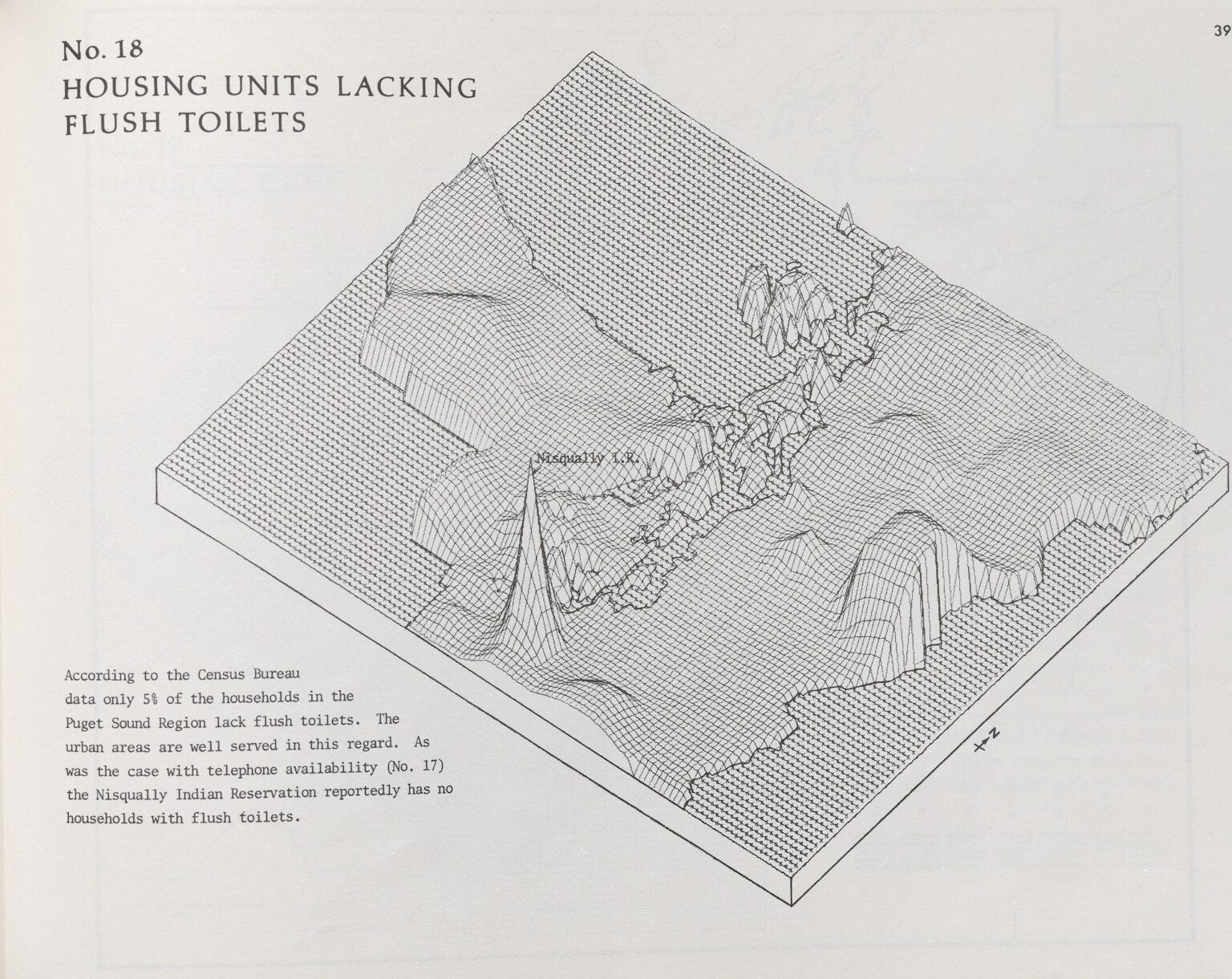
His answer was yes. He built an institutional home for that argument at the National Center for Geographic Information and Analysis at the University of California, Santa Barbara, my alma mater. Goodchild was my senior advisor in 1989 as UCSB was becoming a generative intellectual hub in the field. UCSB’s geography department continues to push the question of what space means analytically, not just how to map it. I’m personally invested in better understanding how GISc may be a natural partner for complexity science, a field I’ve been attracted to since I started researching and writing.
This partnership isn’t new. GISc provides a powerful framework for dissecting the spatial dimensions of complexity, where systems defy reductionist analysis and emerge through nonlinear interactions. In the early 2000s, geographer David O’Sullivan, and others, articulated this as the study of
“the behaviour of macroscopic collections of many basic but interacting units endowed with the potential to evolve in time”
emphasizing these characteristic elements of complexity science: self-organization, path dependence, and the irreducibility of wholes to their parts. Around the same time, sociologist John Urry (and others) extended this to global scales, portraying globalization as co-evolving systems marked by unpredictability, irreversibility, and positive feedback loops that amplify disorder within pockets of order.
These parings are a good start, but computational biologist Michael Levin offers what can be seen as a genuinely unsettling upgrade. His recent work on the origin of cognitive and morphological patterns suggests the dominant appeal to emergence as an explanatory endpoint may itself be, in his words, a “mysterian” position — one that “does not facilitate further advances.” When a surprising pattern appears in a complex system, the emergentist says “that’s just what happens” and catalogs it.
But Levin proposes these patterns are not random facts to be noted and admired. They are part of an ordered, non-physical space that physical systems, when configured the right way, ingress into. Ingression is a term Levin borrows from mathematician Alfred North Whitehead as a potential that timeless abstract objects possess to become actual concrete experiences. “Red” only becomes red when its potential is realized.
These ‘ordered spaces’ of potential are portals into what Levin calls a Platonic Space. Plato argued that the objects we encounter in the world are imperfect instances of perfect, eternal Forms that exist independently of any physical thing. The most primitive form being the triangle. Levin’s argument is the triangle participates in a kind of Triangleness; it realizes it’s potential to exist.
Nature keeps arriving at triangles independently, across wildly different substrates, as if drawn by the same attractor. The triangle is the only polygon that is inherently rigid: push on any corner and the shape holds, which is why trusses, bridges, and bones all rely on triangular geometry for structural strength. Radiolarians, single-celled ocean organisms with no brain and no blueprint, construct intricate skeletal lattices of triangulated geometry at microscopic scales.
In Levin’s terms, nature is ingressing Triangleness — repeatedly, across billions of years and countless lineages — because the Form has properties that reward any physical system stable enough to express it. The truth that a triangle’s angles sum to exactly 180 degrees owed nothing to the first organism that built one.
Physical systems are, in this sense, less like containers and more like pointers — a term borrowed from computer science. Pointers are variables that hold the addresses that reference more information. Levin’s framework requires a specific kind of pointer: not a pointer to stored data, which retrieves a static value, but a pointer to a subroutine that calls up a routine that executes complex actions and outputs beyond the pointer itself. The pointer is small, while the executed routine may be vast and behave unpredictably.
Think of a street address. The address itself contains nothing — it is a short string of numbers and words that fits on an envelope — but hand it to the right system and it retrieves a house, a history, a neighborhood, everything that has ever happened inside those walls. This is Levin’s claim about physical structures. A genome, a city, an institution doesn’t contain its pattern so much as it points at one — and when the pointer is well-formed, you get considerably more out than you put in.
What does this mean for GISc? It means that spatial configurations — cities, borders, trade corridors, migration routes — are not merely sites where local interactions produce global outcomes. They are interfaces into a latent pattern space. When a hub city emerges, when a colonial border persists for centuries past the empire that drew it, when a pandemic spreads exactly along the topology of air travel, we are not only witnessing the consequential mechanical emergence of patterns derived from local rules. We are watching physical structures act as pointers that summon — ingress — specific patterns of collective behavior, whose full complexity exceeds what was put in. Levin’s core observation about biological morphogenesis translates here with uncomfortable precision.
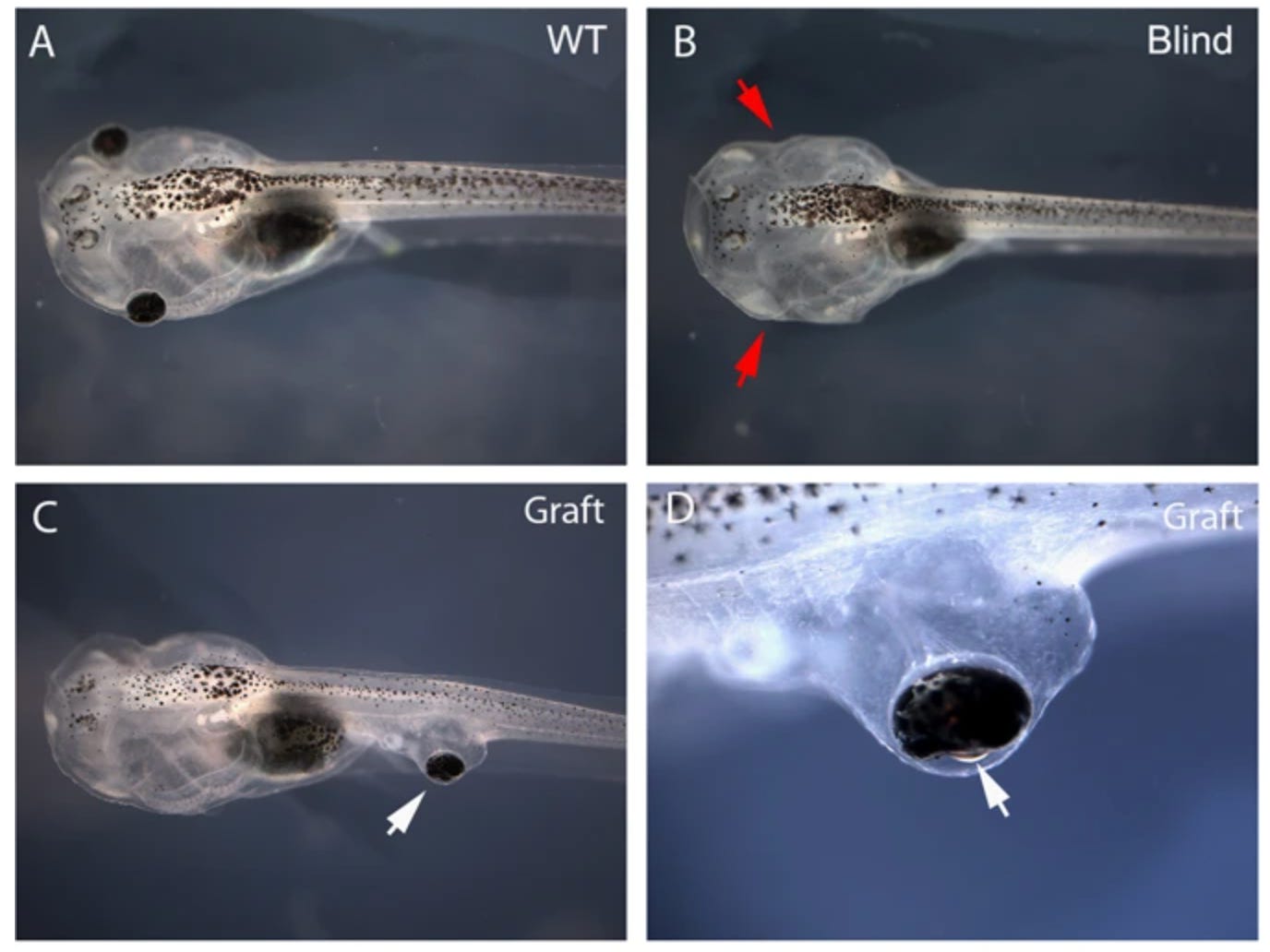
Consider one of his more unsettling tadpole experiments. The creation of its normal bulging eyes are suppressed (by microscopically manipulating cellular ‘software’) and a replacement eye is instead induced — ingressed — on the tail. The optic nerve growing from that tail-eye doesn’t connect to the brain — it terminates somewhere around the spinal cord. By any conventional account, the animal should be blind. It isn’t. The tadpoles can still see and perform well in visual tasks. Somehow, the system routes around its own abnormal wiring to recover function. The pattern being pointed to — sight — was never housed in the eye itself, or in the specific neural pathway, or in any single component. The eye on the tail is a wildly improbable pointer, and yet it retrieves something far richer than its own structure contains. You get considerably more out than you put in.
Some GISc tools — like agent-based models or network analysis — already detect this excess in a geography context. A single infected traveler tips a system toward chaos not because of arithmetic addition of local interactions described in the GISc analysis, but because that traveler’s position in a network acts as an interface to a pattern of contagion whose scope was latent in the structure all along. The “geographic advantage” O’Sullivan, and crew, describes — GISc’s relationship to multi-scalar processes and human-environment couplings — is, in Levin’s vocabulary, a sensitivity to how physical arrangements act as pointers into a rich space of possible collective behaviors.
This reframes world events not as linear narratives but as navigations of morphospace — the full landscape of forms a system could take, where some configurations are reachable and others are not, and where attractors pull trajectories toward specific patterns regardless of starting conditions.
What pattern are current geopolitical configurations pointing toward? What is being ingressed by the particular architecture of today’s global institutions, communication networks, and urban densities? While GIScience sharpens our sight on outcomes, it leaves uncharted the deeper question of what is the shape of the latent space these material forms slip into.
BORDERS STORE WHAT BODIES KNOW
Levin’s work suggests at every scale of organization, we are dealing not with mechanical aggregation but with collective intelligence. To understand what he means by that, it helps to borrow an image from Einstein.
Because nothing travels faster than light, any event you could possibly influence — or that could possibly influence you — is bounded by how far light could travel in the available time. Draw that boundary in spacetime and it forms a cone. Everything inside it is causally reachable, everything outside it is not. Levin borrows this image to describe the reach of any cognitive agent. A single cell’s light cone is tiny — it can only sense and respond within its immediate chemical neighborhood, over milliseconds. A brain’s light cone is vastly larger — it can model consequences years out and coordinate behavior across great distances. The cone is simply a measure of how far an agent’s agency actually extends. And just as the body is a nested hierarchy of such agents — molecular networks, cells, tissues, organs — each operating within its own cone, pursuing goals whose scale its parts cannot perceive, so too is human society.
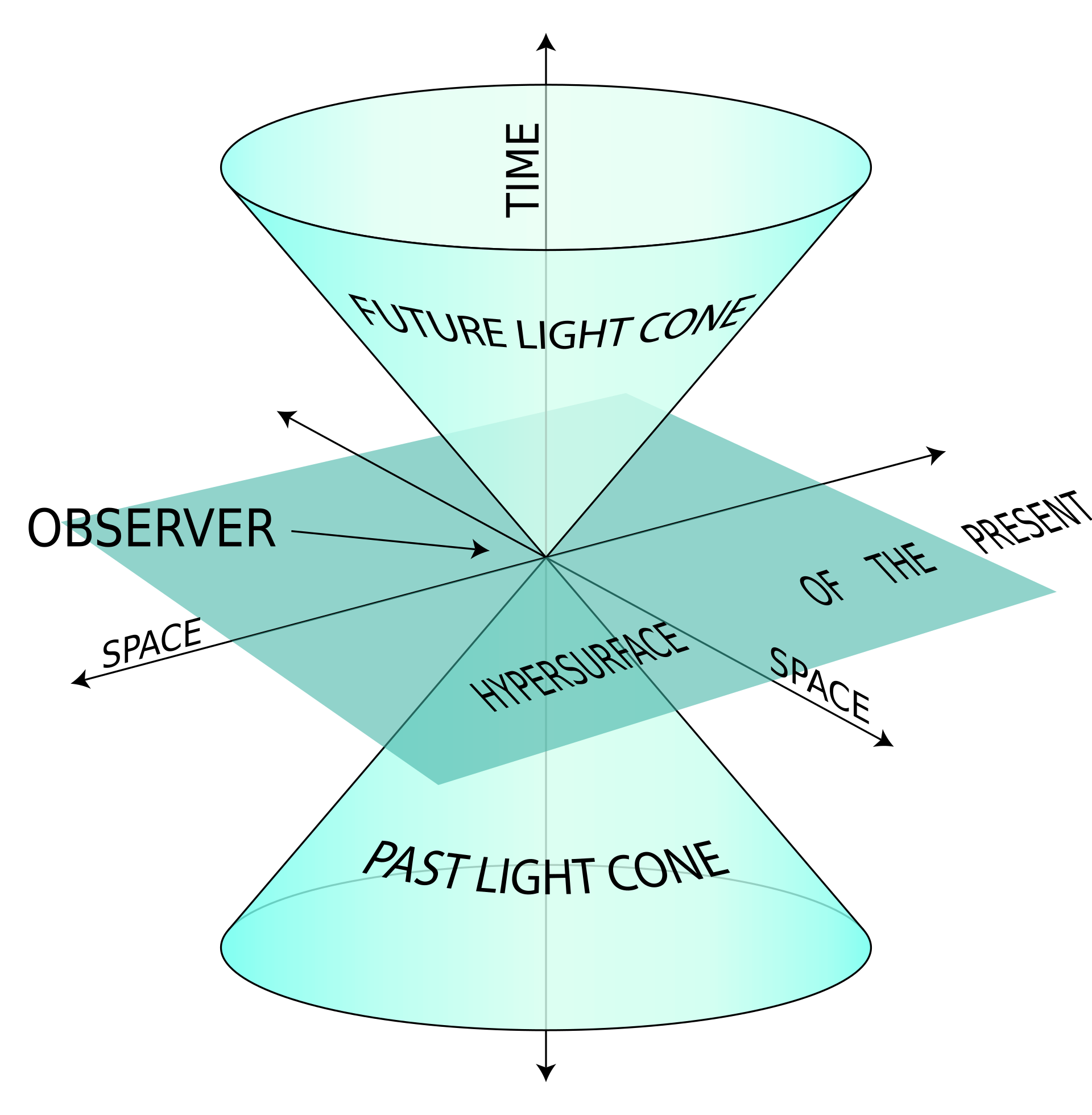
A city is not simply a dense clustering of individuals whose local interactions produce urban dynamics. It is, in Levin’s sense, a collective intelligence with a cognitive light cone that vastly exceeds that of any constituent. It pursues goals (economic growth, defense, habitability) across spatial and temporal horizons no individual cell — or individual person — can access. Institutions, legal codes, infrastructure, and cultural norms function as bioelectric memory — rewritable pattern memories that store the target morphology of the social body and guide error-correction toward it. Colonial borders, or the Great Wall of China, persist not merely through inertia but because they function like historic bioelectric setpoints. That is, they encode a spatial pattern that downstream processes continuously re-instantiate, even after the circumstances that produced them have dissolved.
Levin’s planarian flatworm experiments demonstrate this in biology. When bioelectric circuits are disrupted, the worm grows heads of other species — without any change to its genome. The pattern being expressed was latent in the space of possible forms, and a change in the interface (the bioelectric circuit) changed which pattern was ingressed. Geopolitical history offers analogies. How much of what we call a nation-state’s “character” is not in its people but in the pattern stored in its institutional circuitry? When those circuits are disrupted — by revolution, invasion, or collapse — new patterns rush in from the adjacent possible, sometimes from regions of the latent space that are recognizable, sometimes shockingly novel.
Pandemics also embody this scalar nesting. Viral replication is a molecular-scale process; its spread is topologically determined by the network of global mobility; its political consequences are mediated by institutional pattern memories about sovereignty, solidarity, and resource allocation. The COVID-19 pandemic did not merely “emerge” — it ingressed a set of patterns whose latency was already encoded in the physical architecture of 21st-century globalization. Competitive resource hoarding and cooperative vaccine-sharing were not just policy choices but different attractors in a landscape of a kind of “social morphospace”, pulling collective behavior toward different setpoints.
GISc tools (like spatial game theory and network percolation models) map the surface of these landscapes. But Levin’s framework asks us to go further. He wants us to not just map the attractors, but to ask what structured space those attractors are features of, and whether that space can be systematically explored.
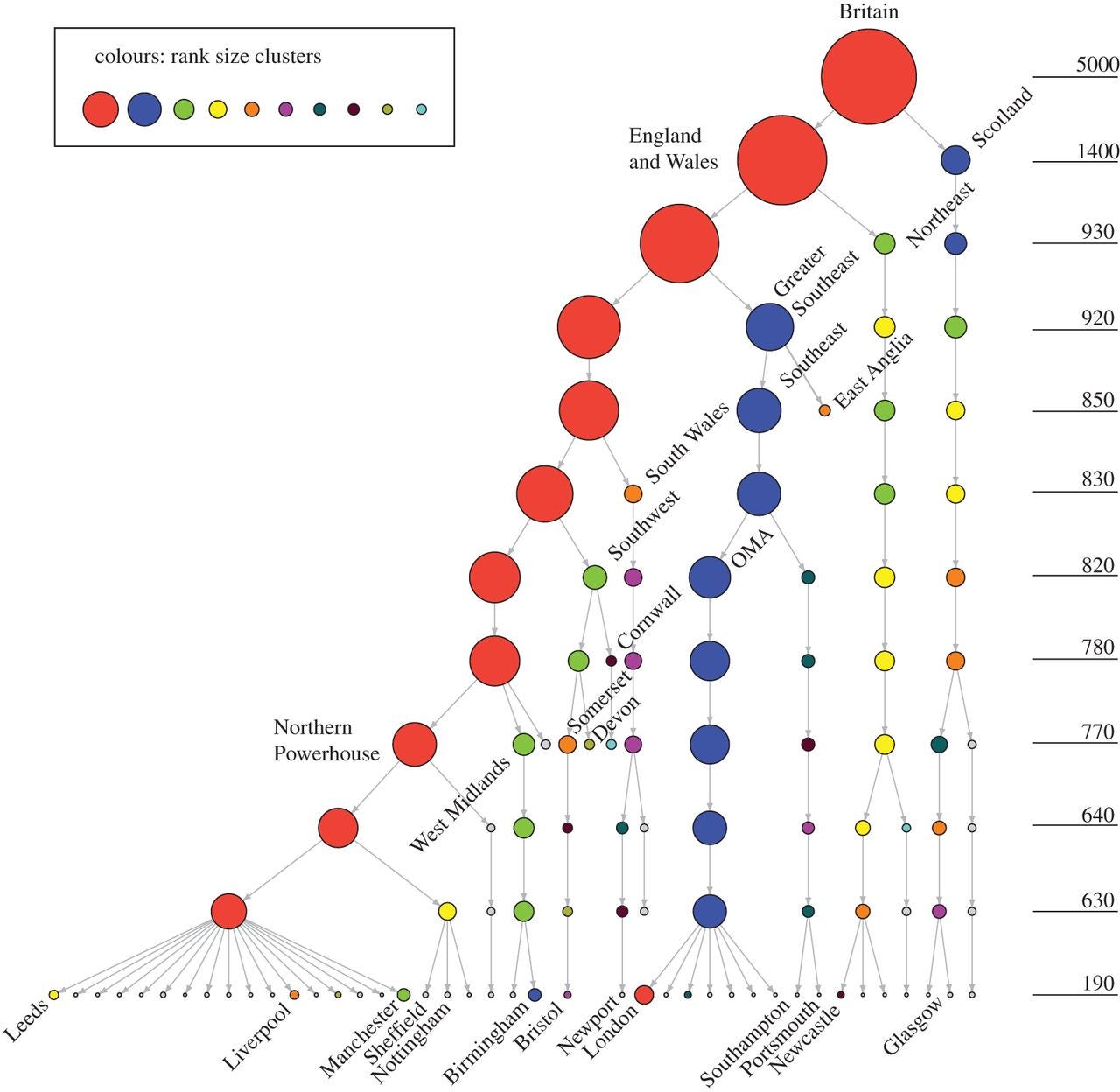
The scalar interplay extends outward. Local ethnic tensions, mapped via GIS hot-spot analysis, interact with what social theorist Zygmunt Bauman might term “global fluids” — arms, money, diasporas — to produce cascades that reflect not random chaos but path-dependent trajectories through a space of historical patterns. History’s “nightmare on the brain of the living” becomes, in Levin’s terms, a pattern-memory etched into the social substrate. Territorial borders, attempted genocide, human displacement are held as bioelectric setpoints, where trauma lingers as a morphogenetic field, quietly organizing the tissue of the present long after the original wound.
MAPPING WHAT MATTER MERELY MISSES
Complexity science, via GISc, forecasts world events as probabilistic landscapes rather than deterministic paths. Urry describes global systems as “adapting and co-evolving,” with attractors drawing trajectories amid chaos. GISc simulates this through fitness landscapes like agents navigate peaks and valleys of viability, local adaptations generating global patterns like economic booms or institutional collapses.
Levin’s framework intensifies this picture in two ways. First, it insists that the attractors are not randomly distributed. The latent space of possible social patterns — like the latent space of morphogenetic outcomes — has structure. Evolution, as Levin argues, progresses rapidly precisely because the space has “a relatively smooth character” in which “past interactions with it carry non-trivial information about the adjacent possible.” The same may be true of cultural and institutional evolution. The reason certain forms of governance, urbanism, or economic organization recur across independent civilizations is not purely because of convergent environmental pressures, but because they represent attractors in a structured space of collective intelligence patterns that sufficiently complex social interfaces tend to ingress.
Second, and more provocatively, Levin’s framework suggests that we do not simply make the social forms we inhabit. We invite patterns to temporarily inhabit our collective embodiments. To see why, consider one of his most uncontroversial and disarming experiments. Levin’s lab studied simple sorting algorithms — the kind computer science students have used for decades. These are short deterministic procedures that take a jumbled list of numbers and rearrange them into sequential order. Nothing mysterious here but made for many an interview question at Microsoft!
When Levin’s team visualized the algorithm’s progress as a movement through an abstract sorting space, unexpected behaviors emerged that nobody had noticed in all those decades of use. When the algorithm encountered a number that refused to move — a piece of broken data blocking its path — it didn’t simply halt. It temporarily de-sorted the rest of the array, moved things around the obstruction, and then recovered its progress. It was exhibiting something resembling delayed gratification — the capacity to temporarily move away from a goal in order to reach it more completely later. Like a soccer player kicking the ball backwards to advance it forward.
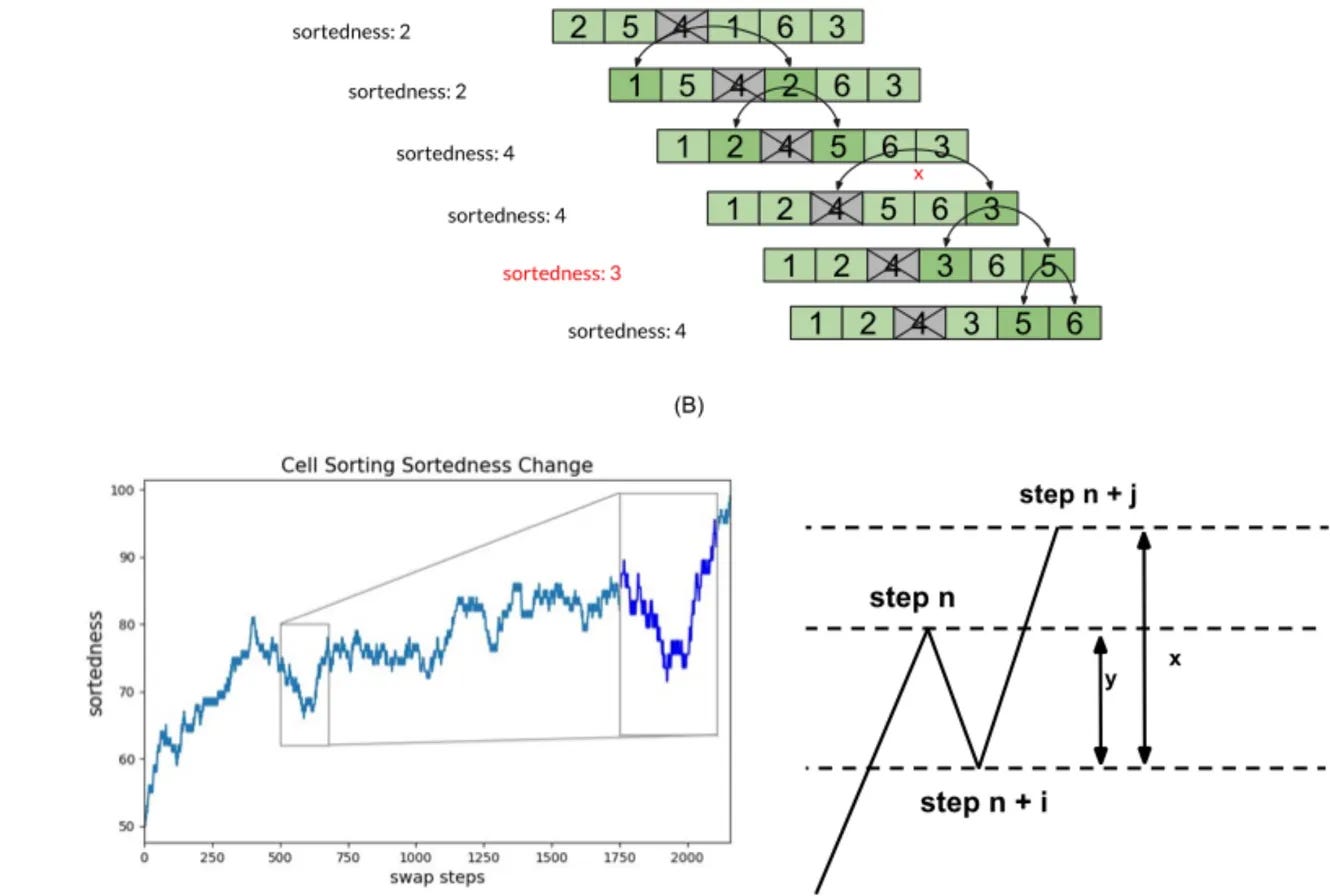
This ability was not written into the algorithm. Nobody put it there. Then, when the team ran a distributed version where each number ran its own variant of the algorithm, numbers sharing the same variant spontaneously clustered together — a kind of social behavior, emerging without a single line of code instructing any number to notice or prefer its own kind. The algorithm was doing something it was never designed to do, and had been doing it, unobserved, for decades.
Now, imagine a democracy is not constructed from scratch by rational agents but an interface that, when configured appropriately, ingresses a pattern of distributed decision-making whose properties exceed what any designer or participant imagined or specified. Cities, constitutions, and international institutions become pointers. The patterns they summon may even surprise their architects — and may have been quietly surprising them and us all along.
This has immediate consequences for how GISc could approach attempts at predicting futures. For example, prospective spatial modeling — Markov chains, scenario planning — maps the probability surface of possible trajectories. But a Levin-inflected GISc would ask this: what new pointers are being constructed right now, and what regions of the latent pattern space are they configured to access?
The answers could become bewildering in a world of AI-mediated governance, hybrid human-machine urban systems, and the synthetic biological constructions Levin’s team pursues. These are vehicles of exploration into regions of Platonic space we have not navigated before. “We are now fishing in regions of Platonic space we have never explored before,” he writes — with implications not only practical (”what will it do to us”) but ethical (”how do we fulfill the opportunities and duties of an ethical synthbiosis with beings who are not quite like us”).
For GISc, this need not be merely philosophical. Spatial planning and governance literally configure the physical interfaces through which collective intelligence patterns are ingressed. Urban density fosters certain attractors of solidarity and innovation while sprawl ingresses different ones. Green civic infrastructure designed to buffer floods mechanically also reconfigures the relationship between human settlement and ecological pattern space which invites a whole different class of emergent resilience. The question is no longer only “what will happen here, probabilistically” but “what are we building a pointer toward?”
Fatalists may see the latent space as already barring our options. Pessimists will amplify the risks of novel pointers we cannot control. Realists might attempt to quantify via more Monte Carlo simulations. And techo-optimists may try to engineer and configure interfaces to access and profit from whatever attractors emerge. But what I like most of all about Levin’s framework is that it offers something more nuanced than any of these: structured humility. We do not know the full topology of the space we are pointing into. Every new city, every new institution, every new technological architecture is, in some sense, a bioengineering experiment — and like Levin’s Xenobots and Anthrobots, it may manifest competencies and patterns nobody designed or predicted.
If Levin’s intuition is correct, we are but temporary self-organizing forms that hold together for a time, perform actions that exceed their physical composition, and then yield to the impermanence built into any pointer’s relationship with the patterns it accesses. Humility does feel like the appropriate response. But more importantly, the recognition that mapping the structure of the space we are ingressing into is, at this moment, among the most important things we could do.
The information embedded in Geographic Information Science has the potential to demystify fatalism, especially when death’s certainty yields to spatial agency. Levin reminds us that information, at its Latin root, means to give form — to in-form. That is what geographic information has always done, long before it became a science. It did not merely transmit data, but impose structure on space, render the implicit geometry of human existence legible and actionable. Every map is an act of in-forming. The world is no doomsday script, but a co-evolving field — its attractors mappable, its interfaces legible, its vectors steerable — if we aim with care, with intent, and with the humility to know what we summon may exceed what we design.
REFERENCES
Levin, M. (2025). Ingressing minds: Causal patterns beyond genetics and environment in natural, synthetic, and hybrid embodiments. PsyArXiv.
O’Sullivan, D., Manson, S. M., Messina, J. P., & Crawford, T. W. (2006). Space, place, and complexity science. Environment and Planning A: Economy and Space.
Urry, J. (2003). Global complexity. Polity Press.


