

Hello Interactors,
We like to think we choose our own paths, but our cities have already decided for us. New York and Los Angeles function as the extended phenotype of our species — a living circulatory system that subtly channels our collective behavior. This week, we explore the multi-generational biology of transit to see how modern infrastructure effectively dissolves what we perceive as individual autonomy.
MANHATTAN MOBILITY AND THE MASSED MILIEU
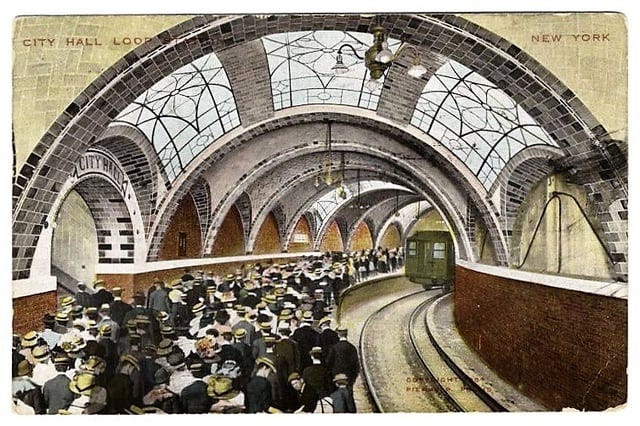
I recently flew from New York visiting my daughter, where large vessels moved massive numbers of people around, to Los Angeles visiting my son, where small vessels moved small numbers of people around. The transition was jarring. I went from being physically enmeshed in a dense social milieu to being systematically protected from it — from walking over 10,000 steps a day to barely 1,000. My daily cadence shifted from bobbing and weaving around persons I could see, hear, and smell, to maneuvering around what sociologist Mike Michael termed ‘carsons’ — persons fused with a car.1
This deep-seated desire for individual control over our own mobility is not unique to the modern driver. The instinct to leverage an external entity to conquer long distances is as old as the domestication of the horse in the third millennium BCE. Every stage of human life presents a shifting horizon of mobile autonomy: from crawling to walking, to the childhood triumph of mastering a bicycle or a local bus network, to the initial rush of freedom that comes with a first car. All before the natural declines of aging ultimately diminish our autonomy once more.
Yet, suggesting mass transit to many Americans accustomed to the perceived agency of the car feels like a threat to their very freedom. Because transit routes are fixed and schedules are unyielding, collective travel is often mischaracterized as an artificial restriction on liberty. History shows that long before the locomotive, scheduled, multi-passenger transit enabled human freedom and societal cohesion where individual movement was risky or impossible. Across Eastern Polynesia, the Caribbean, and northern Eurasia, multi-passenger canoes were the lifeblood of trade and travel. In southern California, the Chumash and Tongva communities developed advanced sewn-plank canoes called tomols and ti’ats, which facilitated complex political economies between the Channel Islands and the mainland.2 This reliance on collective vehicles extended beyond coastal waterways. Human networks also depended on highly organized, shared transport to conquer distance across vast terrestrial and inland landscapes.
Centuries before Western cities built public transit, imperial China constructed the Grand Canal, a two-thousand-kilometer artificial waterway that operated as a continental transit artery during the Sui Dynasty. This facilitated the regular movement of millions of passengers and state resources between agricultural basins and northern metropolises. On land, Tokugawa-era Japan structured its empire around the Tōkaidō, a highly regulated highway system where travelers moved rhythmically between post stations using a coordinated network of horse relays and official permits.
Eastern aquatic and terrestrial networks achieved continental scale, replicated on Europe’s rugged overland trails. Public multi-passenger carriage service began in Paris in 1662 with the world's first urban transit system. In colonial America, occasional stagecoaches linked Boston and New York starting around 1735, with regular schedules emerging in the 1740s. By the late 1820s, fixed-route horse-buses (omnibuses) appeared in Paris (1828) and New York City (1827).
When urban populations exploded in mid 1800s, these street-level collective networks buckled under their own weight. It triggered unprecedented structural crises. By the late 19th century, New York City was drowning in a public health emergency born of its own transit power. Imagine over 150,000 working horses blanketing the streets. Now imagine thousands of tons of manure and urine daily. When a horse influenza epidemic paralyzed the city overnight in 1872, New Yorkers realized they could no longer rely on street-level animal power. The city initially looked upward and built coal-fired elevated railroads — the “Els” — on massive iron trestles. While these steam engines bypassed street traffic and allowed Manhattan to expand northward, they rained hot ash onto pedestrians, blocked natural light, and shattered the urban peace with deafening noise.
True structural relief required going underground. Early pneumatic experiments, like Alfred Ely Beach's secret, air-driven tunnel in 1870, remained short-lived novelties due to political opposition and mechanical limitations (only 300 feet long, single-car shuttle). The project closed in 1873. The breakthrough for electric rail came in 1890 with the City & South London Railway in London, the first railway to use third rail electrification. The third rail — an additional, continuous steel rail running alongside the tracks that carries electricity to train cars — became the standard for underground and metro systems from around 1900.
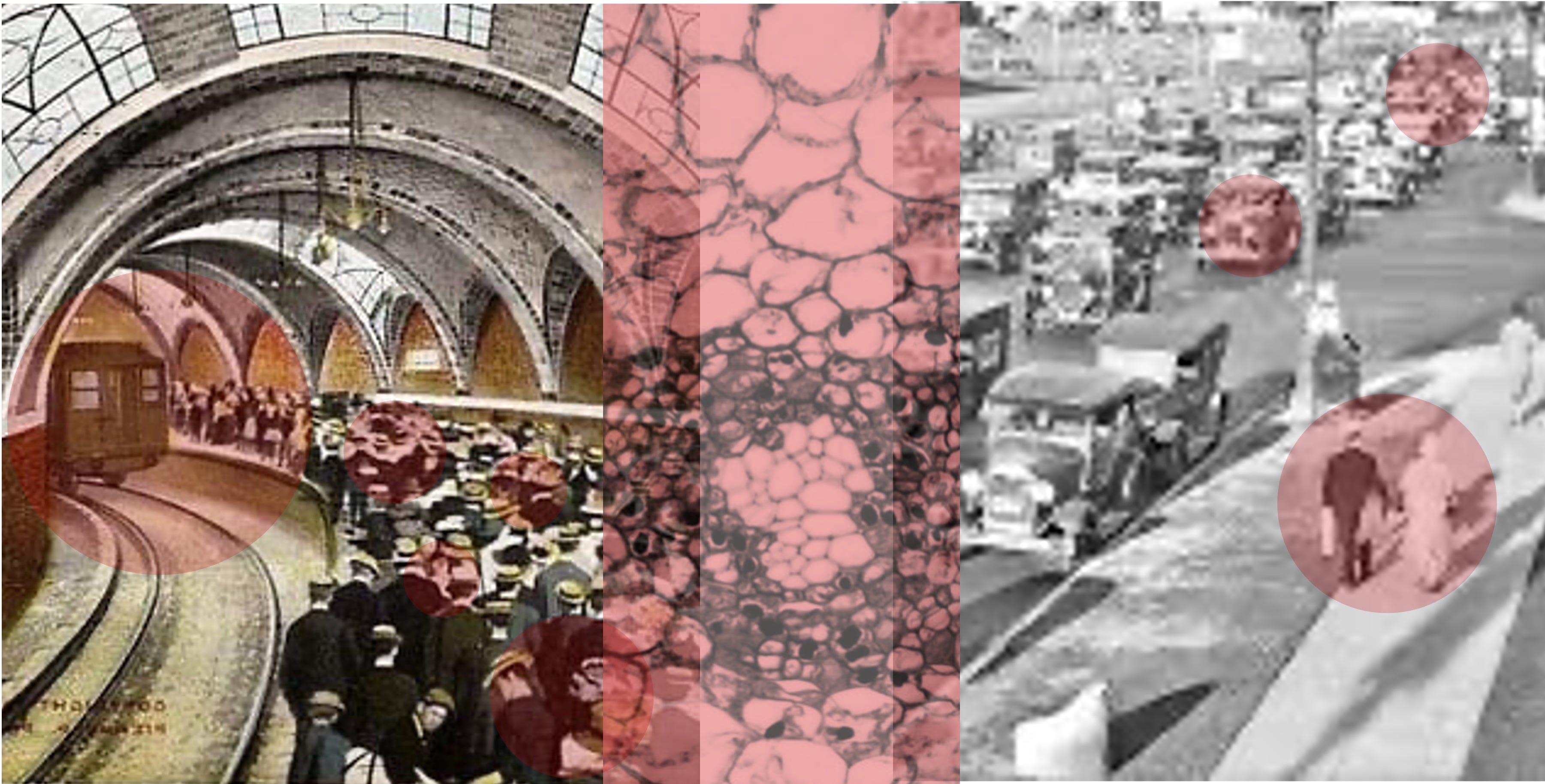
October 27, 1904, the Interborough Rapid Transit Company opened its first official subway line from City Hall to Harlem. This permanently compressed densely housed humanity into a swift, subterranean network, channeling the city’s chaos beneath the cobblestones.
COASTAL CARRIAGES AND THE CYCLEWAY
While New York dug into the earth to consolidate its density, a parallel but radically different evolution was unfolding across the wide horizon of the Los Angeles basin. Between the 1820s and 1904, Los Angeles transformed from an isolated Mexican pueblo (population ~650) into a sprawling metropolis (population 100,000+). Here surface transit was not just responding to growth, but was actively engineering it. After bridging the distance to its seaport via the San Pedro Railroad in 1869 and connecting to the transcontinental rail network via Southern Pacific in 1876, the city experienced the Southern California real estate boom of the 1880s (1884-1887), which required vast spatial integration. The 1885 completion of the Santa Fe Railroad's direct line to Chicago triggered a development boom that dwarfed the earlier one, transforming the region.
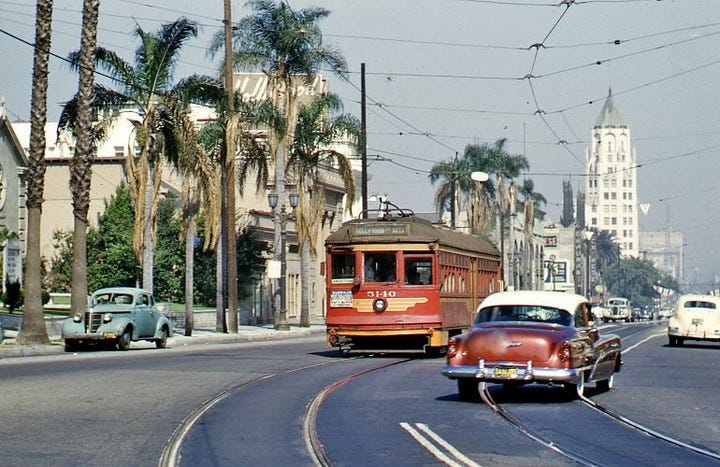
Rather than stacking millions of people into a vertical core, transit magnates like Moses Sherman and Henry Huntington realized that electric surface rail could be weaponized as a tool for land speculation. They built lines out into empty fields, bought up the surrounding acreage, and subdivided it into suburban tracts for commuting workers. A similar strategy played out in Chicago. Founded in 1901, Huntington's Pacific Electric 'Red Cars' rapidly expanded, opening its first interurban line to Long Beach on July 4, 1902.
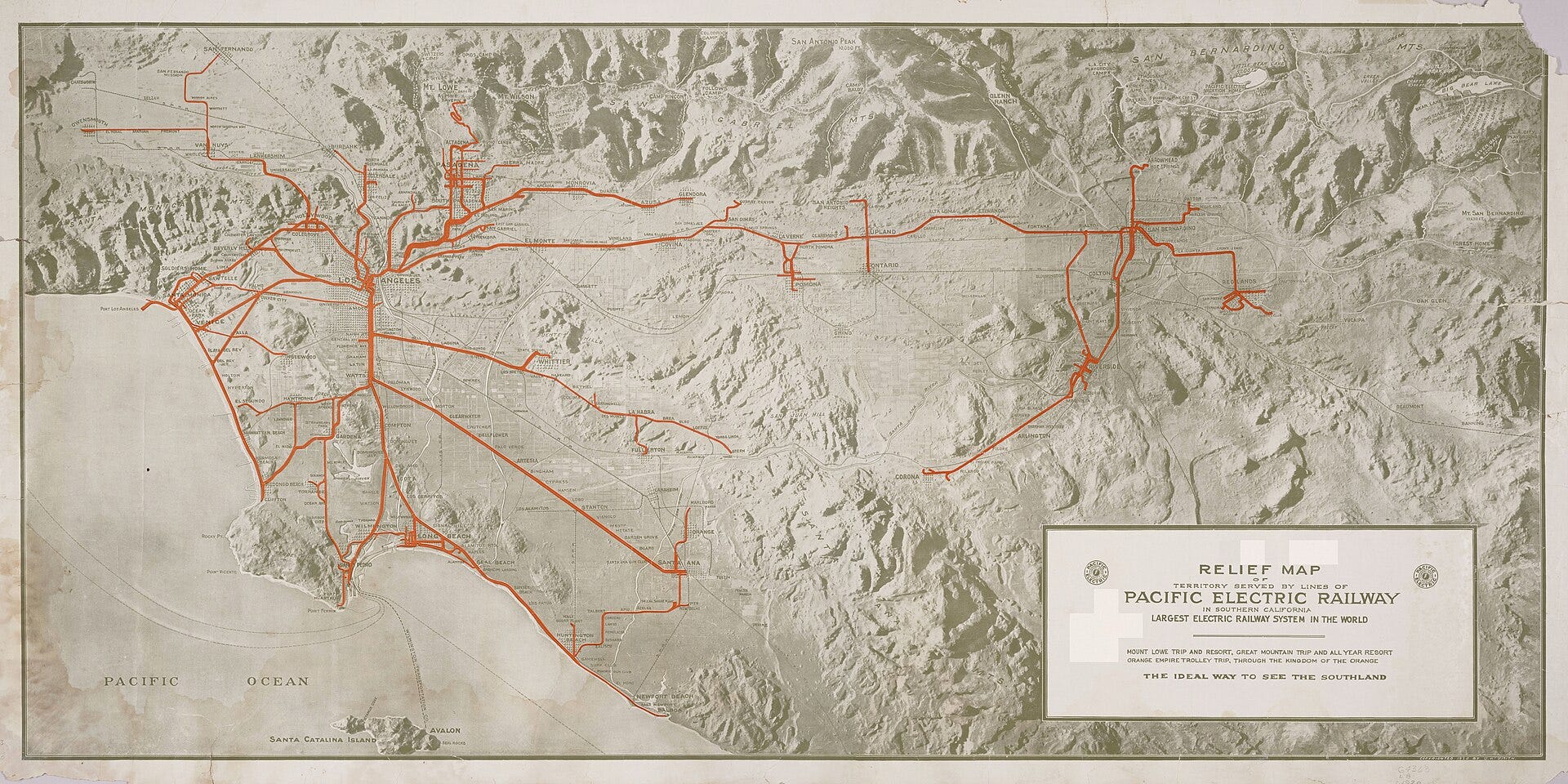
At its peak in the 1920s, the Pacific Electric system became the largest electric railway system in the world, with over 1,000 miles of track connecting dozens of isolated towns across Los Angeles, Orange, Riverside, and San Bernardino Counties, stitching together hundreds of square miles. By scattering its population across a massive geographic basin, this surface network wrote the genetic code for LA’s modern identity. This decentralized layout was perfectly primed to swap the shared space of the streetcar for the individualized isolation of the highway just a generation later.
Yet, beneath both the subway tunnels of Manhattan and the streetcar tracks of Los Angeles lies a forgotten foundation engineered by an entirely different mode of transit. As Carlton Reid uncovers in Roads Were Not Built for Cars, our modern road networks were not designed for the automobile but were hard-won by late-nineteenth-century cyclists. For the moneyed elite who could afford the “safety bicycle” — the high-tech, liberating consumer gadget of the 1880s and 1890s — the machine offered an unprecedented leap in individual autonomy. Disgusted by muddy, horse-fouled, and rutted roads, these cyclists organized under the League of American Wheelmen, launching a powerful “Good Roads” movement that pioneered the smooth, paved macadam surfaces that motorists would later inherit and monopolize.
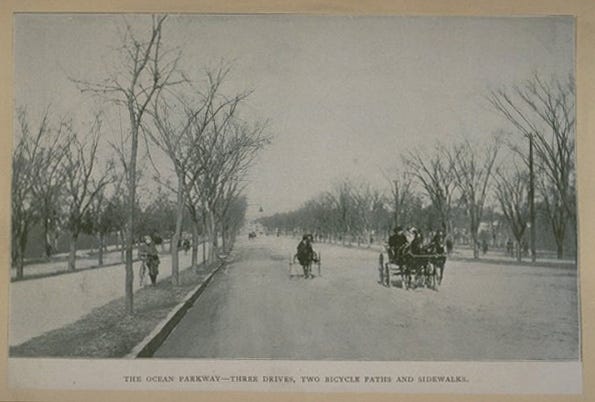
While New York carved out its first dedicated bike path in 1894, when civic pressure led to the opening of the nation's first separated bike path along Brooklyn's Ocean Parkway, wealthy urbanites could now cycle down to Coney Island detached from chaotic street traffic. The parkway became NYC's first dedicated bicycle path and the first in the United States, described as the oldest bike path in the world by Guinness World Records.
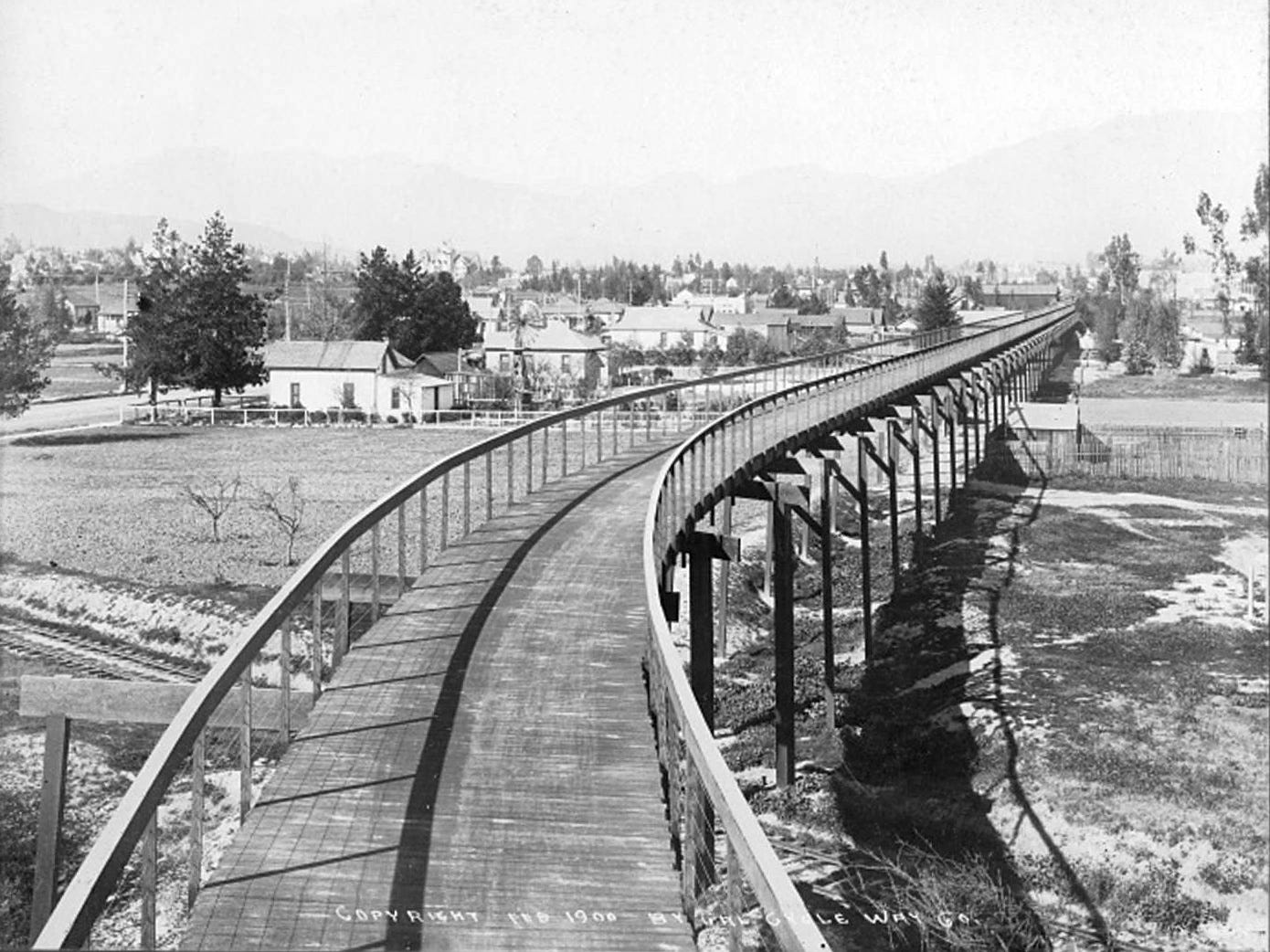
Simultaneously, the early elite of Pasadena and LA used the bicycle to weave together their sprawling territory. This culminated in 1900 with the opening of the California Cycleway — a spectacular, approximately 1.3-mile elevated timber bicycle toll-way running through the Arroyo Seco. Lit by incandescent bulbs and built from over 1.25 million board feet of pine, this highway offered a vision of uninterrupted, rapid commuter flow through open terrain. Though the full nine-mile route was never completed by the rapid rise of electric streetcars, its right-of-way established a profound precedent. Decades later, that exact path found a permanent place as the Arroyo Seco Parkway, LA’s first freeway, formally opening on December 30, 1940.
SUBTERRANEAN SABOTAGE AND THE SOCIALIZATION SYSTEM
The triumph of the automobile in Los Angeles was not an inevitability, nor was the city entirely devoid of subterranean ambition. In December 1925, Pacific Electric opened the Hollywood Subway. Boring a mile-long concrete tunnel beneath the Victorian mansions of Bunker Hill, they were able to bypass downtown LA’s already paralyzing surface congestion. Emerging from the Beaux-Arts style Subway Terminal Building on Hill Street, this route allowed Red Cars to escape street traffic entirely, cutting fifteen minutes off the commute to Hollywood and Glendale.3 This subway featured 800 cars and carried over 20 million passengers annually during World War II.4
Grander visions for an expansive, multi-line underground network were ultimately thwarted by the financial instability inherent in private streetcar systems. There land speculating owners treated the tracks as loss leaders for real estate rather than long-term transportation infrastructure. When cars continued to flood the streets and choked the shared surface rights-of-way, the streetcars became agonizingly slow. Seduced by the promise of vehicular autonomy, voters repeatedly rejected ballot measures to publicly rescue the now dilapidated rail networks. By 1955, the Hollywood Subway was permanently shuttered, its tracks torn up, and the era of the freeway commenced.
Yet, the ghost of this old network continues to dictate the spatial reality of Southern California. When LA began aggressively rebuilding its rail transit system in the 1990s, planners did not draw a new map from scratch. They followed the exact blueprint laid down by their turn-of-the-century predecessors. Today’s Metro light rail lines heavily reuse those original, preserved rights-of-way. The Metro A Line runs directly along the old Red Car route to Long Beach, while the E Line utilizes an 1875 steam rail corridor to connect downtown to Santa Monica. Because LA’s original commercial districts sprouted around these historic streetcar nodes, the region’s current high-density transit-oriented developments naturally cluster along these legacy paths. LA is resurrecting a collective socio-technical network within the very corridors carved out a century ago.5

This haunting of contemporary geography by obsolete infrastructure is not unique to the West Coast. Manhattan mirrors this architectural resurrection in the form of the High Line, where a decades-abandoned elevated freight rail line was dramatically salvaged and transformed into a lush, floating pedestrian thoroughfare. Much like the ghost corridors of LA, this steel-and-concrete relic from a bygone industrial era was not demolished, but re-engineered to dictate a new rhythm of urban mobility. This shows that even when the original motors fall silent, the skeletal memory of our transit history retains the power to reshape how we move, meet, and experience the city.
SOMATIC SWARMS AND THE SPATIAL SCALE
To understand the jarring shift between the enmeshed collective of New York and the isolated individual of LA, we must look beyond human culture and into the very architecture of living systems. We are accustomed to thinking of ourselves as singular, autonomous decision-makers possessing a unified will. In reality, a human being is a cooperative collective — a high-level agency born out of the coordinated actions of trillions of individual cells, each working together without a central dictator to maintain a shared physiological boundary. When we move through a city, this nested intelligence does not end at our skin. The cities themselves are higher-order organisms. Their grid lines, subway tunnels, and freeway arterials function as an emergent collective anatomy engineered by the uncoordinated actions of millions of individuals over centuries.
Just as a developing embryo relies on a distributed intelligence among cells to build and repair a complex body without a master architect, a city shapes its layout through emergent collective agency.6 No single planner willed the current configuration of New York or Los Angeles. Instead, these vast geographies are the bi-product of millions of cellularly nested actors. They coordinated as if through a process biologists call stigmergy — where actions leave physical traces in the environment that automatically stimulate and guide the next action.
These externalized anatomy deposits act like large-scale forces that encourage individual parts to develop specific habits that guide our daily lives. It’s like space holds a memory that tells us how to behave. And if you think you’re being entirely rational in determining the most efficient path across that distance, human mobility science proves otherwise. Recent empirical findings demonstrate that pedestrians and vehicle drivers consistently fail to follow mathematically optimal routes.7
Instead of calculating the shortest distance, our choices are heavily distorted by the subjective features of our surroundings. We are unconsciously biased by prominent landmarks, influenced by how regions are hierarchically organized in our minds, as we’re pulled toward our goal. Our cognitive routing is actively hijacked and reshaped by the physical structure of the street network itself, alongside environmental variables like the presence of greenery, traffic volume, and noise.
It seems we don’t possess the total, isolated agency we imagine. When we step onto a street, into a subway car, or into a vehicle, we enter spaces where private autonomy and collective systems intricately intertwine. The freedom we feel when moving is a distributed property, bound up in whether our individual cellular collectives can harmoniously interface with the larger socio-technical system of the city. Road networks may promise ultimate individual autonomy, yet their uncoordinated use inevitably collapses into the shared immobility of gridlock — a collective consequence born of uncoordinated individual choices.
The “carsons” of Los Angeles, encased in their hermetically sealed exoskeletons, represent a shift in the morphology of higher-order urban organism. Drivers choose to wall themselves off in private vehicles…or vacuoles — tiny fluid-filled compartments inside a cell. “Carsons” glide along asphalt pathways originally demanded and paved by nineteenth-century wheelmen whose bi-cycles gave way to quad-cycles from which automobiles emerged. Whether drifting through the subterranean capillaries of the Interborough Rapid Transit or the resurrected neural pathways of the Pacific Electric, we are constantly transitioning across nested scales of kind of collective intelligence.
Across generations, our preferences are encoded early by our environments, yet human practice remains remarkably adaptable. We are all capable of shifting habits when embedded in new spatial layouts. Ultimately, we are not isolated travelers making independent choices in a static world. We are interlocking parts of a grand, multi-generational biology. The vast superstructures we craft — from the subterranean capillaries of the subway to the asphalt arteries of the freeway — are not separate from nature, but act as an extended phenotype of our species. Over generations, in New York and LA, a co-engineered metabolic network surrounds us and shapes us. We are biological superstructures within living human-made superstructures generated through encoded scripts.
Divided by a vast continent and a century of divergent design, New York and Los Angeles appear to share almost nothing in common — one a dense, vertical labyrinth of concrete and shadow, the other a sun-bleached, horizontal expanse of asphalt and sky. Yet, look past the geometry of the infrastructure, and the human ecology within them is identical. One day I was navigating the deep subterranean shafts of Manhattan the next I was tracking the sweeping curves of a California freeway.
In both cases I was embedded inside different machinery but driven by the exact same instincts and societal pulses that drive urban mobility. Across differing geographies and distant time zones, the human element remains constant. Together we, and our cities, evolve to sustain and channel the collective currents of humanity crossing space and time, like individual cells using subtle electrical signals to coordinate movements that ultimately flow together into complex, living shapes we call humans.
Michael, M. 2000. Reconnecting Culture, Technology and Nature: From Society to Heterogeneity. London: Routledge.
Fauvelle, M., Sasaki, S., & Jordan, P. (2024). Maritime technologies and coastal identities: seafaring and social complexity in Indigenous California and Hokkaido. Indigenous Studies and Cultural Diversity.
Shepard, M. (1996, January 8). 70 years before sinkholes, L.A. had a subway. Los Angeles Times.
Hollywood Subway. (2008, May 18). In Wikipedia.
Vallianatos, M., & Brozen, M. (2019, May). Transit-oriented development in Los Angeles: Past, present and future. UCLA Lewis Center for Regional Policy Studies.
Levin, M., & Watson, R. (2023). The collective intelligence of evolution and development. Collective Intelligence.
Pappalardo, L., Manley, E., Sekara, V., & Alessandretti, L. (2023). Future directions in human mobility science. Nature Computational Science.


