


Hello Interactors,
Welcome to summer where Interplace turns its attention to physical geography and the environment. It’s already a crazy El Niño — thanks in large part to global warming — and the United States is having a big birthday. How might these be related and what to do about it?
What follows is not a celebration or a condemnation, but more of a reckoning. I look at what was built, what was deliberately forgotten, and what is now continually arriving, season by season, in forms of weather the founders could not have imagined.
Although Alexander Humboldt — one of the world’s most famous scientists at the time — did warn Jefferson of the effects of human-induced climate change in 1804. He based his prediction on changes he observed in forests and water systems as a result of mono-crops and industrial “steam and gas”. Jefferson ignored him.
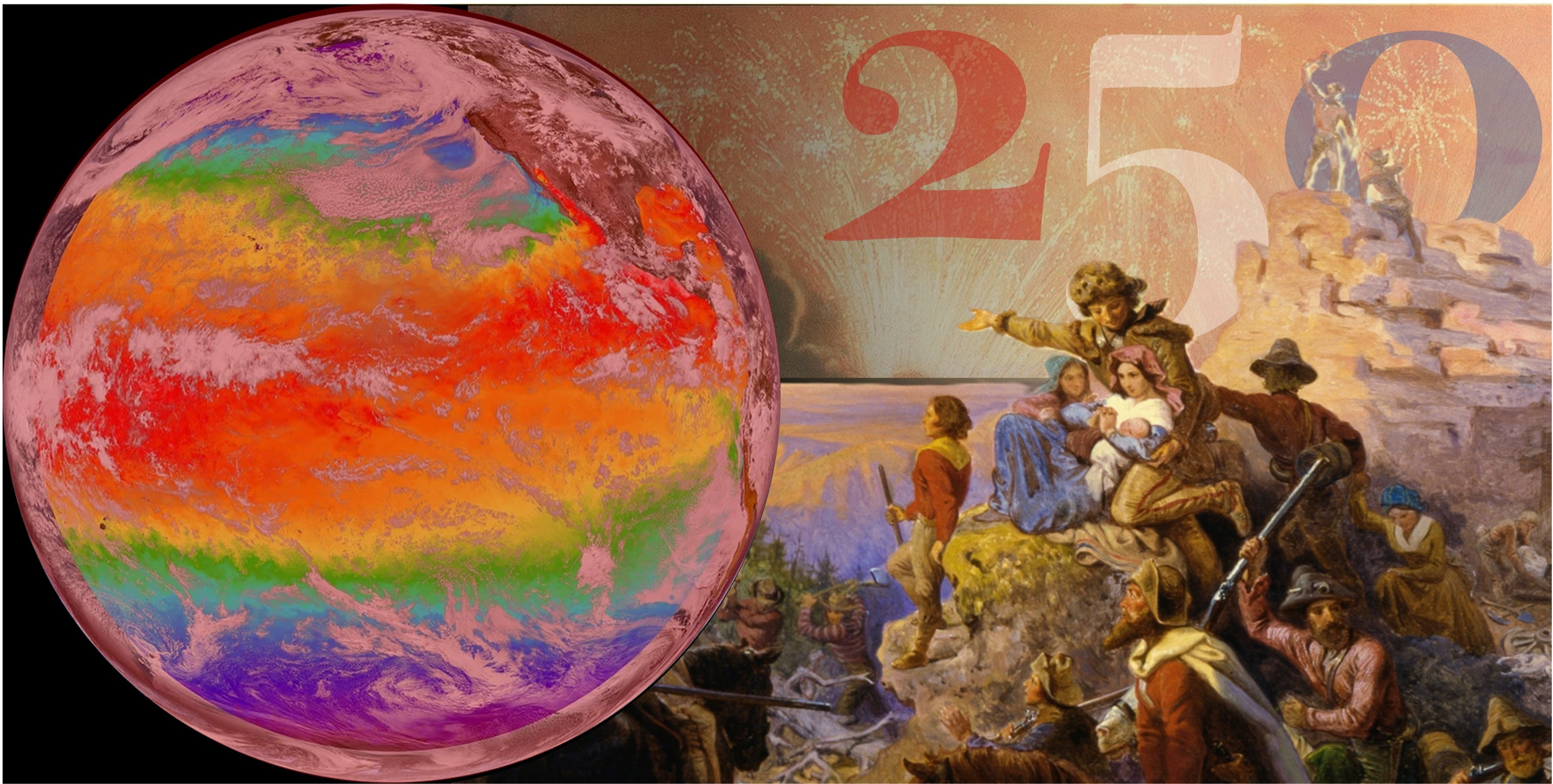
BUILDING, BURNING, BILLOWING BACK
On this momentous 250th Fourth of July, when the world is experiencing record level extreme weather events, let’s reflect on how over the last 250 years the United States helped build, extract, and then burn the material and political conditions that made climate change possible. From the beginning, it tied itself to land, extraction, mobility, and expansion. Over time those commitments became an energy system built on coal, oil, gas, highways, suburbs, industrial agriculture, and a development model that treated nature as an inexhaustible storehouse. That legacy is now legible in the atmosphere itself. Let’s light a Roman Candle in celebration!
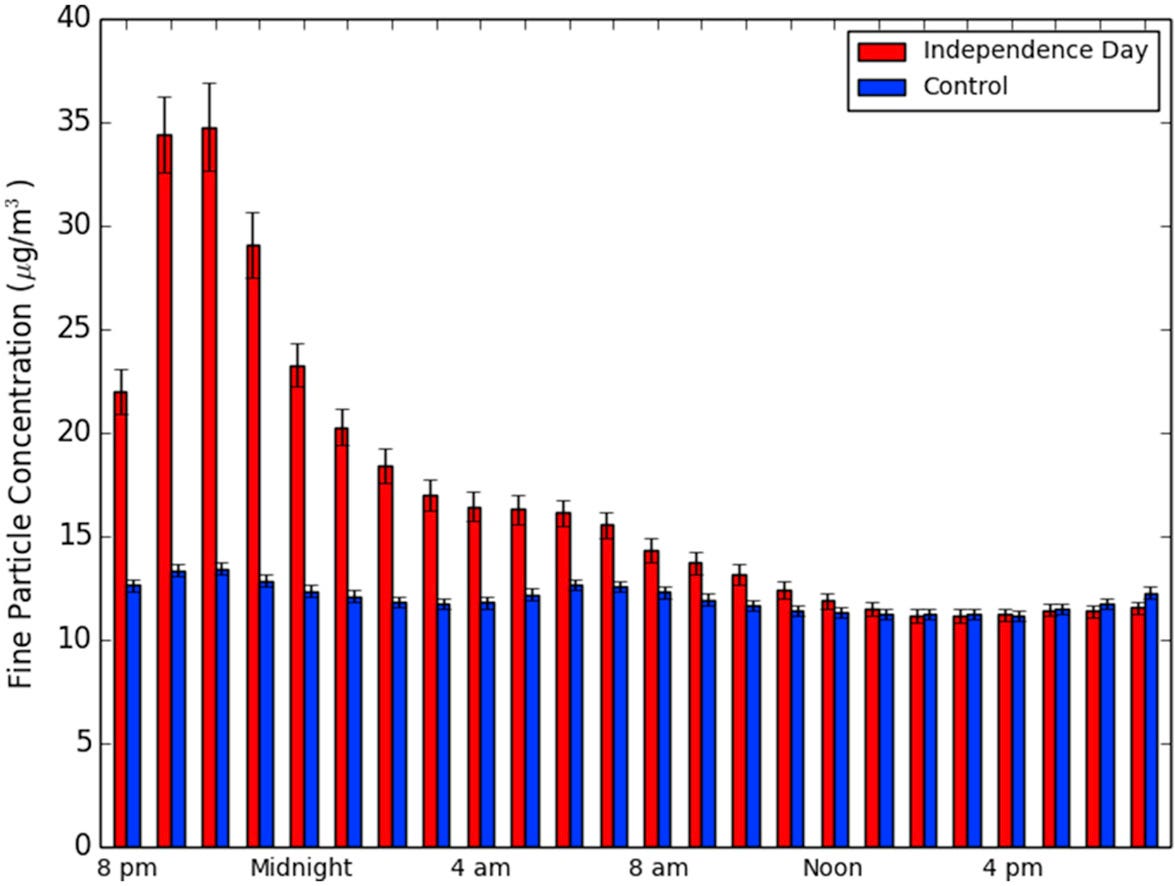
Even before the 4th of July fireworks celebrations create another nationwide 42% average increase in fine particulate matter (Seidel, et al., 2015), the United States bears the single largest share of cumulative historical CO₂ emissions of any nation . We represent roughly 20 percent of the global total since 1850 contributing approximately 0.2°C of warming to date (Carbon Brief, 2021; UNEP, 2023). To represent four percent of the world’s current population and be responsible for nearly a fifth of its cumulative warming is not a coincidence of geography or fake news. It is the outcome of deliberate choices about how a republic would be organized, energized, and expanded across two and a half centuries.
The United States has long imagined freedom in spatial terms: movement, property, settlement, mastery, frontier, and circulation. Those abstract ideals were made real through land theft and remade landscapes, as well as through infrastructure built in significant part by African and African American enslaved labor. Each step along the way depended on ever-greater throughput of energy, labor, and material. In that sense, the country’s history is also a history of how thought became organized around extraction and exploitation, until those thoughts and actions themselves became a kind of common sense.
But by the late nineteenth century and early twentieth centuries increased industrialization meant emissions grew. They surged during the postwar era and peaked in the early 2000s — a trajectory that maps almost exactly onto the spatial project of suburban expansion, highway construction, and fossil-fuel-dependent agriculture (Climate Change Tracker, 2024). Two-thirds of the country’s cumulative warming impact derives from fossil CO₂ alone. The built environment of American freedom is as inseparable from the chemical footprint it left behind as a firecracker’s scattered debris and carbon residue.
This leaves us with a climate crisis that is not just the result of a few bad policy choices in the late twentieth century. We exist in a cumulative outcome of a long national project that normalized combustion as prosperity and treated atmospheric consequence as some distant abstraction. Kind of like turning up the radio to drowned out the sound of your car making a funny noise. The federal state government played a central role in this process. Not only through direct policy and subsidies, but through the development of roads, ports, power systems, agricultural regimes, and military logistics that expanded the scale of fossil dependence at every scale of national life.
The fossil fuel industry understood this trajectory earlier than the public was permitted to know. A systematic analysis published in Science found that ExxonMobil’s own scientists accurately projected and skillfully modeled global warming due to fossil fuel burning from as early as 1977. These projections are consistent with subsequent observations. And yet, for decades, the company publicly pushed doubt and denial (Supran, Rahmstorf, & Oreskes, 2023). Consequently, what America projects as “economic growth”, fueled enormously by the fossil fuel industry, is embedded not only in a collective national memory but in the scientific record.
The irony is that America’s confidence in its own permanence rested on a false sense of geography. The landscape seemed stable because the costs were displaced in the form of upstream mining, downstream pollution, hidden emissions, imported and exported harm, and deferred climate effects. The effects on the atmosphere made that displacement impossible to sustain. The ‘progress’ that had been scattered across space and time returns as heat, drought, fire, flood, and increasingly volatile weather. We built a world in which the rewards of extraction were immediate while the penalties were delayed. Call it what you will — the climate crisis is just the debt of delay, dressed as disaster.
KNOWING, NEGLECTING, NEUTERING KNOWLEDGE
The USA did not simply keep burning and expanding on autopilot. By the late twentieth century, it had also begun to lose the institutional capacity to understand what its own trajectory meant. The problem was no longer that the 1970’s scientific picture Exxon had already portrayed was absent. The evidence was clear. By the early 1990s the United States had ratified the United Nations Framework Convention on Climate Change (UNFCCC) and formally accepted the goal of returning greenhouse-gas emissions to 1990 levels by the end of the decade.
The barrier to progress was not ignorance, but a degraded relationship between knowledge and power. This was engineered in part by more fossil fuel industry campaigns to sow doubt about science it privately accepted. Historians of science Naomi Oreskes and Erik Conway documented how a loose-knit network of industry-connected scientists ran effective campaigns to mislead the public on issues from tobacco to climate change. They exploited the media’s tendency toward false balance and keeping controversy alive long after scientific consensus had been reached (Oreskes & Conway, 2010). The strategy was to make certainty seem uncertain, and it worked. For decades, political inaction persisted through every window of action that may have helped.
By the mid-1990s, climate change had become legible enough for federal institutions to name, study, and plan around, but the machinery of governance was being bent in the opposite direction. Newt Gingrich and the Republicans who rose with him may not have invented anti-government politics, but they weaponized it. Curiously, through pro-governmental politics. While their rhetoric promised efficiency and modernization, in practice it often meant cutting staffs, weakening committees, abolishing subcommittees, and treating the legislature less as a site of deliberation than as a theater of permanent combat. After all, their own staffers affectionately referred to Gingrich and his wrecking crew as ‘jihadists’ — even as those same politicians promulgated and attached that term as a slur toward Muslims. 1
One of the most consequential acts of this period was the 1995 defunding of the Office of Technology Assessment. This was a bipartisan, independent body that had produced over 750 reports on complex scientific and technical questions since 1974, including major studies on energy policy, environmental risk, and the long-range consequences of atmospheric change. Gingrich had vowed to kill the OTA during his 1994 election campaign. He kept his promise, and with it eliminated one of Congress’s primary mechanisms for converting scientific knowledge into durable legislative capacity (Wikipedia, Office of Technology Assessment; AAAS Science, 2019).
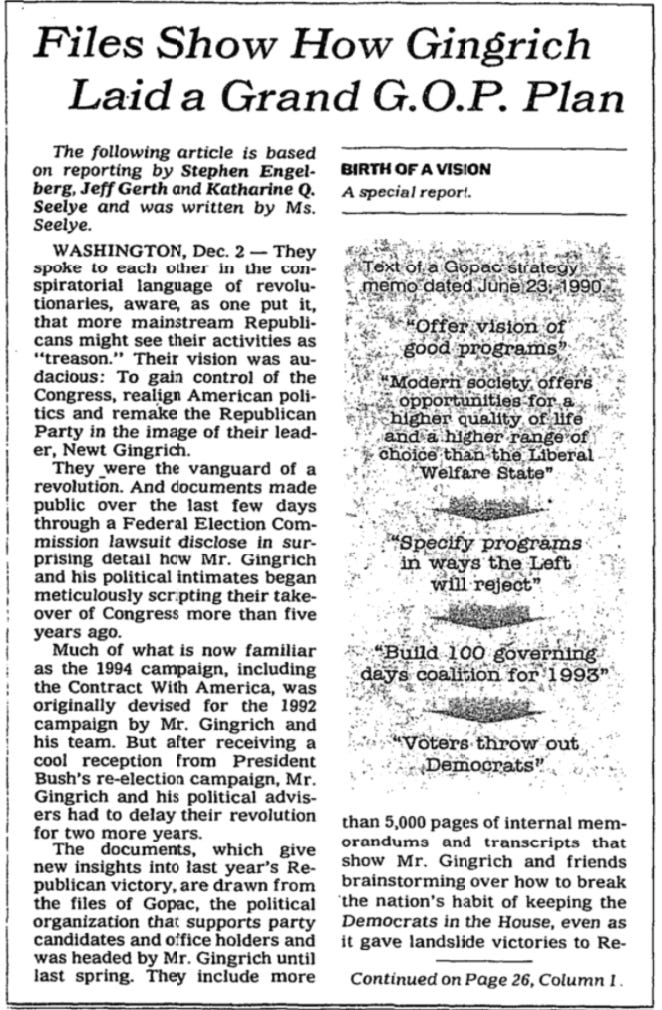
A legislature cannot respond intelligently to a long-range atmospheric crisis if it has stripped away the very mechanisms designed to synthesize evidence, test assumptions, and tackle complex questions over time. What replaced deliberations mediated by experts was a vacuum quickly filled by industry lobbyists — the same industry that, amongst themselves, knew exactly what Gingrich was doing. Research on institutional dynamics in climate governance consistently finds that fragmented policy, weak intergovernmental coordination, and the erosion of technical capacity are among the most significant barriers to effective long-range climate action (Jaisridhar et al., 2025; Birchall, Bonnett, & Kehler, 2023).
The thinning of Congress’s own cognitive infrastructure in 1995 was a bureaucratic adjustment that disabled the country’s capacity to govern on topics beyond the timescales and dimensions of a single administration. The political system was becoming less capable of converting recognition into sustained action precisely as the need for that conversion became most urgent. The United States not only helped create the conditions for warming but undermined its own capacity to govern the effects warming created. The atmosphere was warming and so was the willful weakening of the world's most powerful potential partner in planetary protection.
CASCADES, CRISES, AND COMING TO TERMS
What follows is not simply a warmer world, but a less legible and actionable one. Once a political system weakens its own capacity to think long-term, it becomes ill-equipped to face a future that arrives not as a single rupture but as a cascade of self-reinforcing disruptions. We’ve all experienced or read about hotter summers, fire, more erratic rainfall, stressed coasts, shifting storm tracks, and weather that no longer behaves as the old seasonal calendar once did. Anthropogenic warming is already increasing variability in frequency and severity of weather systems. This in turn can alter local precipitation variability, storm behavior, and the climatic conditions on which seasonal expectations have long depended (Robinson, 2021; Wang et al., 2017; Scher & Messori, 2019). In several regions, climate change is expected not only to shift average conditions but to change seasonal predictability itself — especially for rainfall — making the future harder to read through the calendars and risk assumptions modeled and built from the past (Le et al., 2023; Delsole et al., 2014).
Even now, the atmosphere offers a live demonstration of this instability. On June 11, 2026, NOAA officially declared that El Niño has arrived — with a 63 percent probability of reaching “very strong” intensity, defined as sea surface temperature anomalies of at least +2°C in the equatorial Pacific. This would rank it among the largest events in the historical record (NOAA, 2026). What makes 2026 categorically different from prior super events is not just its projected intensity but its baseline. This El Niño begins from the warmest ocean temperatures in human history, layered onto anthropogenic warming that has already pushed the planet to 1.55°C above preindustrial levels.
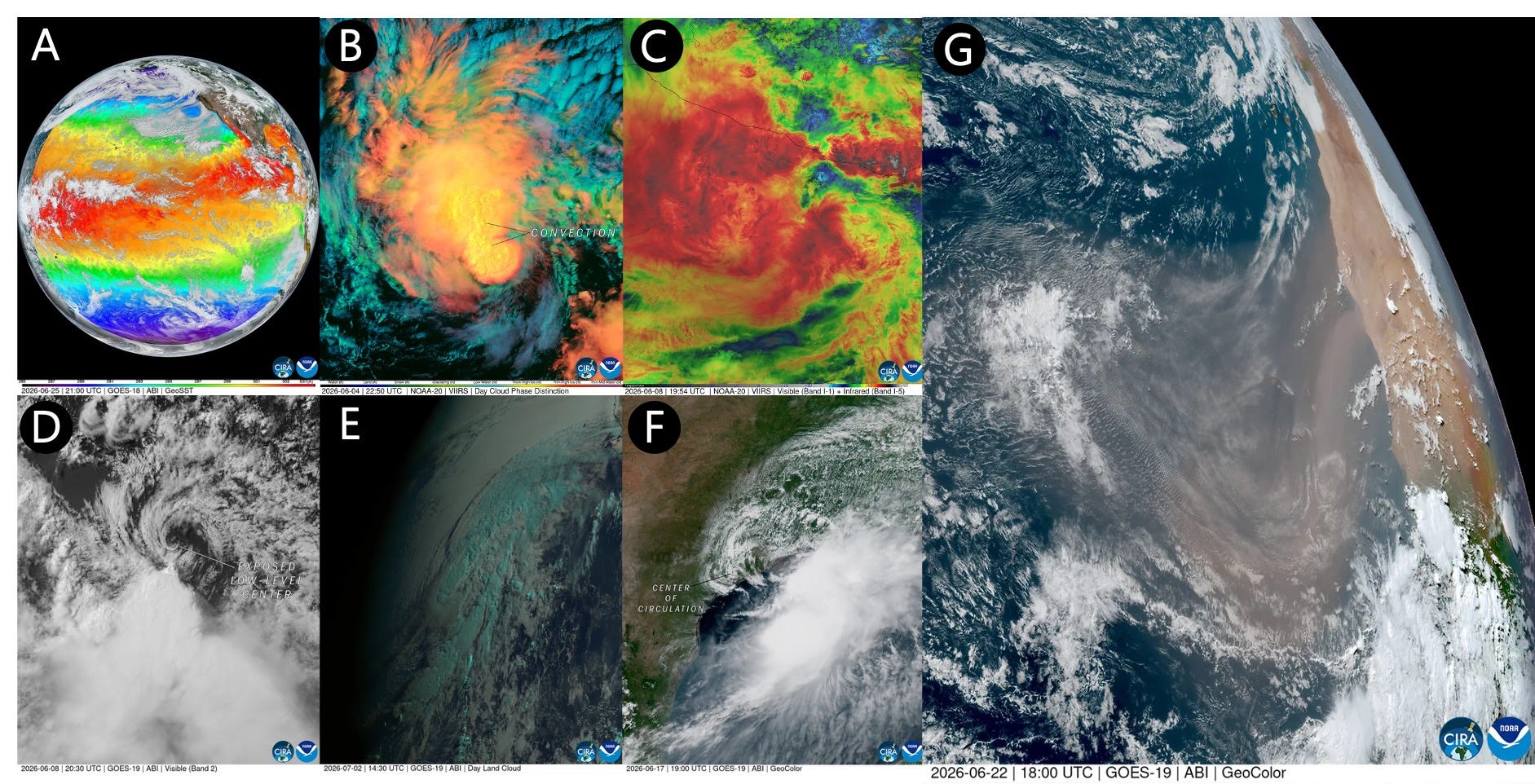
As one paper argued in April, the El Niño is the accelerant; the fuel was already stacked (Hansen et al., 2026). The World Meteorological Organization (WMO) has placed an 86 percent probability on at least one year between 2026 and 2030 surpassing 2024 as the warmest on record, with 2027 — when El Niño’s thermal lag typically produces its most extreme global signals — as the most likely candidate (WMO, 2026).
When that variability is layered onto long-term warming, the result is not just discomfort but a deeper erosion of climatic predictability. ENSO — the El Niño-Southern Oscillation, the coupled ocean-atmosphere system that drives El Niño’s periodic warming and its counterpart La Niña’s cooling across the tropical Pacific — is not a new phenomenon, but its behavior is changing. Model evidence indicates that ENSO-related rainfall variability is likely to intensify and shift eastward under greenhouse warming, creating more severe and sometimes novel climate conditions across the terrestrial tropics (Cai et al., 2021; Rifai, Li, & Malhi, 2019). The question is no longer whether the climate will change, but how many of the social and political structures built on climatic regularity can survive that change.
Climate change is often presented as a technical or environmental problem to be solved. Especially amidst a culture of pervasive techno-optimism. But climate change is way more fundamental than this. It’s a reordering of the relationship between how we need to think and the geography in which we exist. This includes political geography and a reordering of political imagination as it relates to physical geography. The old originally envisioned republic of the USA assumed that land could be mastered, seasons could be predicted, and institutions could absorb shock without losing coherence. Those assumptions no longer hold.
The old assumption that infrastructure could be planned around stationary baselines is increasingly at odds with the evidence. We can already see how energy systems show measurable vulnerability to climatic uncertainty and extremes. Modeled systems evidence declines in reliability and large performance gaps when future weather variation is not adequately incorporated into planning (Perera et al., 2020; Ouyang et al., 2023).
As a result, the challenge ahead is not adaptation to these changes in the narrow sense, but reconstruction of our relationship to them in the broad sense. This may seem impossible in today’s American political system, but truly Democratic societies will need stronger scientific institutions, more durable legislative capacity, and trustworthy public agencies able to interpret risk before disaster becomes routine. They will need not only infrastructure, but intelligence. Embodied intelligence — embodied engagement with physical and social environments rather than as a purely singular-brain augmented by LLM computation. This includes a renewed ability to gather, preserve, and act on knowledge over long horizons.
The literature on adaptation governance is clear that resilience depends on organizational learning, intergovernmental collaboration, inclusive planning, and long-term institutional capacity. Short-term, reactive, market or donor-driven interventions that respond to emergencies without building the durable frameworks that prevent them won’t work (Birchall et al., 2026; Rahman & Islam, 2024). What this means practically is the reconstitution of the kind of congressional expertise that was dismantled in 1995. We need not merely revive the OTA but to imagine a broader democratic intelligence infrastructure capable of thinking on the timescales that climate change demands — decades, generations, and centuries. Without that, climate change will continue to be experienced as a succession of emergency, political, or market conditions rather than as a governable transformation.
We can do this. After all, a country that once imagined itself through movement, expansion, and mastery made a certain kind of freedom seem natural. A new kind of freedom can be made to seem natural too. But right now our current system returns prosperity for many — but heat, flood, instability, and constraint for all. What was built now must be lived within — good and bad — while what was extracted must now live in the atmosphere — all bad. What gets burned today, will burn more later. The political order that was built through extraction, combustion, and territorial expansion must confront the atmospheric and hydrological consequences of those choices.
That confrontation will only intensify. Past century’s cumulative emissions have already committed the planet to changes that will outlast any government, living generation, or institution that exists. Including you and me. The next 250 years will belong less to societies that imagine escape than to those that can build the institutional intelligence, infrastructural redundancy, and long-term public capacity required to inhabit a less legible and hospitable climate (Ouyang et al., 2023; Jaisridhar et al., 2025).
So, as you watch the rocket’s red glare and bombs bursting in air — sending even more smoke, chemicals and debris everywhere — know the flag will still be there. But to endure, it must repair an institution to be once again knowledgeable and fair.
References
Birchall, S. J., Villeneuve, K., Rose, D., Baran, N. N., & Adams, S. (2026). Exploring the modifying effects of adaptive capacity on resilience to climate change across 4 coastal cities in British Columbia, Canada. Cities.
Birchall, S. J., Bonnett, N. L., & Kehler, S. (2023). The influence of governance structure on local resilience: Enabling and constraining factors for climate change adaptation in practice. Urban Climate.
Cai, W., McPhaden, M., Grimm, A., Rodrigues, R., Taschetto, A., Garreaud, R., … Vera, C. (2020). Climate impacts of the El Niño–Southern Oscillation on South America. Nature Reviews Earth & Environment.
Cai, W., Santoso, A., Collins, M., Dewitte, B., Karamperidou, C., Kug, J., … Zhong, W. (2021). Changing El Niño–Southern Oscillation in a warming climate. Nature Reviews Earth & Environment.
Carbon Brief. (2021). Analysis: Which countries are historically responsible for climate change?
Climate Change Tracker. (2024). United States of America: Historic contribution to global warming since 1850.
Delsole, T., Yan, X., Dirmeyer, P., Fennessy, M., & Altshuler, E. (2014). Changes in seasonal predictability due to global warming. Journal of Climate.
Holgate, C., Evans, J., Taschetto, A., Gupta, S. A., & Santoso, A. (2022). The impact of interacting climate modes on east Australian precipitation moisture sources. Journal of Climate.
Jaisridhar, P., Nirosha, R., Jasimudeen, S., Senthilkumar, M., Ponsneka, I., & Raja, P. (2025). Institutional dynamics in climate change adaptation: A bibliometric analysis. Frontiers in Environmental Science.
Le, P., Randerson, J., Willett, R., Wright, S., Smyth, P., Guilloteau, C., Mamalakis, A., & Foufoula-Georgiou, E. (2023). Climate-driven changes in the predictability of seasonal precipitation. Nature Communications.
Oreskes, N., & Conway, E. M. (2010). Merchants of Doubt: How a Handful of Scientists Obscured the Truth on Issues from Tobacco Smoke to Global Warming. Bloomsbury Press.
Ouyang, H., Tang, X., Zhang, R., Baklanov, A., Brasseur, G., Kumar, R., Han, Q., & Luo, Y. (2023). Resilience building and collaborative governance for climate change adaptation in response to a new state of more frequent and intense extreme weather events. International Journal of Disaster Risk Science.
Perera, A., Nik, V., Chen, D., Scartezzini, J., & Hong, T. (2020). Quantifying the impacts of climate change and extreme climate events on energy systems.
Rahman, M. M., & Islam, M. S. (2024). Institutional dynamics and climate adaptation: Unveiling the challenges and opportunities in coastal Bangladesh.
Rifai, S., Li, S., & Malhi, Y. (2019). Coupling of El Niño events and long-term warming leads to pervasive climate extremes in the terrestrial tropics.
Robinson, W. (2021). Climate change and extreme weather: A review focusing on the continental United States.
Scher, S., & Messori, G. (2019). How global warming changes the difficulty of synoptic weather forecasting.
Supran, G., Rahmstorf, S., & Oreskes, N. (2023). Assessing ExxonMobil’s global warming projections.
UNEP. (2023). Current and historic contributions to global warming and emissions in the United States from 1850 to 2021. Statista.
Wang, X., Jiang, D., & Lang, X. (2017). Future extreme climate changes linked to global warming intensity. Science Bulletin.
Hansen, J., Kharecha, P., Morgan, D., & Vest, J. (2026, April 15). Super-Duper El Niño. Columbia University Earth Institute.
National Oceanic and Atmospheric Administration. (2026, June 11). El Niño forms, expected to strengthen, say NOAA forecasters [Press release].
NOAA Climate Prediction Center. (2026, June 11). ENSO diagnostic discussion. National Weather Service.
Seidel, D. J., & Birnbaum, A. N. (2015). Effects of Independence Day fireworks on atmospheric concentrations of fine particulate matter in the United States. Atmospheric Environment.
World Meteorological Organization. (2026). Global annual-to-decadal climate update 2026–2035. WMO.


