


Hello Interactors,
A couple weeks ago, I found myself in Tulsa for the first time. I left pleasantly surprised. There’s a lot of private money flowing into this town, but the city is filled with sorted stories about land, who holds it, who loses it, and how that loss and potential return is engineered. On Juneteenth, the city’s history feels especially close so I thought I’d unpack the layers of displacement, violence, and reinvention that lurk beneath a city still struggling to face them.
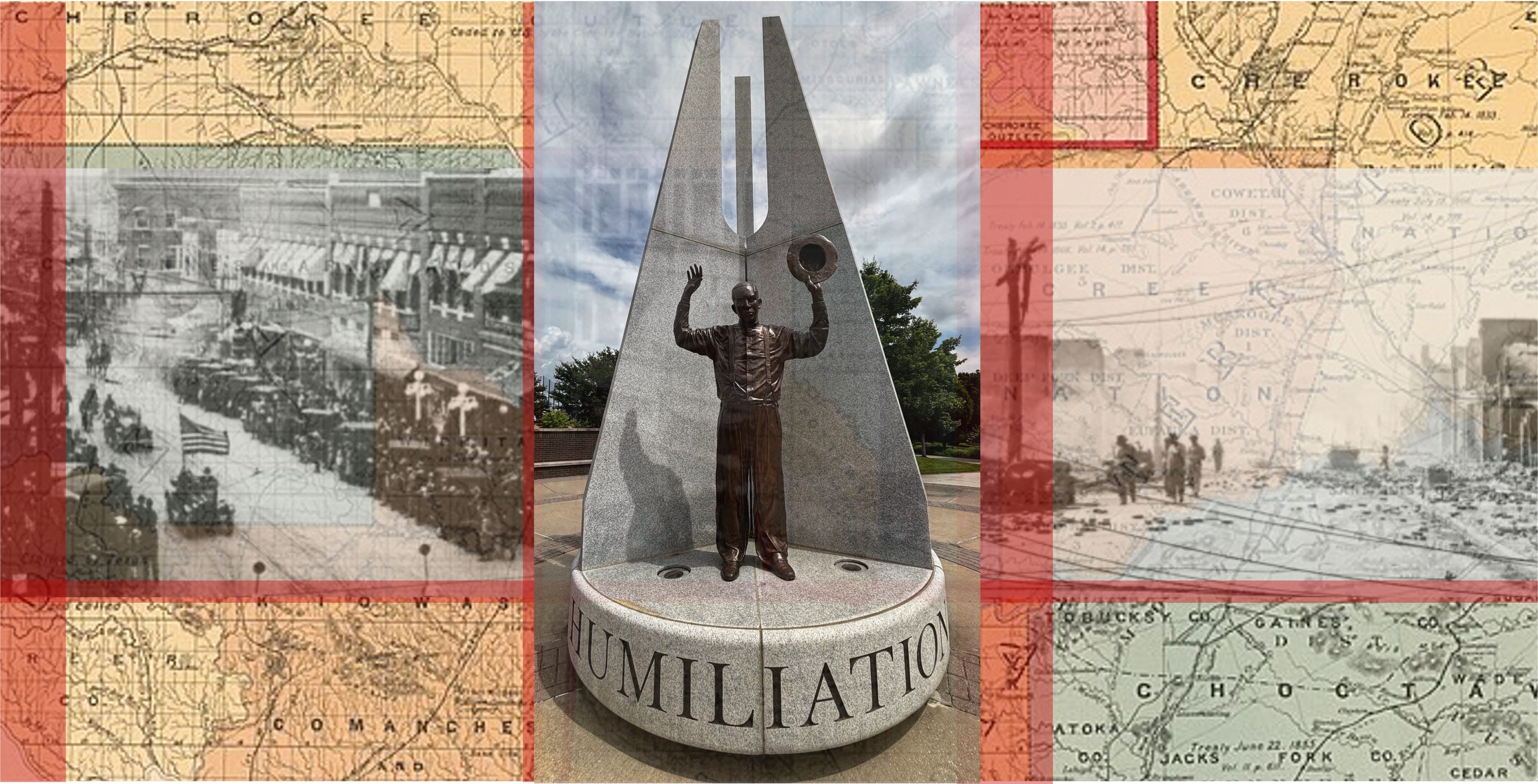
CONCRETE, COALS, AND A CITY THAT CONCEALS
Raise your hand if you like Brutalist architecture (I’m raising mine.) I just didn’t expect to find it in Tulsa, Oklahoma, where I was visiting for my niece’s wedding.
The Brut Hotel is a converted Brutalist tower a few blocks from the Arkansas River and it’s all raw concrete. Even the floors and counters. Most people see Brutalism as cold — which is nice on a hot Tulsa day — but I read it as honest and direct. A bit like a Midwestern prairie settler stereotype. After all, the style did emerge in postwar Europe from an egalitarian impulse. It was meant to be democratic architecture stripped of ornamental excesses of fancy city folks. It arrived in America just in time to become the aesthetic of urban renewal. We mostly got housing projects and highway interchanges built on top of what had been Black and working-class neighborhoods, often by eminent domain and without meaningful consent. Concrete can be made to beautiful, but it’s definitely also the material of displacement. Tulsa is no exception.
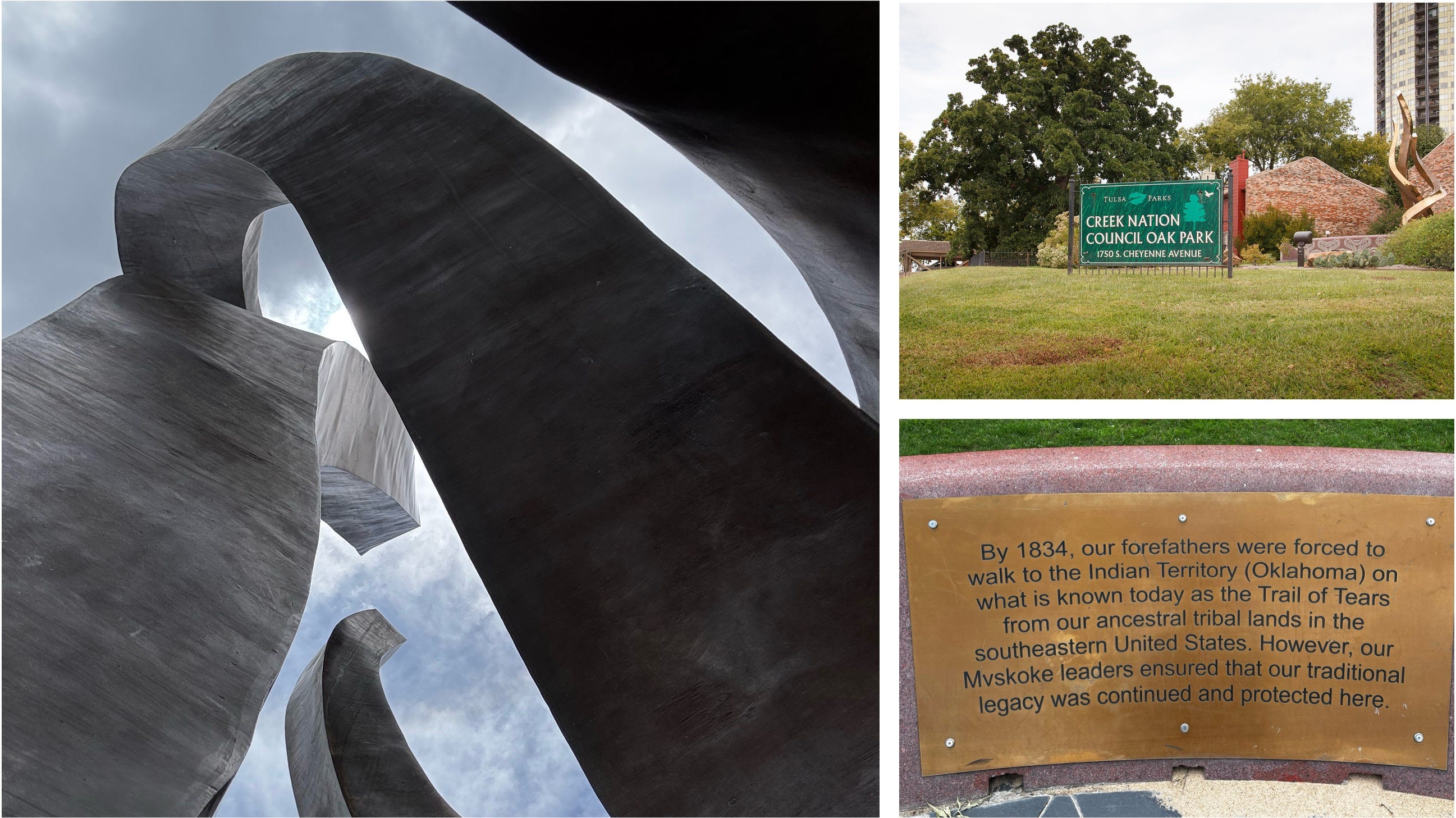
On my first muggy Tulsa morning, I ran from The Brut toward the river. A block or two along, tucked between midtown houses on Cheyenne Avenue, I passed a small park I had read about but didn’t know was so close. The bronze sculpture of a flame was the give away. This is Creek Nation Council Oak Park, and it is, in the most literal sense, where Tulsa began.
In 1836, the Lochapoka clan of the Creek Nation arrived at this hill above the river after two years on the Trail of Tears. They had carried live coals from their last ceremonial fires in Alabama the entire way — embers kept alive through hundreds of miles of forced march. Under this oak, they set those coals down and kindled a new flame. They named the settlement Talasi, meaning “old town.” White settlers mispronounced it into Tulsa. The term “Trail of Tears” perhaps softens this forced displacement too much. Of the 630 Lochapoka who began the journey, 161 did not survive it. The oak did and it still holds its annual ceremonies. In November 2024, the site was formally returned to the Muscogee (Creek) Nation.
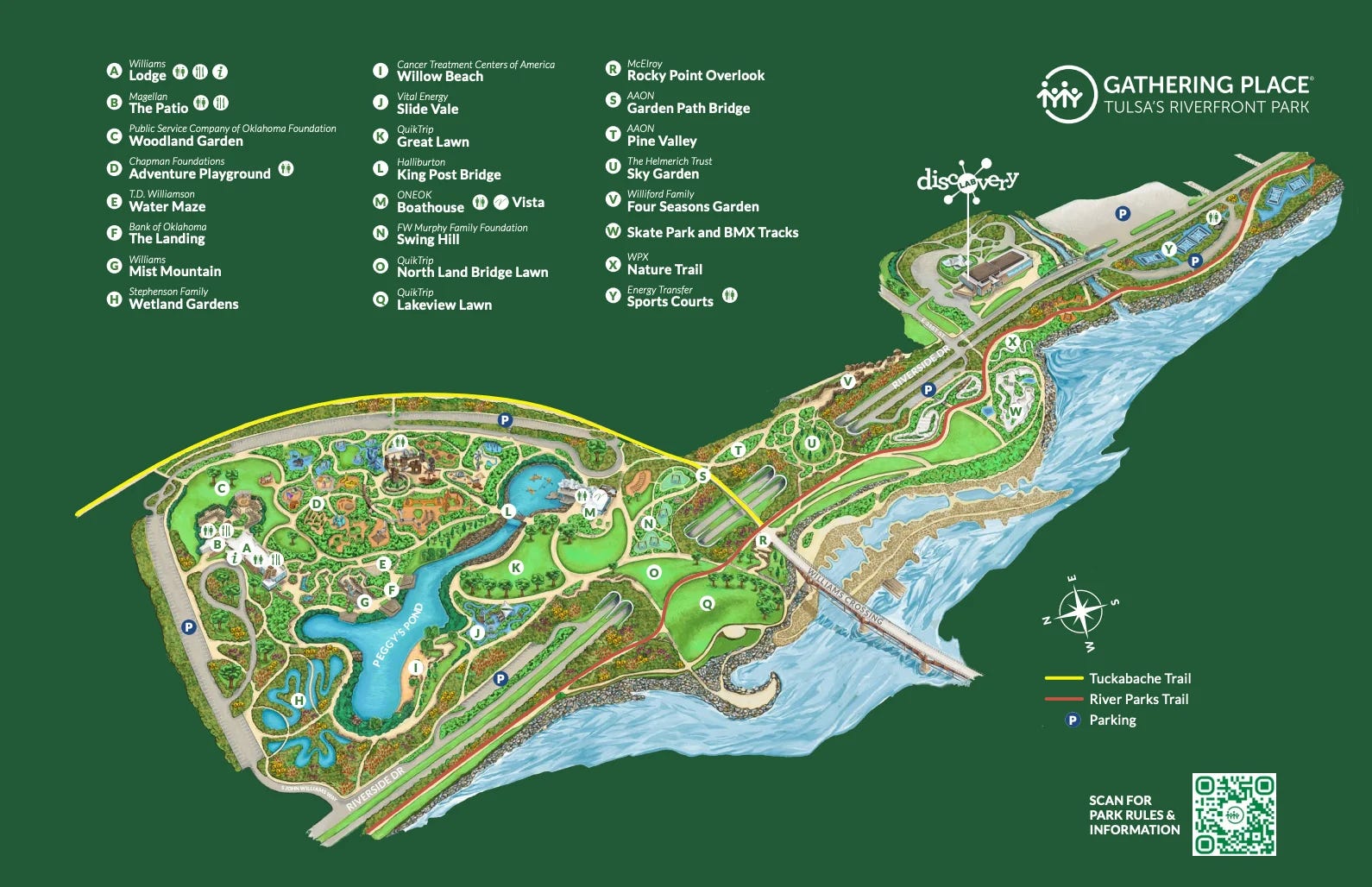
As I kept running south along the river, a second gathering place was harder to miss. It has a giant sign that reads, The Gathering Place.
The Gathering Place is a privately built public-ish park that stretches along the Arkansas River’s eastern bank and inland a bit. It’s one hundred acres of fountains, climbing structures, event lawns, and restored prairie plantings. It is, by nearly any measure, a stunningly beautiful park. It is also unmistakably the product of a single man’s fortune. George Kaiser, the Tulsa-born oil billionaire and philanthropist, has poured more than $350 million into transforming this stretch of riverfront. It’s honestly something you’d expect to see in a Northern European city. The park opened in 2018 to national acclaim. The New York Times called it “the most ambitious new park in a generation.” I can see why.
But head north from the riverfront, past the gleaming BOK Center arena (“B. OK.” is a financial services company dating back to 1910 oil money and is half owned by Kaiser) and the reclaimed warehouse districts, (including the Bob Dylan Center — Kaiser bought Bob Dylan’s archive collection in 2016) and within minutes you are in a different city.
North Tulsa — and specifically the Greenwood District — reveals modest homes and stretches of underdevelopment. This is an area that feels like it’s being watched and commemorated but it’s not entirely clear it is being heard. The Greenwood Rising history center, also primarily bankrolled by Kaiser, opened in 2021 exactly one hundred years after the neighborhood was destroyed in the Tulsa Massacre. This building is also very nice and tells the area’s story well. Whether it changes the story is another matter.
Cities can act as maps of their own history, so that’s how I try to read them. I take note of the distances between prosperity and poverty, commemoration and investment…even a museum and a neighborhood. These are not determinant accidents of the market, but accumulated residue of specific decisions made by specific people over a very long time.
To understand Tulsa’s geography today, you have to go back not just to 1921, but further — to the rivers and grasslands of Indian Territory the Lochapoka people encountered. It’s here you’ll find federal ledgers leveraged as weapons, their lines and lists legalizing the largest land liquidation in American history.
PROMISES, PARCELS, AND THE POLITICS OF POSSESSION
The Lochapoka were not the only ones force-marched into Indian Territory. All five of the so-called Civilized Tribes — the Cherokee, Choctaw, Chickasaw, Creek, and Seminole nations — were relocated from their homelands in the American Southeast across the 1830s. Each tribe were given the same federal promise that the territory would remain theirs permanently. The maps and the Federal treaties said so, but neither turned out to mean much.
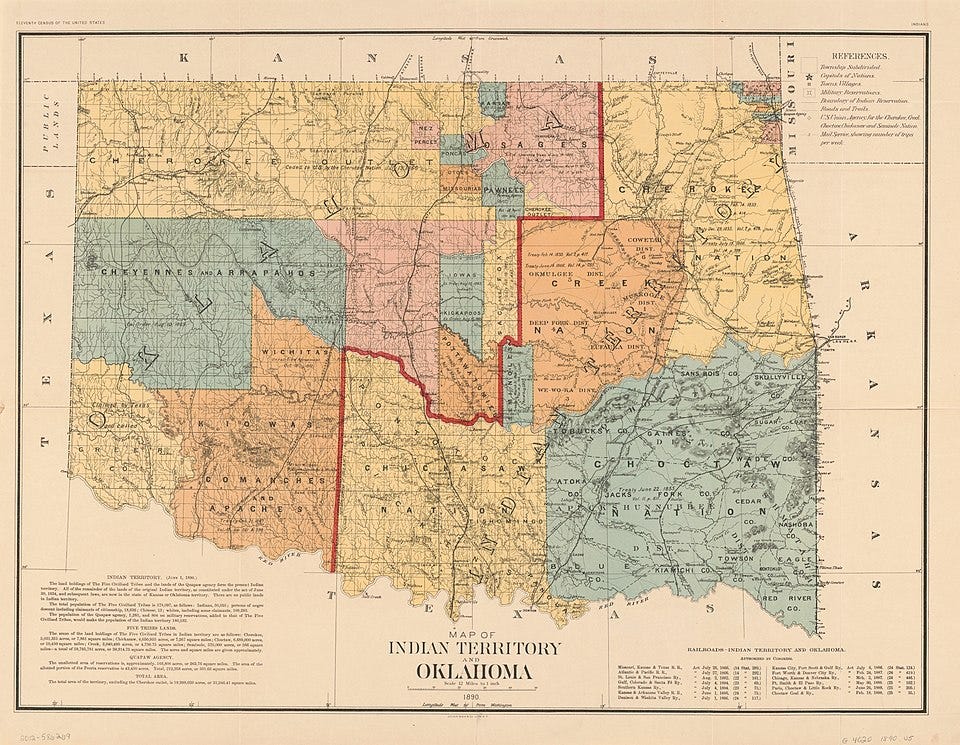
What the maps did not show, and what the official history long preferred to omit, is that the Five Tribes brought enslaved Black people with them into Indian Territory. As the historians Annette Gordon-Reed and Rose Stremlau have noted in the context of the 1619 Project, the story of this dispossession cannot be told without acknowledging that intersection: the Trail of Tears was also, for some, a forced march into continued bondage (Gordon-Reed et al., 2022). That fact would shape the politics of Oklahoma for generations — and it is the thread that connects the founding fire under the Council Oak to the rise of Greenwood eighty years later.
After the Civil War, the federal government’s promises to the Five Tribes began to erode almost immediately. The Freedmen — formerly enslaved people who had been held by tribal members — were formally granted citizenship in the tribes by treaty, though the tribes’ willingness to honor that citizenship varied considerably. Many Freedmen, seeking mutual protection and economic self-sufficiency, began establishing their own communities. This impulse gave rise to what became known as the Black Towns Movement. Between the 1870s and the 1920s, more than fifty all-Black towns were founded in Oklahoma and Kansas, created by people who had learned, with good reason, not to rely on the goodwill of white-majority governments (Martin, 2025; Gordon-Reed et al., 2022).
The legal and cartographic instrument that made the Black Towns possible — and that would ultimately help destroy them — was the allotment system. The Dawes Act of 1887 broke up communally held tribal land into individual parcels, assigning plots to enrolled tribal members and opening the remainder to white settlement. It was framed as a civilizing measure. It was in practice a mechanism for transferring Indigenous land to white hands on an enormous scale. Each parcel was drawn on a map, recorded in a ledger, and assigned a legal description. This act appeared to secure property rights while in fact it made land far easier to steal through legal machinery than it had ever been to simply seize.
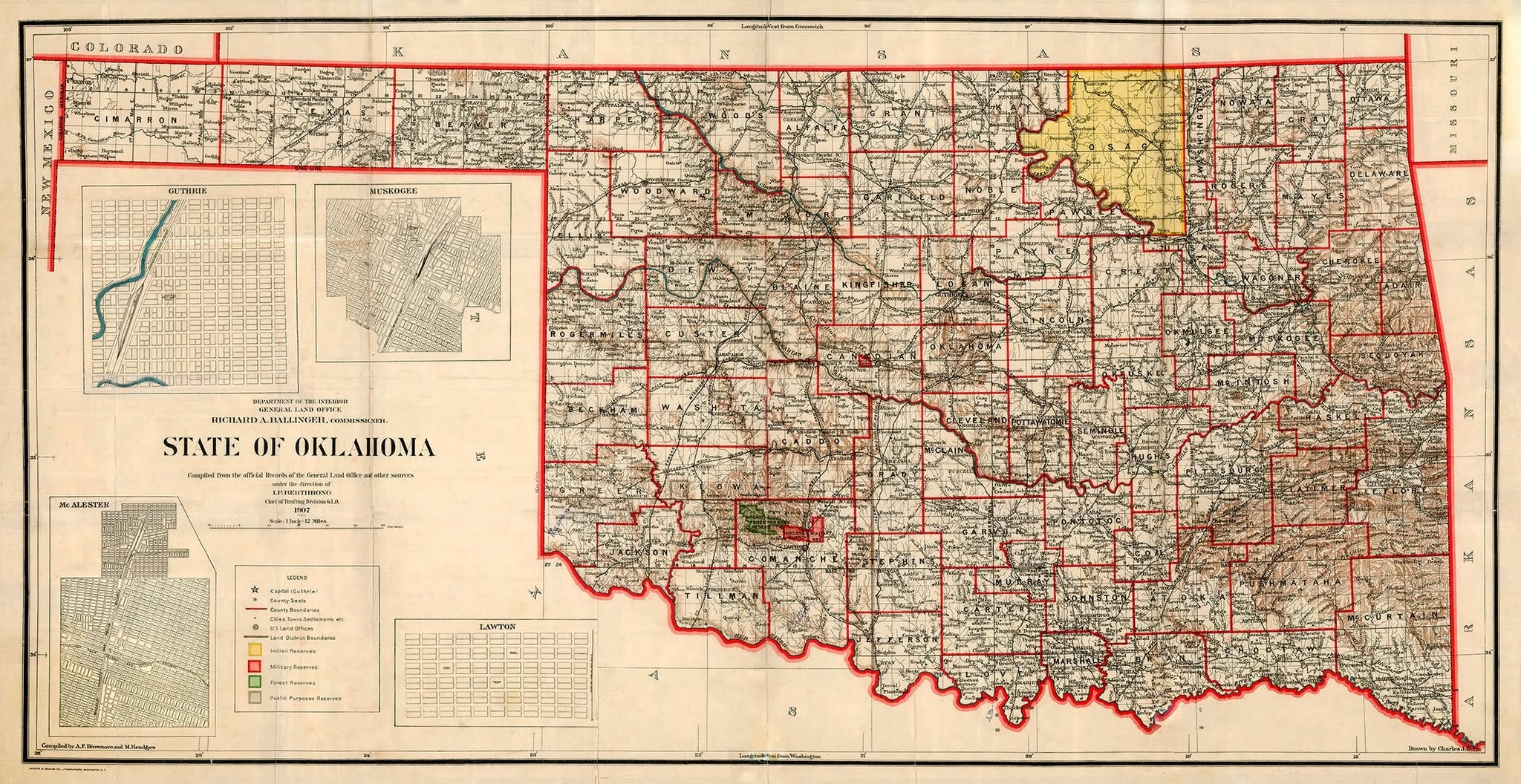
The discovery of oil made the theft more systematic and more lethal. When crude was found beneath allotments assigned to Native people — particularly in the Osage Nation, the Creek Nation, and elsewhere — a federal guardianship system allowed courts to appoint white guardians for Native landowners deemed “incompetent” to manage their own affairs. The definition of incompetence was flexible and self-serving. Native heirs to oil-bearing land died under suspicious circumstances with startling frequency. Deeds were forged. Guardians enriched themselves and left their wards landless. The historian David Grann has documented this in devastating detail for the Osage Nation specifically, but the pattern was region-wide. Modern GIS analysis of original allotment records against subsequent deed transfers reveals what contemporaries knew but rarely said aloud: the disappearance of Native landowners from oil country was not a coincidence, but a covert policy.
For Black Oklahomans, the allotment system created a narrow window of possibility. Freedmen who appeared on the Dawes Rolls received allotments of their own. Some of this land was in proximity to other Black allottees, and the Black Towns Movement capitalized on that geography, incorporating towns, establishing churches and schools, and building the civic infrastructure that Black communities had been denied elsewhere. As scholar JT Martin has argued, the philanthropic traditions within these communities — the mutual aid societies, the church networks, the communal investment in education — were not secondary features of the Black Towns Movement but its essential architecture (Martin, 2025). People who had nothing built institutions that served everyone.
Greenwood, established in the early 1900s on the northern edge of Tulsa, was the apex of that project. By 1921, it contained over thirty-five blocks of Black-owned businesses, a hospital, law offices, two newspapers, a library, schools, and churches. Booker T. Washington reportedly called it “the Negro Wall Street,” a phrase that has since become shorthand for what the neighborhood achieved. Although that shorthand flattens what was, more precisely, a masterwork of community-building under conditions designed to make community impossible.
As the literary scholar Gary M. Jenkins has observed, Greenwood sat directly along what would become Route 66 (Jenkins, 2022). The all-Black towns of Oklahoma were embedded in the landscape that John Steinbeck traversed in The Grapes of Wrath — and conspicuously omitted from it. The invisibility of Black spatial achievement in the canonical accounts of American westward movement is not incidental. It reflects a pattern in which the places, presence, and prosperity of Black life were purposefully purged from the maps white Americans made of their own country.
BURNING, BURYING, AND THE BATTLE TO BELONG
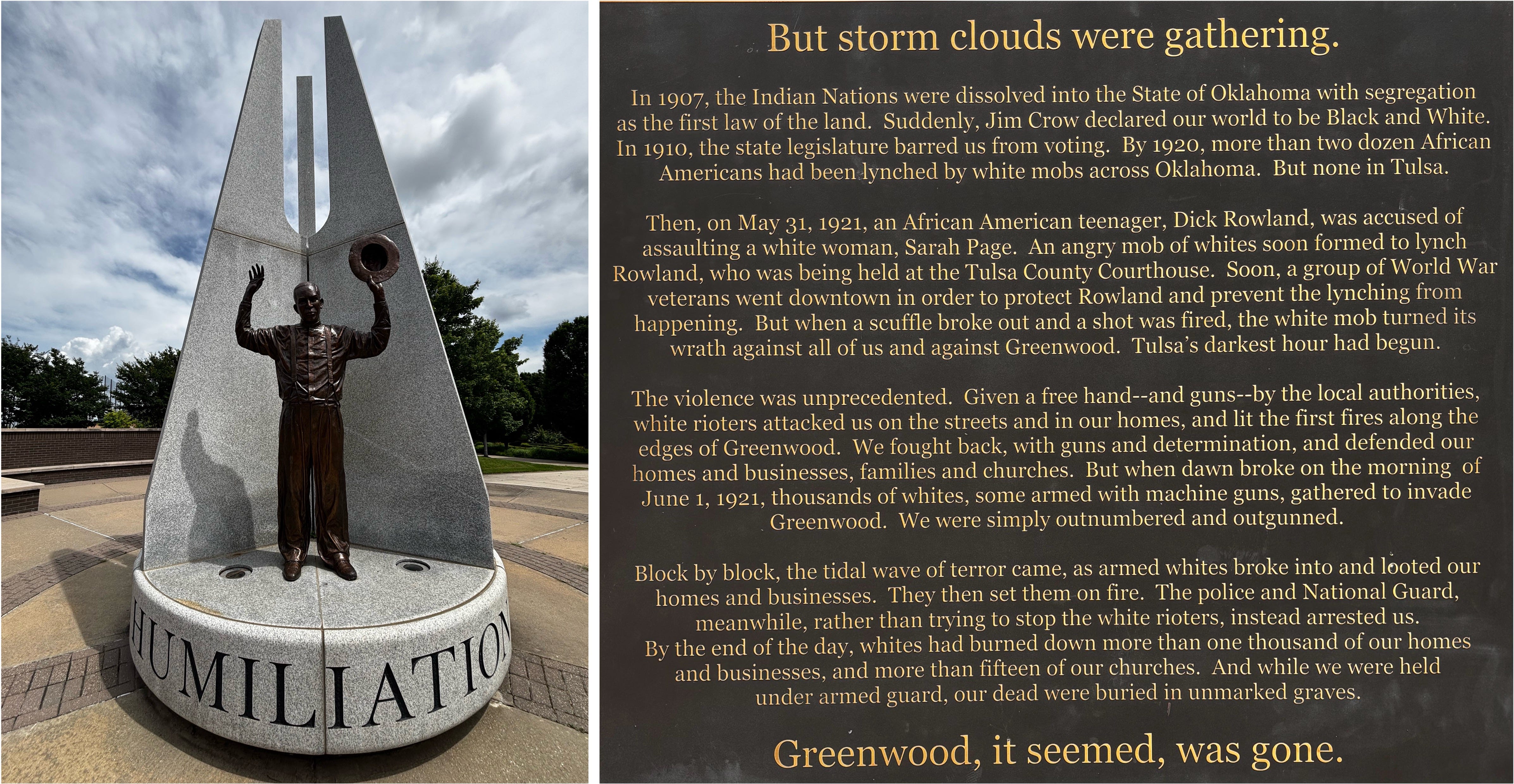
On the night of May 31, 1921, a white mob descended on Greenwood. Over the following eighteen hours, the neighborhood was looted, burned, and bombed — aircraft dropped incendiary devices on residential streets. When it was over, 35 square blocks had been reduced to ash. Somewhere between 100 and 300 people were dead, most of them Black. More than 10,000 Black residents were left homeless. Survivors were interned in camps run by the National Guard — many of whom had also participated in the destruction.
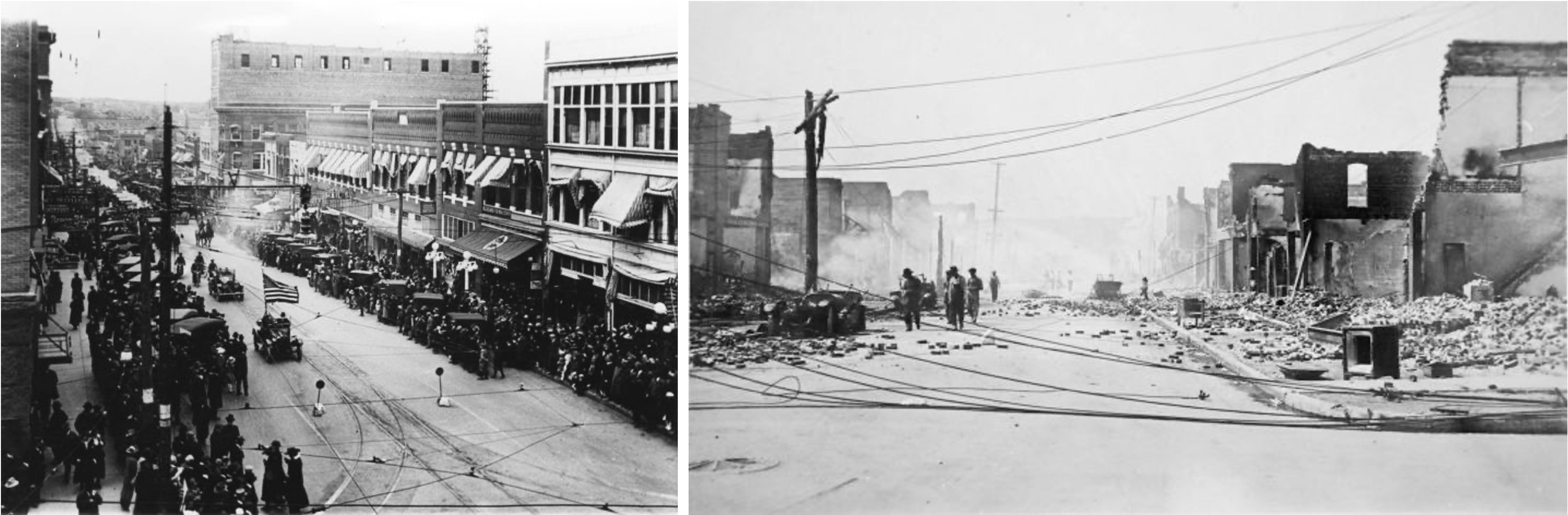
What followed the physical destruction was a second, slower erasure. Greenwood residents who attempted to rebuild found themselves blocked by a newly enacted city ordinance that rezoned their land for commercial and industrial use. Insurance claims were denied. Property was effectively seized under the cover of “urban renewal” in subsequent decades. As Morris, Parker, and Negrón have documented, the Tulsa massacre is a case study in what they call “Black community-killing” — the systematic destruction not just of physical structures but of the institutional web that makes a community function: the schools, the churches, the newspapers, the businesses (Morris, Parker & Negrón, 2022). The buildings burned in a day. The community’s capacity to reconstitute itself was methodically dismantled over years.
For most of the twentieth century, the massacre was not taught in Oklahoma schools. It did not appear in city histories and land was not returned. The story was, in the most literal sense, removed from the map.
Kaiser’s investments in Tulsa have been substantial and wide-ranging: the Gathering Place, the Greenwood Rising museum, workforce development initiatives, early childhood programs. The philanthropic intent appears sincere, and some of the work — particularly in early education — addresses structural inequities rather than simply aestheticizing them. It would be uncharitable, and inaccurate, to dismiss the whole enterprise as window dressing.
But scholar JT Martin poses this question which cuts to the heart of the matter: when we study philanthropy in America, whose philanthropic traditions do we center? (Martin, 2025). The mutual aid societies, the church networks, the community land trusts built by Black and Indigenous communities — these represent forms of collective investment that predate and often outperform the interventions of elite donors, yet they receive a fraction of the scholarly and public attention. George Kaiser’s riverfront is visible. The endogenous philanthropic infrastructure of North Tulsa — the churches that held Greenwood together after the massacre, the community organizations that exist today — is largely invisible in the civic narrative that Tulsa tells about itself.
The geography makes this concrete. The Gathering Place and the BOK Center sit south on the Arkansas River, in and adjacent to Tulsa’s whiter, wealthier districts. Including the area where the Philbrook Museum of Art sits. This Italian Renaissance villa was built in 1926 by oil pioneer Waite Phillips (as in Phillips 66), donated to the city in 1938 as a public art center. It’s now one of the finest regional museums in the country. This gesture rhymes with Kaiser’s: oil money transmuted into civic cultural institution, the private estate opened to the public as an act of philanthropic legacy-building. The Philbrook is genuinely beautiful and genuinely valuable. It is also located nowhere near North Tulsa.
The pattern is not new. Greenwood Rising stands in Greenwood, but the area remains economically depressed, and North Tulsa is still among the most segregated parts of an already divided city. Philanthropic investments that produce a park on the wealthy side of the river and a museum on the historically Black side, while leaving structural inequalities intact, are not reparative.
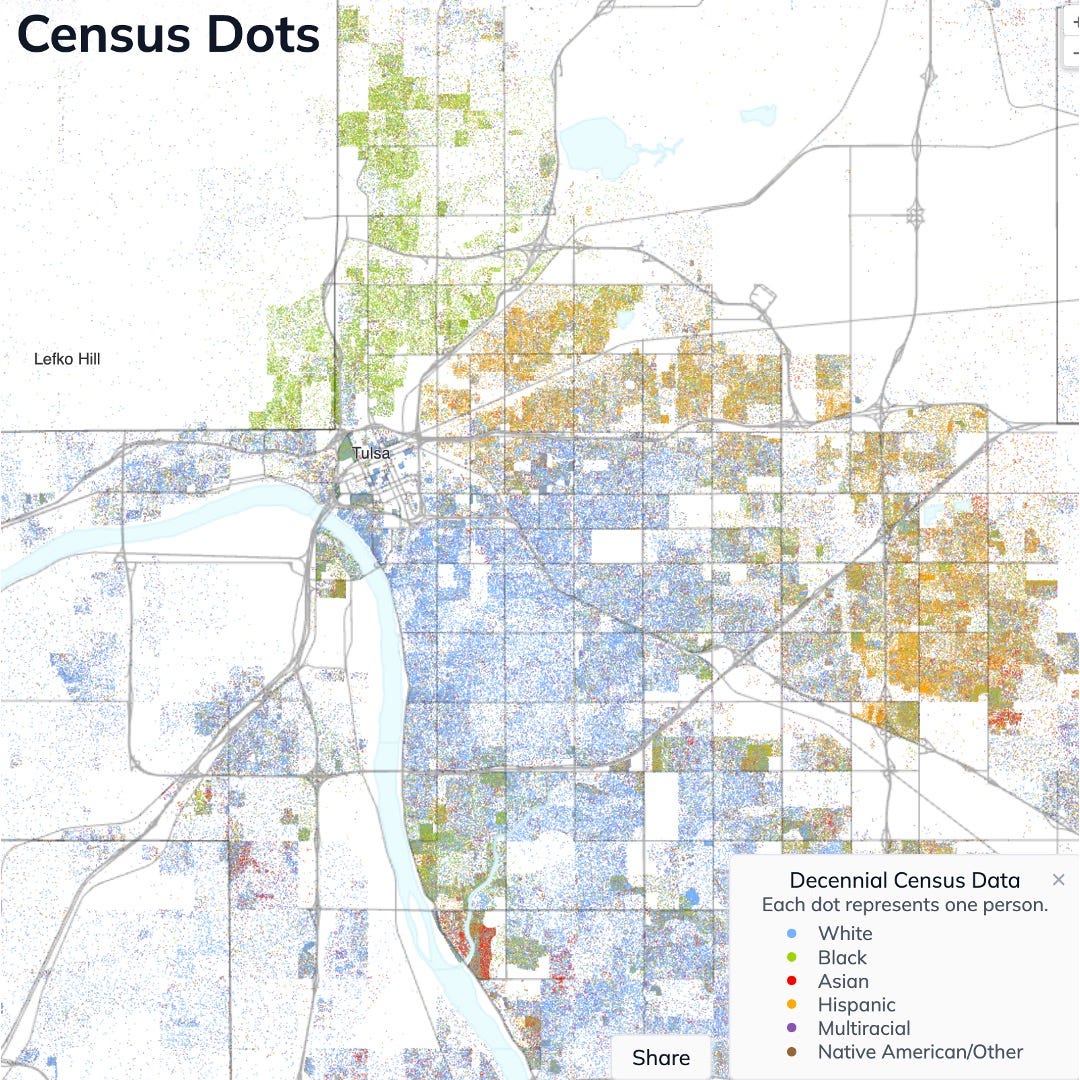
The development around Greenwood tells a more troubling story. ONEOK Field, built in 2010 on historic Greenwood land despite community opposition, has delivered few benefits to Black residents, who are still taxed to support it. Nearby, the Tulsa Arts District has flourished with amenities catering to a whiter, more affluent clientele, while long-standing Black businesses struggle. Even hotels in Greenwood market themselves as part of that district. This is less restoration than a familiar precursor to displacement in the form of cultural investment followed by real estate pressure.
Some argue that understanding land and spatial justice in places like Tulsa requires connecting the Greenwood reparations movement to broader Indigenous-led land reclamation efforts (Du, 2021). In 2020, the Supreme Court’s decision in McGirt v. Oklahoma ruled that the Creek Nation reservation had never been legally dissolved and that the federal government’s century-old maps of Oklahoma had been legally wrong all along. The majority opinion was written by Justice Neil Gorsuch, a conservative textualist, who applied the same originalist logic to treaty rights that right-wing jurists typically apply to the Second Amendment. The ruling was a genuine landmark, restoring tribal jurisdiction over a substantial portion of eastern Oklahoma. Subsequent decisions have extended the logic to other tribes.
The political irony is perplexing. Oklahoma has been among the most reliably right-wing states in the country for decades; its congressional delegation is uniformly conservative; its state government has consistently resisted federal oversight and minority rights claims. Yet it was conservative judicial originalism — the doctrine that legal texts mean what they said when written — that restored, at least partially, what the federal government had promised the Five Tribes in the 1830s. The promise was old, the maps were wrong, and it took a conservative judge to point it out.
What McGirt did not do was address the claims of Black Oklahomans. The Freedmen’s citizenship rights within the Five Tribes remain contested. The Greenwood reparations movement has won moral recognition but not legal remedy. The 1921 massacre commission recommended reparations in 2001 and they have never been paid. These struggles do feel connected — Black and Indigenous claims to land and sovereignty in Oklahoma have been shaped by the same federal machinery of dispossession, and their futures may be intertwined in ways that neither community has yet fully reckoned with (Du, 2021).
Juneteenth, the holiday now recognized federally, commemorates June 19, 1865 — the day enslaved people in Galveston, Texas, were told the war was over (the Emancipation Proclamation had been issued two and a half years earlier) and they were free. What the holiday cannot quite contain is what freedom meant in practice for people who were free but landless. They were free but also targeted. They were also freed from the maps that governed how wealth was accumulated and held in America. The Black Towns of Oklahoma were an answer to these problems and Greenwood was that, for a while. Then it was burned down.
What grows back from a fire depends on who tends the soil, and who owns it. In Tulsa today, that question is still being answered. Will the answers be as brutally honest as Brutalism — the idea that a building should be honest about what it is made of? Tulsa is made of oil money and dispossession, Black resilience and white violence, broken treaties and belated reckonings. Despite conservative political domination, the maps are being redrawn. Whether they will finally show all of that honestly — without the decorative Italian Renaissance stucco — is more political than cartographic. But McGirt proves that promises, however papered over, still possess the power to pierce the present.
References
Du, Y. (2021). Black geographies unveiled: A critical review. Human Geography.
Gordon-Reed, A., Stremlau, R., Lowery, M., et al. (2022). The 1619 project forum. The American Historical Review.
Jenkins, G. M. (2022). Steinbeck, race, and Route 66 in The Grapes of Wrath. Steinbeck Review.
Martin, J. T. (2025). Are Black people philanthropists? Toward a more diverse research agenda on philanthropy. Du Bois Review: Social Science Research on Race.
Morris, J. E., Parker, B. D., & Negrón, L. M. (2022). Black school closings aren’t new: Historically contextualizing contemporary school closings and Black community resistance. Educational Researcher.


