


Hello Interactors,
This one attempts to balance the privilege of cold analytical escapism with the gruesome rehumanization of past, present, and future atrocities. I end up trying to make sense of the political psychology that leads to such jubilant violence. While it can be understood, its the very intelligibility that makes it so intolerable.

PRESSURE, POWER, IMPUNITY
In 1965, as my umbilical cord was being severed in Iowa, U.S. soldiers in Vietnam were cutting the ears off innocent dead Vietnamese children. And their parents. The shriveling cartilage served as “proof” they were killed. They’d string them into necklaces or hoard them in “ear bags” as trophies. Their commanders demanded a tally. This morbid ritual, born from the military’s obsession with numeric “success” metrics amid “search and destroy” orders, exposed not just individual moral depravity but a systemic disregard for human life.
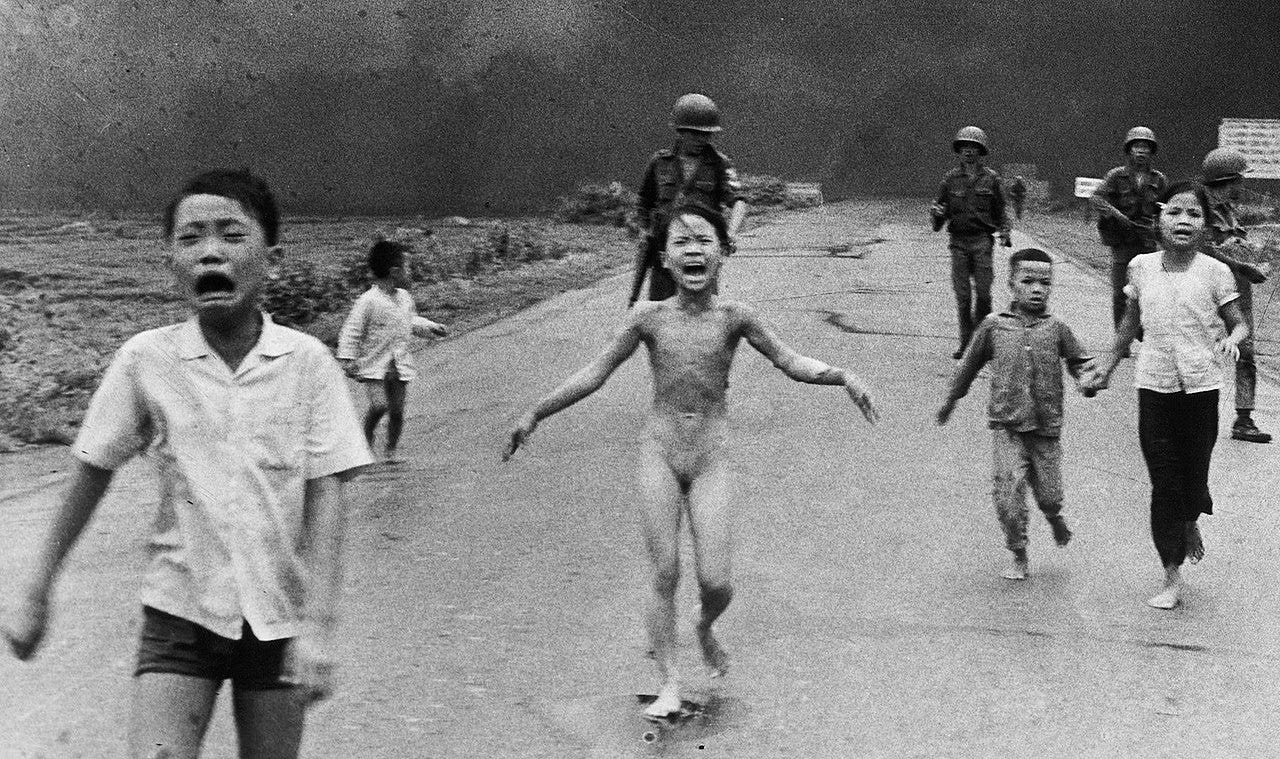
Such barbarity serves as just another example of America’s enduring pattern of defying Geneva Conventions on civilian protections, proportionality, and prohibited weapons. These atrocities are wrapped in bureaucratic euphemisms like “collateral damage”; all to evade accountability and perpetuate unchecked imperial violence.
When barbarity returned like a boomerang to hit the Twin Towers on 9/11, the term “collateral damage” was absent. But “search and destroy” came back. The 2001 Authorization for Use of Military Force authorizes the president
“to use all necessary and appropriate force against those nations, organizations, or persons he determines planned, authorized, committed, or aided the terrorist attacks that occurred on September 11, 2001, or harbored such organizations or persons.”1
These expanded interpretations of and the idea of a “continuing, imminent threat” led to doctrines that allowed drones and bombs to be used as sanctioned forms of force across borders.2 Targeted killings are domestic justifications that override attempts at global legal constraints.
As my own kids were being born in 2004, U.S. drones were flying across the skies over Afghanistan, Yemen, and beyond, vaporizing wedding parties, schools, and outdoor markets, shredding innocent men, women, and children into mangled flesh mixed with bone fragments. These ‘Hellfire missiles’ were sold to the public as possessing surgical precision. These “precision” killings, justified as “targeted” under the euphemism of “signature strikes,” leave behind charred craters, orphaned survivors screaming amid the rubble, and “double taps” that slaughter first responders rushing to the scene. And here again the body-count calculus of modern warfare dehumanizes the dead as mere “collateral” in an endless cycle of remote-control atrocity.
However, unlike in Vietnam, groups controlling casualty numbers and combatant definitions created incentives to undercount civilian deaths to bolster the claims of legal precision. Because such reasoning was long classified, external scrutiny relied on leaks and sporadic court‑ordered disclosures.3
Obama deployed 10 times more drones than Bush. They all occurred in legal grey zones. They were justified through broad claims of self‑defense against “imminent threats” from non‑state actors operating in countries not formally at war with the United States. Legal assessments have found that many attacks did not meet the threshold of an “armed conflict” — meaning strikes there should have been constrained by international human‑rights law — thus violating requirements of necessity, last resort, and proportionality.4
Recent incidents, like the Iranian Khamenei killing, further expose gaps between law and practice. In the case of the 2020 killing of Iranian General Soleimani, scholars argue that the official rationale failed to meet the UN Charter’s Article 51 requirement of an actual armed attack.5 Since then, the U.S. and its allies have instead advanced an even more squishy view of “imminence” to justify anticipatory defense against imagined potential threats. Critics say these interpretations transform what was intended to be a narrow exception into a license for routine, preemptive killing.6
The U.S. government is seemingly unequaled in its interpretive flexibility of law. Rather than submitting to adjudication, they practice “norm‑shaping” noncompliance. This involves acting first, then using rhetoric and diplomatic influence to normalize or justify those actions. Research on the UN Security Council demonstrates how veto rights, opaque bargaining, and diluted resolutions enable permanent members to escape condemnation while weaker states are disciplined.7 In effect, international law becomes a language powerful states can manage, not a rulebook to obey.
U.S. operations in Iran, Afghanistan, Yemen, Somalia, Iraq, and elsewhere are often positioned as short-term “strikes” meant to sustain “rules-based order.” But the U.S. doesn’t have to behave orderly. Moreover, these actions show a longstanding system where the law on force sustains hegemony. Though the justifications shift — from humanitarian intervention in Kosovo and WMD prevention in Iraq to “responsibility to protect” in Libya or preemption against terrorists or nuclear programs in Iran — the underlying logic is the same. You can see why the U.S. systemically refuses to ratify the 1998 Rome Statute.
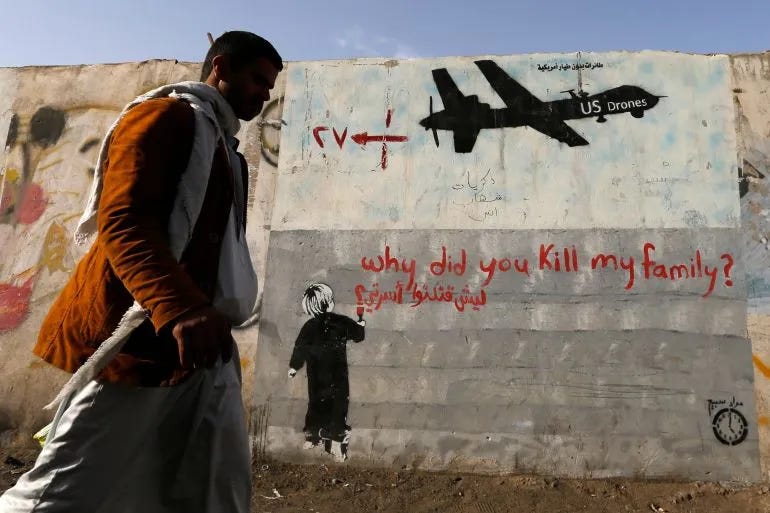
This treaty established the International Criminal Court (ICC) and grants it jurisdiction over the most serious international crimes — genocide, crimes against humanity, war crimes, and the crime of aggression — committed by nationals of states parties or on their territory. It was created after ad hoc tribunals like as those in the former Yugoslavia and Rwanda to ensure accountability. But by remaining outside the Rome Statute (while accepting some of its principles in domestic law), the United States — along with Israel, Russia, and Sudan — avoids the ICC’s adjudicative authority over its own personnel and operations. The U.S. (and three other states) has essentially insulated its use of force from external legal accountability.
This suggests a deeper political culture where U.S. force is assumed to be protective and exceptional. When national security conflicts with legal limits, they are negotiable, and most Americans accept this as normal.
The stability of these justifications over time suggests a shared worldview and America’s place in it. It’s a settler-imperial, racialized imagination of place that makes some regions dangerous and disorderly, while viewing U.S. power as the necessary instrument for security and progress.
STRUCTURES OF SPATIAL SUPPRESSION
To get a better grasp of how legal gray areas become permanent features of the geopolitical landscape, we need to look beyond the law and explore the spatial imaginaries that come before it. The “lawless power” I describe is not merely a failure of international oversight; it is the modern expression of a settler-imperial logic that has long used the map as a weapon. This logic functions through what historian Patrick Wolfe termed a “logic of elimination”: a systemic drive to clear space for a dominant order by rendering the original inhabitants of that space invisible, irrelevant, or “out of place”.8
The bridge between the “body-count calculus” of Vietnam and the “Hellfire missiles” of today lies in the historical practice of declaring territory terra nullius — land belonging to no one. By portraying Indigenous lands as “empty” or “underused,” settler-colonial legal fictions justified removal and massacre as “regrettable but necessary” steps toward progress. This spatial erasure serves as the architectural blueprint for modern drone warfare. Just as 19th-century maps rendered Native peoples “spatially absent” to normalize dominion, modern military doctrines use “bureaucratic euphemisms” to turn vibrant communities into “trouble spots” and “problem-spaces” for management.
When a “signature strike” occurs, the target is not a legal subject but a “pattern of life”. This is the ultimate form of algorithmic governance, where the individual is erased by the data-point before the missile is even fired. By defining specific regions as inherently “disorderly,” the U.S. creates domestic justifications that override attempts at global legal constraints. In this framework, regions treated as a modern “frontier” — a zone where ordinary rules of necessity and proportionality are “negotiable”.9
This “geometry of dominion” is not exclusive to foreign policy; it is mirrored in the way U.S. power organizes its own domestic heartland. George Lipsitz’s concept of the “white spatial imaginary” explains how space is arranged to prioritize the exclusion and property rights of the affluent while subjecting communities of color to displacement and surveillance.10
We see this in the physical “concrete” of urban planning:
Highway Infrastructure: Interstate routes were systematically redirected to demolish poor white, Black, and brown communities, ensuring affluent white residents could “get home faster”.
Nuisance Abatement: In cities like Los Angeles, nuisance laws are used to “preemptively reclaim” areas through speculative policing and banishment, enacting a fantasy of dominion over racialized bodies.
Racialized Sorting: The world is sorted into “secure cores” and “unruly peripheries,” a dynamic that scales from the “redlined” neighborhood to the “sanctioned zone” or “reservation”.

In both the urban grid and the global borderland, the goal is this: to produce order for some while underwriting “legally malleable violence” on “others”.11 The “collateral damage” of an Afghan, Palestinian, or Iranian village is the international equivalent of the “nuisance” of a demolished neighborhood. Both are viewed through an imperial lens that deems certain lives “disposable” for the sake of a broader, racialized security.12
This spatial sorting creates the infrastructure of impunity. When a region is mapped as a “zone of exception,” the violence committed there ceases to feel like a violation; it feels like “maintenance” of a “rules-based order”. This explains why the U.S. can “practice ‘norm-shaping’ noncompliance,” acting first and using diplomatic influence to “normalize” the act afterward.13
The settler-imperial imagination flattens distant worlds into “mappable, legally alienable parcels” of land management. Whether it is the “search and destroy” missions of the 1960s or the “precision” killings of the 2020s, the underlying logic is to secure the “place” of the empire, the “place” of the other must be erased.
Once the world is spatially divided into “ordered property” and “disorderly wards,” it becomes easy for the citizens of the empire to grow comfortable with the authoritarian’s embrace. Dispossessions become necessary to sustain a system where the “other” is already spatially and legally absent. Their suffering barely registers as a tragedy. It’s just the cost of a “righteous” mission.
PROPHETS OF POLITICAL POWER
Spatial erasures don’t just reorganize the land; they reorganize the human psyche. When a society “sees like an empire,” it adopts a specific cognitive map that determines who belongs and whose lives are disposable. This “architecture of absence” is maintained by a set of psychological formations that transform the fear of a “disorderly” world into a mandate for righteous violence.
Political psychology shows how when people experience the world as dangerous and uncertain, they become more attracted to strong leaders, rigid hierarchies, and harsh treatment of “threatening” others. This cluster of attitudes is the essence of authoritarianism. It is not just a set of ideas but a way of managing fear and uncertainty.14
Authoritarianism is especially potent when it fuses with nationalism and religion. Then it becomes “messianic authoritarianism”: the sense that “our” nation or faith community has a special mission in history, is under constant attack, and must therefore be defended at all costs, even by breaking ordinary rules. In this mindset, law and institutions are not neutral constraints; they are either tools for the mission or obstacles to be overridden.
Research on authoritarianism finds a common psychological “core” across left and right: a desire for enforced conformity, punishment of deviants, and centralized control, particularly when people believe they live in a dangerous world.(14) When this core is wrapped in national or religious stories of chosen-ness and persecution, it becomes a powerful justification for violence and impunity. Leaders who promise order, purity, and redemption can present extreme measures as necessary acts of protection.
Over time it builds a collective narcissism: the belief that “our” group is great but unfairly unrecognized and disrespected by others. This is different from healthy hometown pride. It is fragile, defensive, and quick to see insults everywhere. Studies show that collective narcissism predicts hostility toward out‑groups, support for aggressive policies, conspiratorial thinking, and backing for populist and authoritarian leaders.15 People who feel their group’s greatness is denied are more willing to tolerate or endorse harm, so long as it is framed as restoring respect and status.
In religious Zionism, White Christian nationalism, and Khomeinist Shi‘ism, these dynamics are visible through different meanings. Religious Zionist currents interpret control of the land as a non‑negotiable step in a divine redemption process, making territorial compromise feel like a betrayal of a given god’s plan, not just a political choice.16 Christian Zionist and White Christian nationalist discourses in the United States have portrayed the nation as founded by a Christian god, under siege by secular and racial “others,” and uniquely tasked with defending Israel and Christian civilization. Leaders like Donald Trump have been cast as “instruments of god” because of specific policies (for example, on Israel or Iran), even when their personal conduct contradicts ordinary religious standards. The mission outweighs the man.17 Khomeini’s project in 1979 Iran framed the revolution as rescuing Islam from corruption at home and humiliation abroad, casting the new state as the vanguard of an oppressed community engaged in permanent struggle. Even as his regime oppressed…and still does.(16)
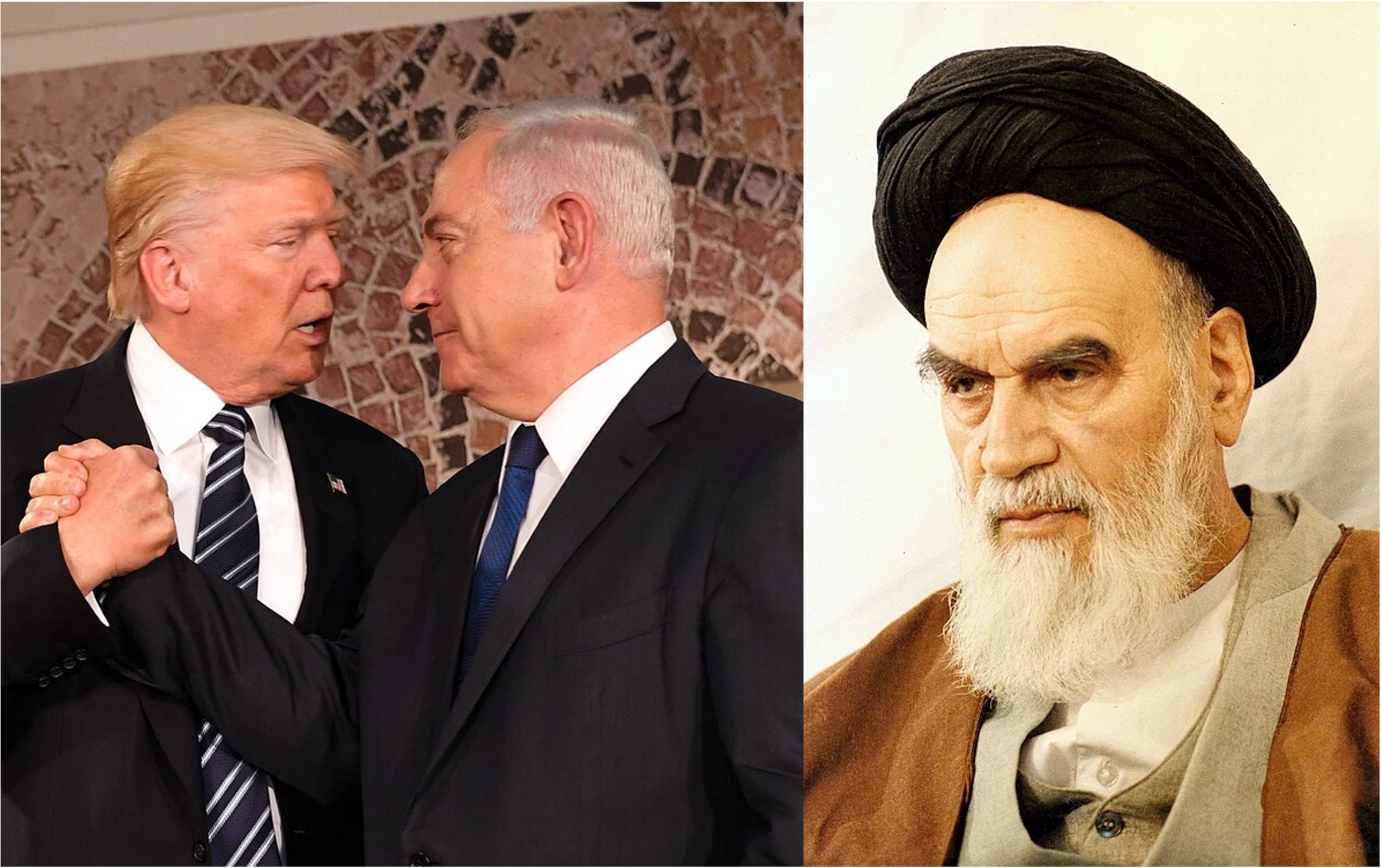
Across these cases, the same psychological building blocks appear:
A world narrated as dangerous and full of enemies.
A group identity that is both superior and victimized (“we are great, but unrecognized and under attack”).
A leader who claims to embody the group and its destiny.
A willingness to override normal legal and moral limits in the name of survival and redemption.
Political psychology also clarifies how these movements treat opponents. When group identity becomes sacred and narcissistic, critics inside the group are labeled traitors, and external critics are portrayed as existential threats. Research shows that collective narcissism and authoritarianism are linked to dehumanization of out‑groups and even justification of political violence; seeing others as less than fully human makes it easier to ignore or excuse their suffering.(15) This helps sustain the kinds of selective empathy and invisible harms I’ve described. Some deaths are tragedies, others are regrettable but necessary, and others barely register at all.
These patterns are not confined to a few extremists. Everyday citizens can be drawn in because messianic authoritarianism offers psychological rewards. In times of rapid change, economic insecurity, or cultural displacement, people often experience self‑uncertainty: a shaky sense of who they are and where they belong. Joining a tightly defined, morally exalted group — with clear enemies and a clear mission — can resolve that uncertainty. Research on uncertainty and extremism shows that people in this state are especially attracted to groups and leaders that provide simple, absolutist answers and sharply draw the line between “us” and “them”.(14) Messianic narratives deliver exactly that.
Once in place, these psychological formations feed directly into infrastructures of impunity. If one believes the nation is uniquely chosen yet unfairly treated, international law and human rights norms can be reimagined as biased constraints imposed by hostile outsiders, rather than shared rules. If one experiences politics as a siege, then surveillance, occupation, or lethal force are not lawless; they are “defensive” acts that outsiders cannot judge. Authoritarian dispositions, collective narcissism, and uncertainty‑driven group identification supply the emotional energy that keeps unequal legal arrangements and racialized security practices politically acceptable.
We’re living in a world now where legal impunity and structural violence are not sustained only by special interests and institutions. They are also held up by recurring psychological patterns rooted in fear of danger, longing for certainty, wounded pride, and the seductions of belonging to a “chosen” community. Messianic authoritarian projects in Israel, the United States, and Iran differ in theology and history, but they draw on similar psychological wells to make extraordinary violence feel not just permissible, but righteous.
Throughout history those claiming victory have found that while they may be able to occupy a territory, they cannot “win” against a people who remain connected to it. The presence of 575 Indigenous nations (and 1200 tribes and villages) with government-to-government relations with the U.S. is testimony. Topophilia is a heavy weight. Those killed aren’t coming back, but those who remain or have been displaced do. In the words of Eleanor Roosevelt, “No one won the last war, and no one will win the next war.”
Curtis A. Bradley & Jack L. Goldsmith, Congressional Authorization and the War on Terrorism, 118 Harvard Law Review 2047-2133 (2005).
Theussen, A. (2021). International law is dead, long live international law: the state practice of drone strikes. International Politics.
Michel, A. (2019). The Kill Chain, Unredacted: A review of Jameel Jaffer, The Drone Memos: Targeted Killing, Secrecy, and the Law. Postmodern Culture.
Zortman, C. (2025). A Consideration of the Legality of U.S. Targeted Killings in Pakistan Under International Human Rights Law. St Andrews Law Journal.
Regueiro Dubra, R. (2025). “The use of armed drones against State actors: The killing of General Soleimani in Iraq.” Behavior & Law Journal.
Heyns, C., Akande, D., Hill-Cawthorne, L., & Chengeta, T. (2016). THE INTERNATIONAL LAW FRAMEWORK REGULATING THE USE OF ARMED DRONES*. International and Comparative Law Quarterly.
Jung, Y. (2025). Conditions of Compliance: Evaluating the Effectiveness of the UN Security Council. Technium Social Sciences Journal.
Glenn, E. (2015). Settler Colonialism as Structure. Sociology of Race and Ethnicity; Englert, S. (2020). Settlers, Workers, and the Logic of Accumulation by Dispossession. Antipode.
Miller, M. (2022). Legitimizing land grabs in a digital age. Dialogues in Human Geography.
Lipsitz, G. (2007). The racialization of space and the spatialization of race: Theorizing the hidden architecture of landscape. Landscape Journal.
Neil, R., & Legewie, J. (2024). Policing neighborhood boundaries and the racialized social control of spaces. Law & Society Review.
Cheikhali, S. (2022). The spatial antecedents for drone governance in Afghanistan. Human Geography.
Türkoğlu, B., & Elitsoy, Z. (2024). The space of permanent and state-level exceptional security measures: Formative years of Israel and Turkey. Security Dialogue.
Osborne, D., Costello, T., Duckitt, J., & Sibley, C. (2023). The psychological causes and societal consequences of authoritarianism. Nature Reviews Psychology.
Zavala, A., Dyduch-Hazar, K., & Lantos, D. (2019). Collective Narcissism: Political Consequences of Investing Self‐Worth in the Ingroup’s Image. Political Psychology.
Don-Yehiya, E. (2014). Messianism and Politics: The Ideological Transformation of Religious Zionism. Israel Studies; Tzfadya, E. (2023). Modern Shia Islamic and Jewish Political Theosophy: An Elective Affinity? Religions.
Durbin, S. (2020). From King Cyrus to Queen Esther: Christian Zionists’ discursive construction of Donald Trump as God’s instrument. Critical Research on Religion; Maritan, M. (2025). Messianic Wilsonianism, an Exceptional Chauvinism? And How Thucydides’ Trap Legitimizes America’s “National Destiny”. Fudan Journal of the Humanities and Social Sciences.


