


Hello Interactors,
I can’t, with certainty, explain my lapse in Interplace posts. I blame the shear bewilderment, ambiguity, angst, and collective anguish, anger, and exhaustion of all that surrounds the increasing intricacies intwining the interaction of people and place. Let’s just say centering my convictions has become as challenging as centering any creative energy on attempts to conjure any clarity to this complexity.
It seems I’m not alone. As Japan-based political scientist Christopher Hobson recently concluded at Imperfect Notes,
“Acceleration accelerates, disorientation deepens.”
This on the heels of a Jean Baudrillard quote from 1995 that further complicates the articulation of the current moment because “the interpretation of things” is “always beyond” the event.
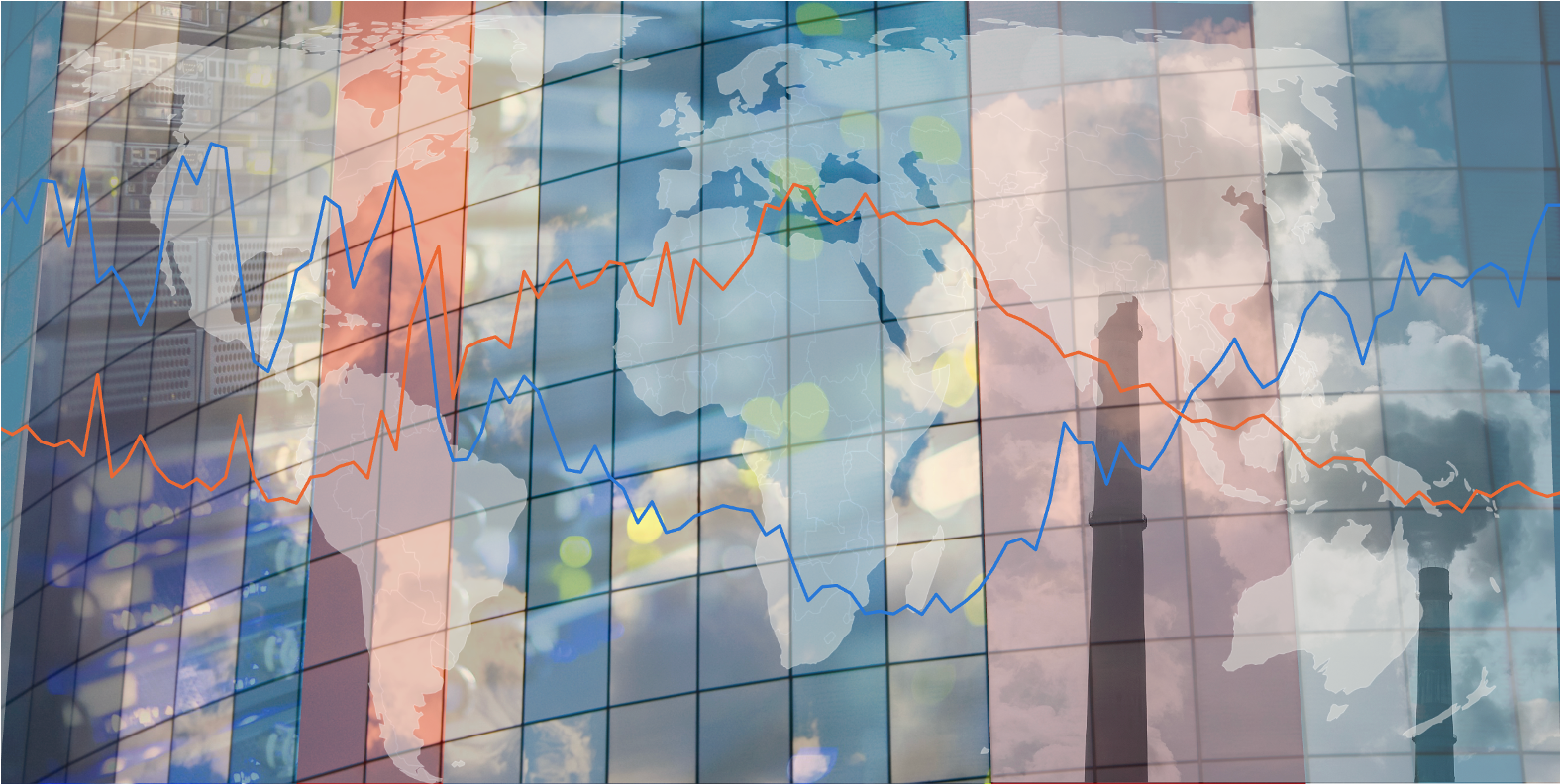
THE SURREAL SPEED OF SOFTWARE AND SILICON
It’s hard not to read Baudrillard’s writings on the simulated reality of the 80s and 90s these days and not feel like he had somehow time-traveled to make such poignant prognostications about today. As a social theorist, he was adept and omniscient at observing how media and technology can reshape not only daily life but the very language through which we perceive and interpret change.
It today’s even higher-paced and surreal world it can be hard to recall just how disorienting the acceleration of personal computers and the internet was in the 80s and 90s. It may be even harder for those of us who were sitting in the driver’s seat. After all, speeding along on a bike, or inside a car, train, or rocket yields a very different experience than standing outside and watching it zoom past.
The same could be said for the fear of computer viruses in the early 2000s that had ‘spontaneously broken free’ of their captive computers to wreak havoc on society. It seems human created ‘rogue’ AI demons and computer viruses have something in common with all technological innovation or failure: human intent, good and bad, is found at the source of their trajectories. Ask any judge and jury…humans are where ultimate accountability rests.
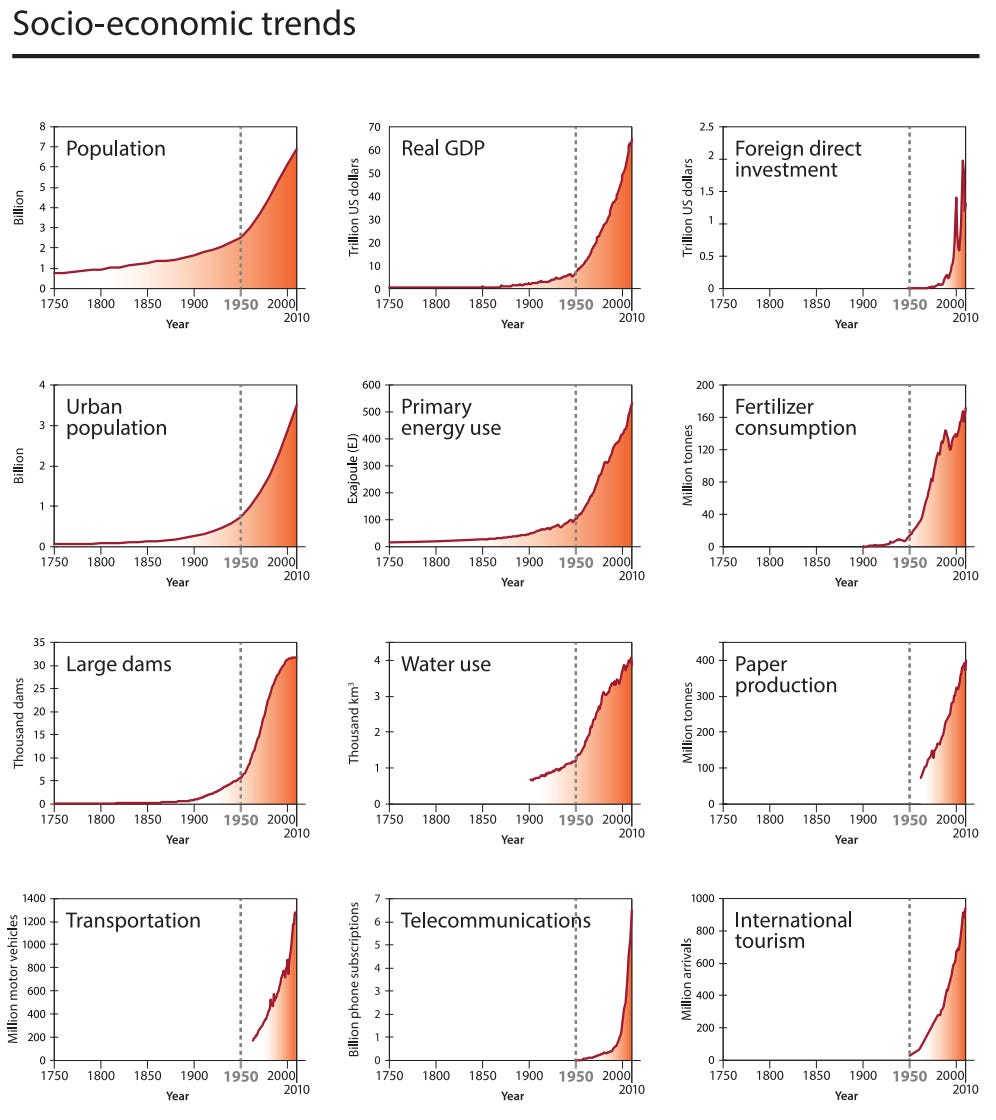
Human backed technology acceleration has undoubtedly brought unparalleled and miraculous good to the world. It’s also created a world that can be summed up with ‘hockey sticks’ and ‘k-shapes’.1 The “hockey sticks” of the Great Acceleration come from the steep rise since around 1950 in economic activity, resource use, and environmental pressures charted by Steffen and colleagues.
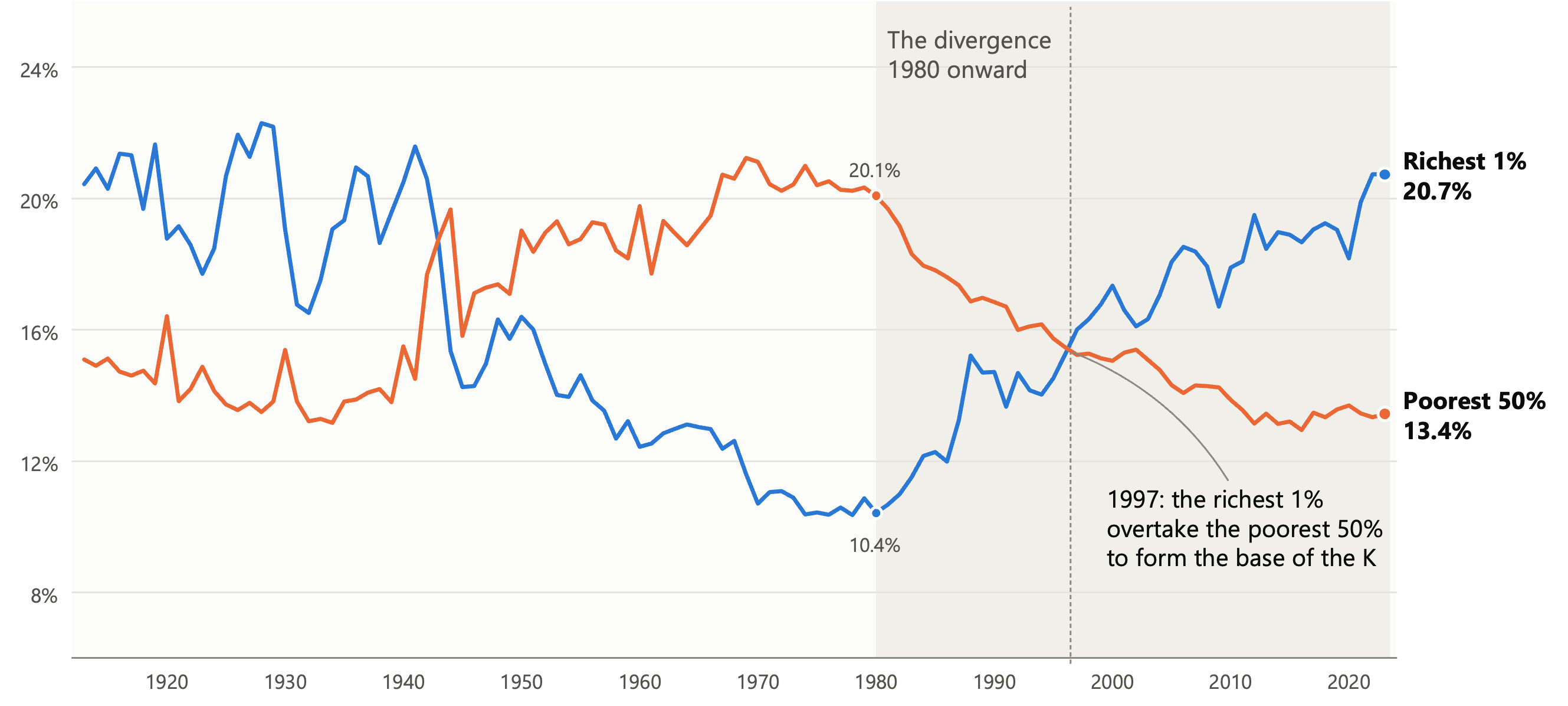
The “K-shapes” describe diverging fortunes, as some people and places prosper while others fall behind. After all, accelerating change does not mean everyone around the world shares in the progress.
And this brings us back to economic geography. Here too, it turns out there is disorientation. When I had the privilege of presenting a paper last year at the Digital Geographies conference in Lisbon (almost exactly a year ago), I had the pleasure of meeting two researchers who interrogate this period of disorientation for a living, Yuko Aoyama and Matthew Zook. They were both also gracious enough to accept my paper to their session!
Yuko had recently led editing a 2025 book called Economic Geography for the 21st Century.2 Matt and a colleague provided a chapter on Global Digital Networks by comparing them to global production networks and global financial networks. This book offers the latest in economic geography research on topics that matter most in this modern world of ‘hockey sticks’ and ‘k-shaped economies’. It looks at these four elements of economic geography:
the changing nature of capitalism,
the future of globalization,
the transition to a greener economy, and
the influence of technology.
Given technology is at the forefront of what is shaping much of the world’s economy, where, exactly, do digital economies fit into economic geography? AI, cryptocurrency, cloud computing, digital payments, and algorithmic-everything have all emerged from the 90s Baudrillard was reacting to. These economies manifest and perpetuate on even more screens than the 90s. And they do so without any clear origin, location, or, increasingly, human involvement. Economic geography brings this all back to earth. Instead of focusing on the apparent weightless digital vapor of these systems, why not look for the underlying infrastructures, workers, resources, institutions, and unequal power dynamics that enable them to function?
This doesn’t mean that the familiar geographies of mines, factories, ports, warehouses, and industrial labor have vanished. Instead, they now coexist and are reshaped by global production networks, financial networks, and digital networks. The mission isn’t just about finding out that the cloud is real, but to understand how supposedly immaterial systems continue to produce very material consequences across unevenly situated places.
MAKING THE CLOUD CONCRETE
I remember being at Microsoft when we were trying to bring together the PC, Xbox, Phone, and this new thing called Azure. “Three screens and a cloud” became the shorthand branding strategy at a time when ‘the cloud’ was still gaining purchase as a term. It’s now become the digital economy’s most popular metaphor.
“The cloud” paints a picture of a floating, untethered layer of ‘compute’ that floats above the messiness of the everyday world. We store stuff, stream it, ask questions, send money, and increasingly rely on it to help us with our daily work, travel, communication, and decisions. The cloud’s apparent weightlessness is part of its appeal. It arrives through a UI on a screen, without origin, jurisdiction, material footprint, or visible work force.
But ‘the cloud’ doesn’t exist in some ethereal elsewhere. Like traditional modern Western economies, it’s distributed unevenly across real physical landscapes, cities, industrial zones, ports, power grids, watersheds, factories, and other new found and formed frontiers of extraction. Data centers alone make ‘the cloud’ less ethereal and more real. But it’s not just data centers. It’s fiber-optic cables, server racks, cooling systems, substations, semiconductor fabrication plants, mines, processing facilities, warehouses, and all the people who build, maintain, clean, secure, regulate, and supply them. A primary point of my talk in Lisbon was how the digital economy reorganizes geography in ways difficult to see from the interfaces that I helped bring to the world.
Economic geography helps with this reversal of perspective. It asks what makes a service possible in the first place. It interrogates where computations are performed, who owns the infrastructure, what energy sustains it, which jurisdictions authorize and subsidize it, and which materials travel through global supply chains. These questions reveal that hardware, software, capital, labor, law, and territory are co-assembled. Technology becomes a bit more demystified when it’s reduced to a combination of factors already present in the world.
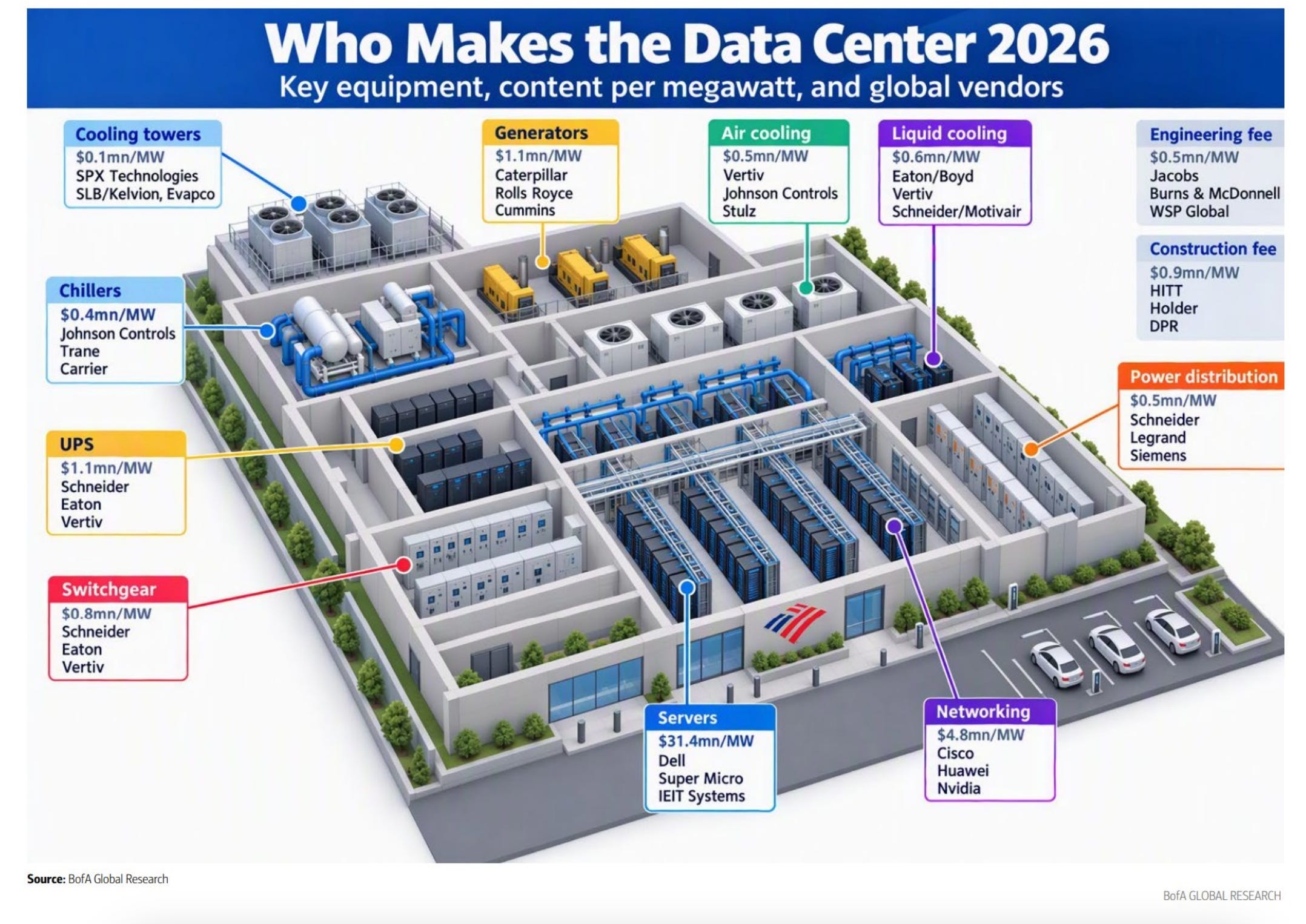
Consider data centers. They show up as low, windowless industrial buildings, a bit of fencing, some parking, piles of cooling equipment, and unusually massive electrical infrastructure relative to the regions in which they’re placed. All of this, as we now see, can significantly impact regional political economies. The location depends on cheap and reliable electricity, high-capacity fiber connections, lots of water, available land, tax deals, and proximity to a sizable population or nodes in a transportation, finance, or digital network. Construction might mean new transmission capacity, energy generation, road upgrades, zoning changes, and, of course, negotiation with an often disgruntled and skeptical public.
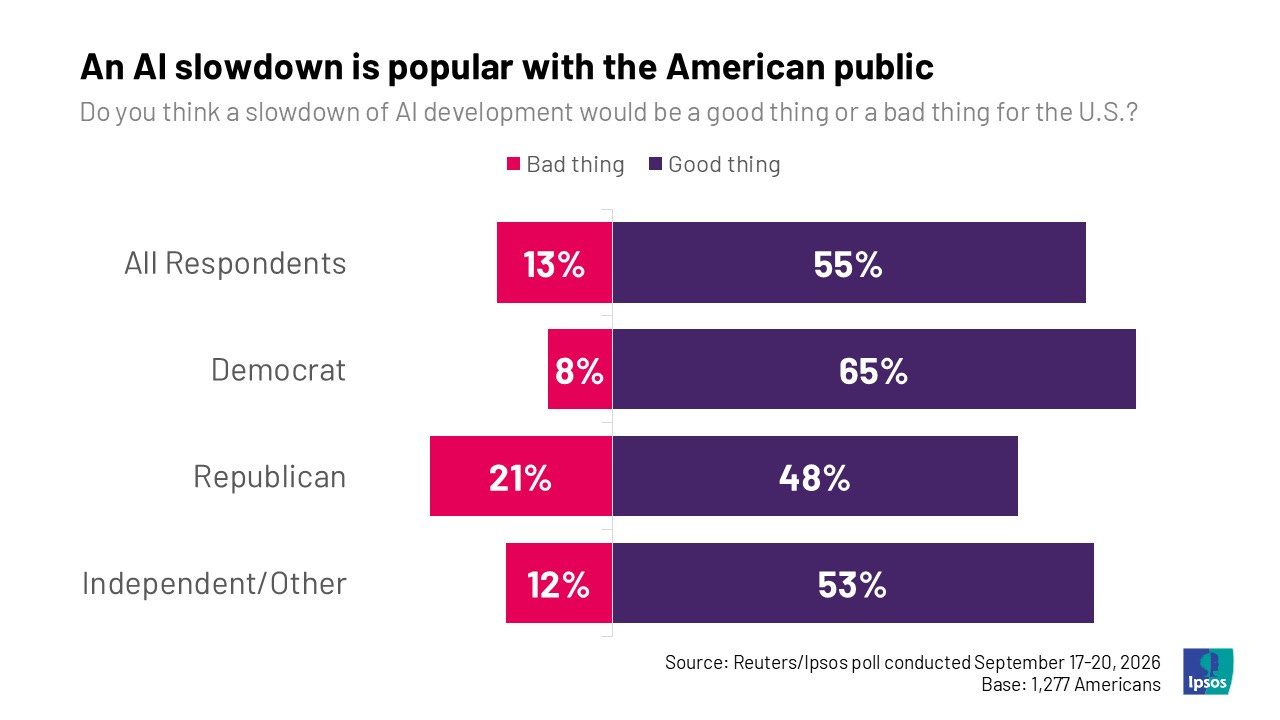
Data center owners and builders try to sooth public tensions, or sweeten deals, with promises of new jobs, tax revenue, or a place on the path to a techno-optimistic future. Communities counter with questions about pragmatic tangibles like electricity usage, grid upgrades, and water scarcity — pressing elected local officials on their justifications for concessions. But these questions, and the answers (sometimes unknowingly), transcend local boundaries.
A data center in one county can serve users across continents or the world. A much greater potential economic value will be captured by firms far away, while its environmental effects will certainly be felt locally. Meanwhile, operations are dependent on equipment and resources sourced from far away. This pattern is not new in economic geography. We have centuries of examples where the places value is created, profits are booked, and costs are borne are rarely the same.
However, AI has enhanced this visibility while simultaneously making the underlying system even more complex. It’s often described as models, data, and vaguely as ‘intelligence’, but today’s AI also involves an expanding physical stack. It’s not only energy-intensive, but requires specialized chips, networking equipment, and data storage. All of which need cooling, construction, and improved grid infrastructure. Human labor exists at all sorts of levels, from researchers, engineers, construction workers, technicians, electricians, logistics experts, contract workers, and remote data labelers and content moderators. “Artificial” intelligence intensifies human and material systems more than transcends them.
Semiconductors are central to this story. While chips are small, producing advanced ones requires immense specialized facilities, precision equipment, chemicals, clean water, power, expertise, supply relationships, finance, and decades of accumulated knowledge. Asking which country “makes” a chip is a fool’s errand. Semiconductor production is a marvel of geographically dispersed coordination, with various firms, facilities, and territories playing significantly different roles. As we’ve seen with Covid, disruptions can travel outward through manufacturing, consumer electronics, transportation, communications, and computing.
The same is true for digital infrastructure’s minerals and processing networks. Extraction alone doesn’t explain centers of power. Materials must be transported, refined, processed, transformed into components, incorporated into equipment, and eventually recovered or discarded through waste management and recycling systems of dizzying proportions. Each stage has its own geography, legal and labor relations, environmental consequences, ownership patterns, and political conflicts. Old school economic geography could make sense of much of this with a map of mines. For the digital economy, mines are a starting point.
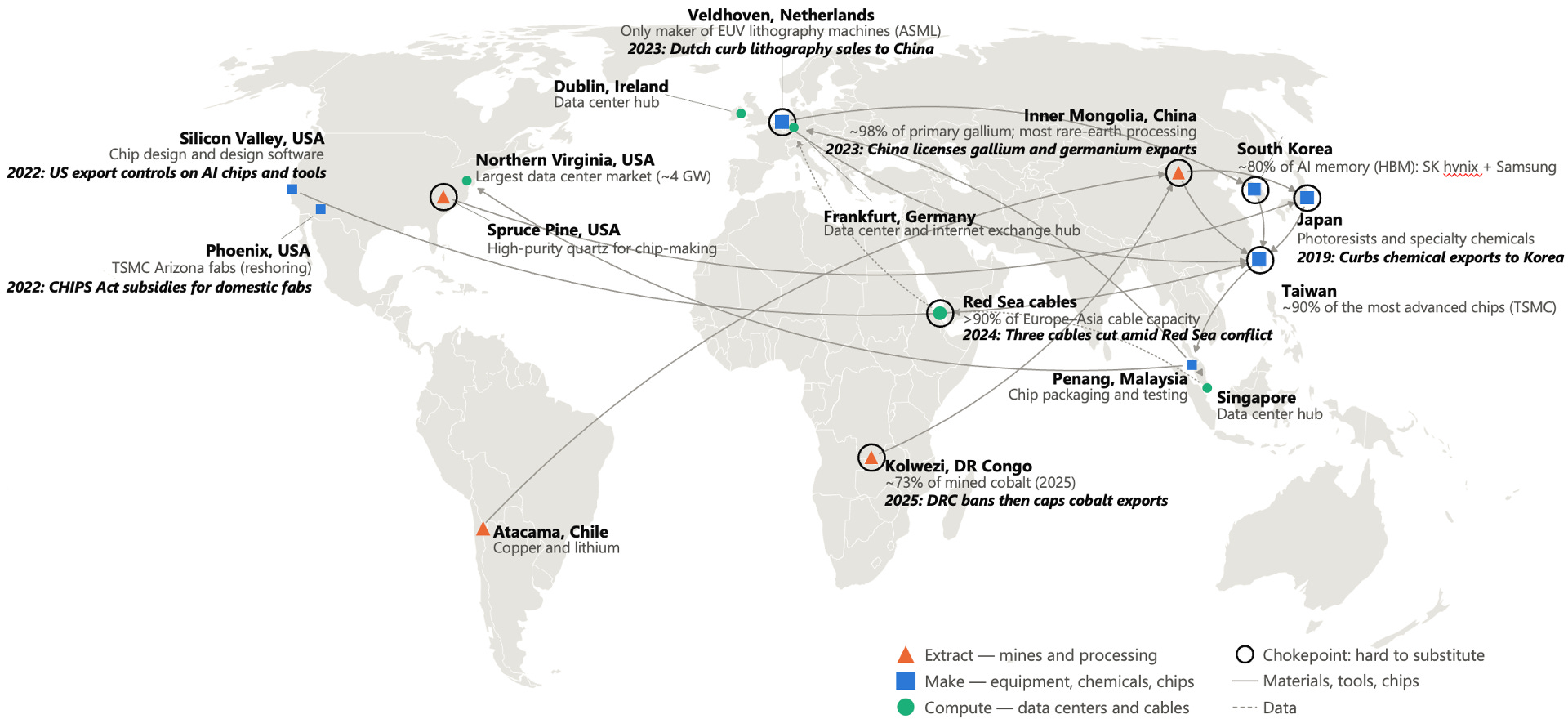
“Hockey sticks” and “K-shapes” are also a starting point. Digital capacity accelerates both the good and the bad unevenly. Some cities and regions gain investment, connectivity, technical expertise, and political influence, while others become sites of mining, energy crises, waste, logistical service slowdowns, or harmful and prolonged environmental exposure. Some people get well-compensated technical roles, while many others face precarious employment, displacement, weakened bargaining power, or bear the costs of infrastructure built for distant users, customers, and investors. Accelerated technological change doesn’t dissolve inequality so much as gives it new systems to travel through.
These outcomes aren’t determined by human-shaped technology alone. Humans also decide corporate strategy and make public decisions that shape them. These come in the form of tax incentives, zoning rules, environmental review, labor protections, electricity regulation, trade policy, export controls, public investment, and infrastructure ownership. Geography isn’t just the stage on which humans act, it’s actively made and remade through these choices. Some (or many) of which could be made a public utility.3
Now that these ‘cloud’ dependencies become visible, more and more people question who controls them. That leads to today’s contemporary geopolitics of strategic infrastructure, concentrated capabilities, and chokepoints.
CONCENT RATION, CHOKEPOINTS, AND COUNTER-MOVES
Once we see the physical geography of the digital economy, things quickly become political. What happens when a required mineral, technology, or skill is held by a single company, country, or region? A chokepoint is a concentrated point of dependence. It’s something others can’t easily replace, and whose disruption or restriction becomes a source of power.
“Chokepoint” is a term that describes a real thing in today’s economy. Local, regional, national, or global networks don’t spread out evenly. However, the most important things they can do usually agglomerate around certain places, like institutions, technology centers, or geographical locations. But a chokepoint isn’t just a place of importance, it’s part of relationship where one person can control another because they know there aren’t many good options, they’re expensive, or they’re not available at all.
Again, semiconductors clarify the distinction. Their supply system is internationally distributed, technically specialized, and built over decades. No single nation can straightforwardly “make” an advanced chip. Yet certain stages and capabilities have become exceptionally difficult to substitute. That unevenness has turned semiconductor production from a story of global specialization into a central topic of geopolitical statecraft. All the various flavors of export controls, public subsidies, investment screening, stockpiles, supplier diversification, and “friend-shoring” are responding to the fear that access to essential technologies can be leveraged or denied.
These responses are not inherently misguided. Governments have reasons to worry about a system in which a commercial dispute, geopolitical conflict, natural disaster, or policy decision in one jurisdiction can reverberate across their economies. Nor should celebration of global interdependence obscure coercion, unequal bargaining power, or the legacy of colonial relations that shapes today’s supply networks.
The difficulty comes when chokepoints become the dominant frame through which governments interpret interdependence. We can all see how each dependency becomes an exposure to eliminate, each capacity becomes weaponized, and national security means maximizing one’s own leverage while minimizing rivals. The question shifts from how a network can reliably serve its participants to how each participant can gain advantage over the rest. Trump may be overly petulant and flamboyant at this, but it happens within countries large and small, quiet and loud, rational and irrational.
Taken together, a self-reinforcing cycle emerges. When one power tightens control over a strategic technology or input, other powers, large and small, reasonably conclude that they need alternatives and countervailing leverage of their own. They may choose to then restrict exports, subsidize domestic substitutes, build parallel supply chains, limit investments, or seek influence over an array of increasingly scarce inputs. Political scientist Henry Farrell describes this as an economic-security dilemma. Measures intended to make one national actor safer can cause others to feel less secure and respond in ways that leave the wider system more tense and brittle.
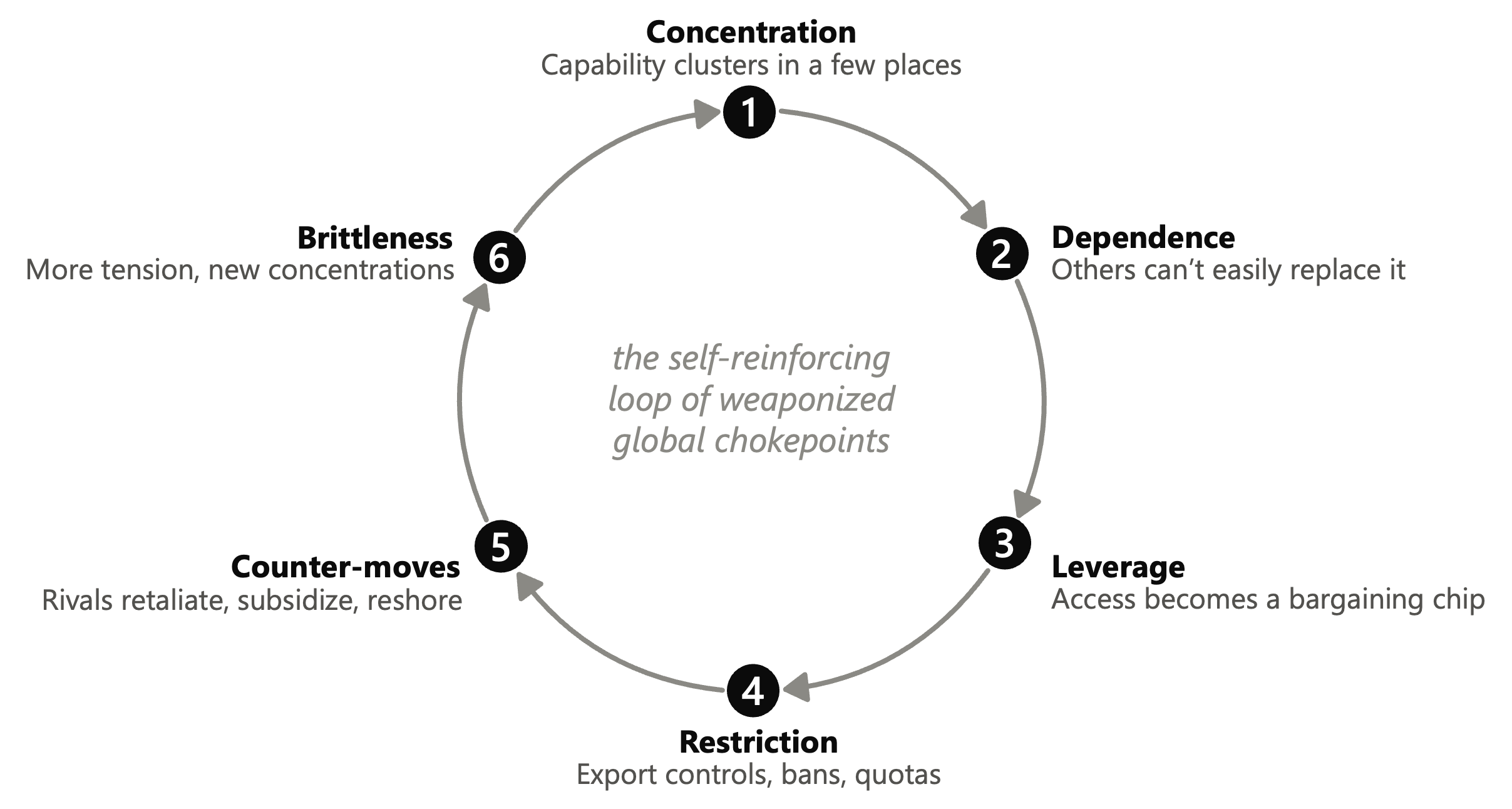
Despite hopeful nationalist intentions, the result may not be a clean transition from dangerous dependence to secure autonomy. Highly complex, well established global production systems cannot be replicated quickly through political will alone. They rely on long-developed expertise, organizational relationships, shared beliefs and standards, earnest scientific exchange, and mutual expectations and commitments that equipment, inputs, knowledge, and investment will continue to circulate. Policies that turn these relationships into weapons of competition only damage the prospects of coordination they presume to protect!
This does not require nostalgia for a supposedly frictionless era of globalization. After all, as Adam Tooze relayed from science fiction writer Kim Stanley Robinson, ‘historical analogy is the refuge of those who can’t face the current situation’. Moreover, interdependence has always distributed benefits and vulnerabilities unequally. The more useful distinction might be between resilience and control.
Resilience can mean redundancy, multiple suppliers, public capability, transparent supply relations, strong labor and environmental standards, and preparation for disruptions. Control, pursued as an overriding aim, can mean treating every cross-border connection as a threat and every partner as a potential adversary.
Economic geography shows the costs of this turn are never evenly shared. Great powers may see strategic assets and national-security exposure, while private companies may see markets, contracts, and risk assessment. Meanwhile, communities experience new mines, factories, transmission lines, logistics facilities, data centers, and changing labor conditions. Smaller states can find themselves pulled between competing blocs. For better or worse, the people living near new infrastructure may be asked to absorb environmental burdens in exchange for uncertain promises of jobs, investment, or strategic relevance.
A complete reckoning of chokepoints therefore has to account for more than who holds leverage. It should consider how that leverage was assembled, whose work sustains it, which institutions authorize it, and where its costs land. It should also reflect on what kinds of cooperation make complex systems possible in the first place.
The point isn’t to ignore the fact that we’re vulnerable strategically. It’s about resisting a politics that sees vulnerability everywhere and only sees relationships as tools to be used. Economic geography can help us hold both truths at once. For sure concentrated power is real, but the systems that support it are also complex and self-reinforcing social, territorial, and ecological arrangements — not just things we can control.
Perhaps Baudrillard was right that interpretation is always late to the event. The acceleration now surrounding us — technical, ecological, financial, and political — can make the world feel as though it is moving faster than thought can follow.
But lateness is not helplessness. Economic geography offers a way to pause, locate, and connect. It helps us to see the data center behind the cloud, the worker behind the infrastructure, the politics behind the network, and the unequal places behind the promise of universal progress.
That does not dissolve the ambiguity or exhaustion that prompted this essay. It does, however, make one conviction easier to reconcile. It echoes my paper from a year ago, technologies do not arrive from nowhere, and their consequences do not land everywhere equally.
Inspired from Christopher Hobson while In conversation with Pete Chambers, Q3 2026
Aoyama, Y., Haberly, D., Horner, R., & Schindler, S. (Eds.). (2025). A research agenda for economic geography: Reframing 21st century capitalism. Edward Elgar Publishing.
This Law and Political Economy post provides a primer on public utility regulation and its application to AI, specifically focusing on networks, platforms, and utilities (NPUs).


